
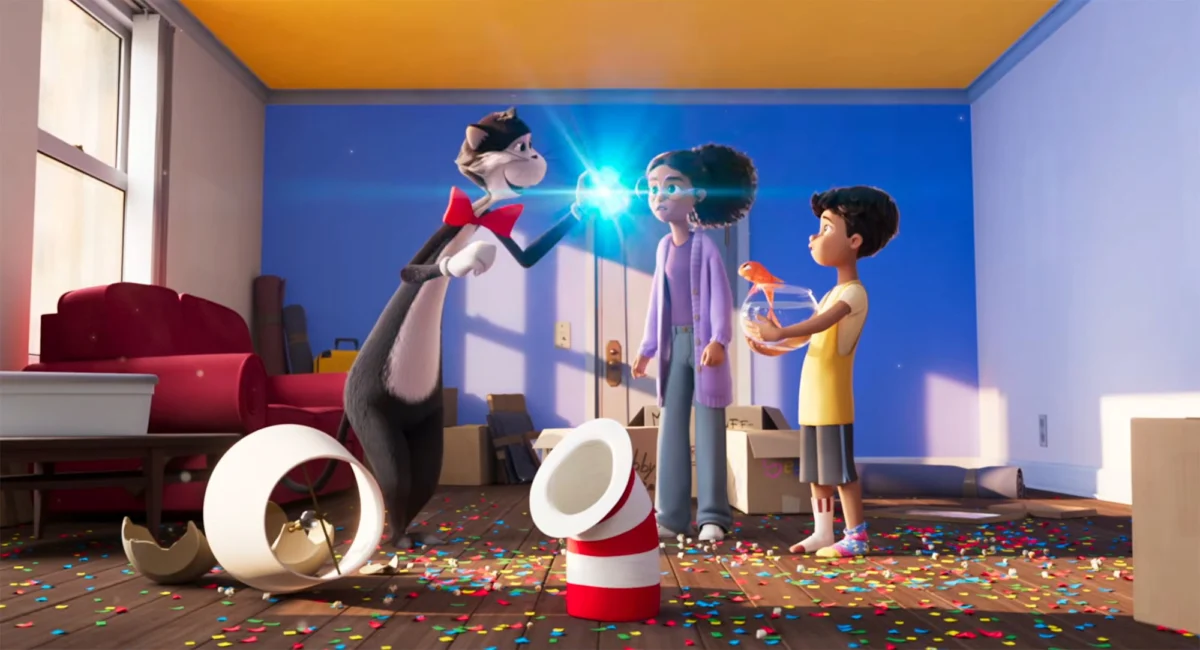
Warner Bros. Pictures and Warner Bros. Animation have released the third official trailer for their upcoming feature-length adaptation of Dr. Seuss’s classic 1957 children’s literary masterpiece, The Cat in the Hat. Scheduled to arrive in theaters nationwide on November 6, 2026, this high-profile project marks the iconic mischievous feline’s first-ever theatrical appearance in an animated format. Headlined by an all-star voice cast led by Emmy Award winner Bill Hader, the film attempts to translate the beloved, rhyming chaos of Theodor Geisel’s original pages into a modern cinematic landscape.
The newly debuted promotional footage offers audiences a deeper look into the narrative framework established by Warner Bros. Animation. In this fresh interpretation, the titular Cat is not merely dropping by for a rainy afternoon of indoor antics; he is operating under official directive. Specifically, the Cat takes on his most challenging and high-stakes assignment yet for the I.I.I.I.—the Institute for the Institution of Imagination and Inspiration, LLC. His mission is to bring joy and levity to Gabby and Sebastian, a pair of young siblings who are grappling with the emotional upheaval of moving to a completely new town. Known historically for taking his penchant for disorder just a bit too far, the Cat faces a monumental test: this could be his final opportunity to prove his worth as an agent of chaos, or risk losing his iconic, magical striped hat forever.
Background Context and Literary Legacy
The publication of Dr. Seuss’s The Cat in the Hat in March 1957 fundamentally altered the trajectory of children’s literature. Written as a response to a perceived crisis in American education regarding the dull nature of early reading primers, the book combined an aggressive limited vocabulary with wildly imaginative, subversive illustrations. It became an instant cultural touchstone, transforming Theodor Geisel into a household name under his pen name, Dr. Seuss.

Adapting the slender, highly visual picture book into feature-length cinema has historically proven to be a complex creative challenge. The most prominent prior theatrical adaptation was Universal Pictures and Imagine Entertainment’s 2003 live-action film, directed by Bo Welch. That project famously featured Mike Myers beneath heavy prosthetic makeup and elaborate costuming, alongside a cast that included Alec Baldwin, Kelly Preston, and Dakota Fanning. While that live-action version achieved notable financial success at the global box office—grossing approximately $134 million against a $109 million production budget—it received largely negative reviews from critics and polarized audiences due to its eccentric tone, adult-skewing humor, and departure from the whimsical innocence of the source material.
Recognizing the pitfalls of live-action translation, Warner Bros. Animation opted to return the property to its illustrated roots through state-of-the-art computer-generated imagery. This animated approach allows the studio to capture the fluid, gravity-defying physics and surrealist environments characteristic of Dr. Seuss’s original drawings, bridging the gap between nostalgic preservation and contemporary visual storytelling.
Production Timeline and Creative Leadership
The journey toward the 2026 release of The Cat in the Hat has been carefully managed by Warner Bros. Animation over several years, serving as a cornerstone of the studio’s broader theatrical strategy. Development on the animated feature gained significant momentum with the attachment of seasoned animation professionals Alessandro Carloni and Erica Rivinoja to direct and write the project.
Carloni brings substantial industry pedigree to the production, having co-directed DreamWorks Animation’s critically acclaimed Kung Fu Panda 3 (2016) and contributed character animation and story development to major franchises including How to Train Your Dragon and The Croods. Rivinoja contributes extensive writing and comedic experience, having worked on notable projects such as Trolls, The Addams Family, and the cult-classic animated series Clone High. The film is produced by Daniela Mazzucato and Jared Stern, who have focused on maintaining a balance between the timeless innocence of Dr. Seuss’s rhyming structure and the fast-paced, character-driven comedy expected by modern family audiences.

The rollout of promotional materials has followed a deliberate, multi-stage timeline designed to build sustained public anticipation. Warner Bros. initially unveiled early teaser footage in 2025, providing audiences with their first glimpse of Bill Hader’s vocal performance as the Cat. This was followed by a comprehensive full-length trailer earlier in 2026, which established the film’s unique premise involving the I.I.I.I. and the sibling protagonists, Gabby and Sebastian. The release of the third trailer in September 2026 cements the marketing push ahead of the fast-approaching autumn theatrical debut.
Voice Cast and Character Dynamics
The production boasts a remarkably deep ensemble cast composed of prominent comedy veterans and rising stars. Leading the call sheet is Bill Hader, whose distinctive cadence, vocal flexibility, and comedic timing anchor the film’s chaotic energy. Hader’s interpretation of the Cat positions the character as an irreverent yet ultimately well-meaning catalyst for emotional healing, steering the children through their anxieties about relocation.
Surrounding Hader is a supporting cast that blends diverse comedic sensibilities. The sibling protagonists, Gabby and Sebastian, are grounded by dynamic performances, while veteran comedic actors populate the broader ensemble. The cast features Xochitl Gomez, Matt Berry—known for his distinctively grand comedic delivery—Quinta Brunson, and Paula Pell. Further rounding out the voice talent are Tiago Martinez, Giancarlo Esposito, America Ferrera, Bowen Yang, and Tituss Burgess. This extensive roster indicates a deliberate effort by the filmmakers to create a vibrant, multi-generational appeal capable of drawing both children and adult animation enthusiasts to theaters.
Narrative Themes and Industry Analysis
Industry observers have noted narrative and thematic parallels between Warner Bros. Animation’s The Cat in the Hat and other recent high-profile animated features, most notably Pixar’s critically acclaimed Inside Out 2. Both narratives center heavily on the psychological and emotional trials of youth—specifically, the disruptive life changes associated with moving to a new environment, adapting to unfamiliar social spheres, and processing complex feelings of displacement and nostalgia.

However, where psychological dramas often delve into internal emotional personifications, The Cat in the Hat leans into externalized chaos, slapstick comedy, and the liberating power of imagination. The narrative mechanism of the I.I.I.I. provides a structured justification for the Cat’s historically unpredictable behavior, framing his mischief not merely as random destruction, but as a calculated, albeit dangerous, form of therapeutic intervention for children in distress.
From a box office perspective, Warner Bros. Animation is positioning the film as a major family event for the competitive autumn corridor. By securing a November 6, 2026 release date, the studio aims to capture early holiday-season moviegoers, capitalizing on the reliable demographic of families seeking theatrical entertainment as the weather cools.
Broader Implications for Dr. Seuss Adaptations
The success or failure of this animated adaptation carries significant weight for the broader cinematic exploitation of the Dr. Seuss catalog. In the wake of the 2003 live-action misstep, subsequent adaptations pivoted heavily toward full animation, yielding varying degrees of commercial and critical reception. Universal Pictures and Illumination found substantial box office success with CG-animated adaptations such as Horton Hears a Who! (2008), The Lorax (2012), and The Grinch (2018), the latter of which grossed over $513 million worldwide.
Warner Bros. Animation is clearly banking on this proven formula of faithful yet modernized CG animation to revitalize the Seuss brand on the big screen. If The Cat in the Hat resonates with critics and general audiences alike this coming November, it could validate a new wave of interconnected or standalone cinematic projects drawing from the extensive bibliography of Dr. Seuss, proving that characters created nearly seventy years ago retain enduring cultural and commercial viability in the modern era of media consumption.