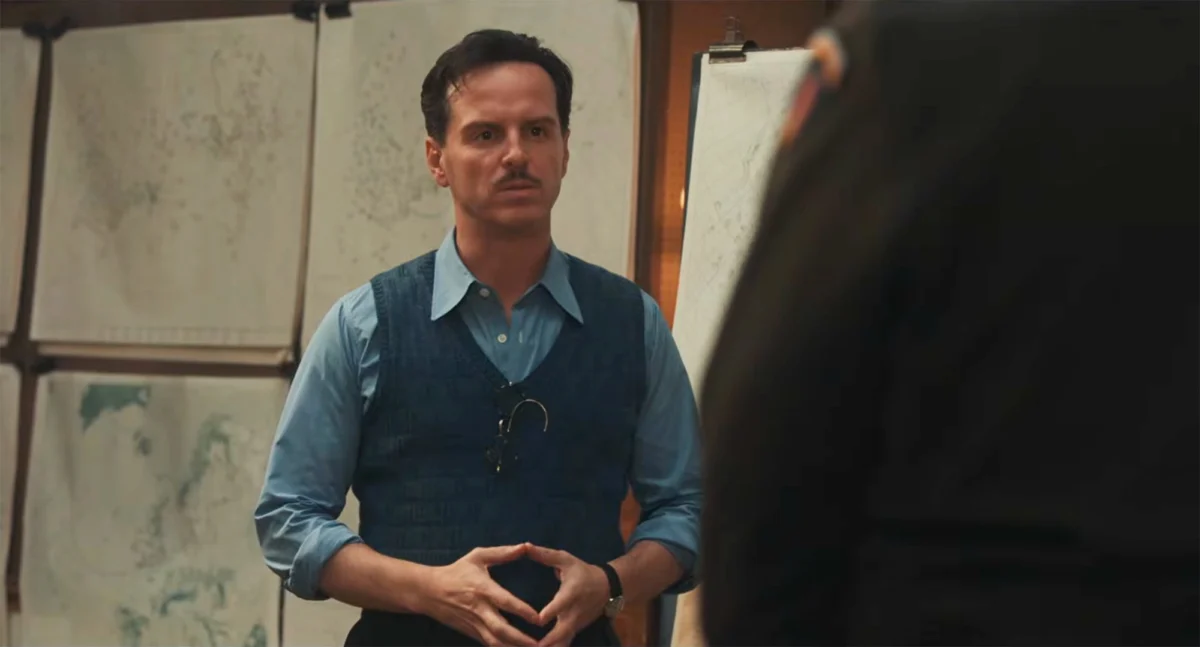
Focus Features has released the second and final United States trailer for its highly anticipated World War II drama, Pressure, offering audiences a gripping glimpse into the intense 72 hours preceding the pivotal D-Day invasion. Set to arrive in US theaters on May 29, 2026, with a subsequent UK release slated for September 9, 2026, the film promises to unravel the high-stakes human drama behind one of history’s most audacious military maneuvers. The newly unveiled trailer amplifies the suspense, focusing on the immense burden of leadership and the critical role of meteorological forecasting that determined the fate of millions and the trajectory of the war.
The cinematic narrative of Pressure centers on the monumental decision to proceed with the Allied invasion of Normandy on June 6, 1944. At the heart of this perilous choice is Royal Air Force meteorologist Captain James Stagg, portrayed by Andrew Scott, who is tasked with delivering a precise weather report to the Allied high command. His forecast would dictate whether the largest seaborne invasion in history would launch as planned or be delayed, with potentially catastrophic consequences. The film delves into the fraught atmosphere where scientific predictions clashed with military imperatives, and the weight of the free world rested on the shoulders of a few key individuals.
Brendan Fraser leads an impressive ensemble cast as General Dwight D. Eisenhower, the Supreme Allied Commander, embodying the immense pressure faced by the man who had to make the ultimate decision. The cast also features Kerry Condon as Captain Kay Summersby, Damian Lewis as Field Marshal Bernard Montgomery, Chris Messina as Irving P. Krick, and Henry Ashton as John Eisenhower, alongside Con O’Neill, Daniel Quinn-Toye, Toby Williams, and Max Croes. Directed by Australian filmmaker Anthony Maras, known for his critically acclaimed work on the intense real-life thriller Hotel Mumbai, Pressure is adapted from David Haig’s compelling 2014 stage play of the same name, with the screenplay co-written by Haig and Maras.
The Critical Juncture: D-Day and the Battle for Weather
The historical backdrop to Pressure is one of the most significant and perilous strategic decisions of World War II: the Normandy landings. The success of Operation Overlord, as the invasion was codenamed, hinged precariously on a confluence of factors, none more volatile and unpredictable than the weather. An amphibious assault of this magnitude required a specific and narrow window of meteorological conditions. Planners needed a period of low tides at dawn to expose German beach defenses, a near full moon for airborne troop deployment and navigation, light winds to minimize rough seas for landing craft, and clear skies for vital air support and reconnaissance.

In the days leading up to the initially planned D-Day date of June 5, 1944, the weather outlook was grim. A fierce storm front was sweeping across the English Channel, threatening to render any invasion attempt suicidal. Landing craft would be swamped, paratroopers scattered, and aerial bombardments impossible. General Eisenhower and his commanders faced an agonizing dilemma: launch into almost certain disaster, or postpone, risking the loss of precious secrecy, the morale of assembled troops, and the synchronization of a complex logistical nightmare.
This is where Captain James Stagg, the chief meteorologist for Eisenhower’s SHAEF (Supreme Headquarters Allied Expeditionary Force), became an unlikely pivotal figure. Stagg, a Scottish meteorologist, was tasked with interpreting often conflicting weather data from a limited network of stations across the Atlantic and Europe. He had to contend with the scientific limitations of the era, where satellite imagery and advanced computer modeling were decades away. His team’s predictions were crucial, yet inherently uncertain. The film aims to capture the essence of this intellectual and psychological battle, as Stagg wrestled with the data, knowing that millions of lives and the fate of the war rested on his analysis.
Stagg’s forecast, delivered on June 4, was for a brief, unexpected break in the weather—a narrow window of opportunity for June 6. This forecast stood in contrast to some other predictions, notably from American meteorologist Irving P. Krick, who was more optimistic about the June 5 window but whose methods were viewed with skepticism by British meteorologists. The tension between these scientific opinions, and the immense pressure on Eisenhower to weigh them, forms the dramatic core of Pressure. Stagg’s revised forecast ultimately swayed Eisenhower, who famously uttered, "Okay, we’ll go." This decision, made in the early hours of June 5, rerouted history.
From Stage to Screen: Crafting Cinematic Intensity
Anthony Maras’s direction, previously lauded for its visceral intensity in Hotel Mumbai, suggests that Pressure will not shy away from the human cost and psychological toll of its subject matter. The transition from a stage play indicates a potential emphasis on character-driven dialogue, intimate dramatic exchanges, and a focus on the confined spaces where these monumental decisions were made. The original play, also titled Pressure, received critical acclaim for its taut storytelling and its ability to build suspense around an event whose outcome is already known. This stage pedigree often translates into films that are rich in character development and intellectual conflict, relying on performance and script rather than large-scale action sequences.
The strength of Pressure is expected to lie in its ability to humanize the historical figures involved, showcasing their anxieties, doubts, and personal struggles. Maras’s approach in Hotel Mumbai demonstrated a keen eye for capturing the raw, immediate impact of crisis on individuals, making the audience feel the tension alongside the characters. In Pressure, this is likely to manifest as a deep exploration of the moral and professional quandaries faced by Stagg and Eisenhower, highlighting the solitude of command and the burden of scientific integrity. The "Why should I trust you?" and "We must face the facts – however frightening they may be!" lines from the trailer encapsulate this internal and external conflict, promising a narrative steeped in intellectual and emotional combat.

An Ensemble of Acclaimed Performers
The casting of Pressure further underscores the film’s commitment to delivering a powerful character study. Brendan Fraser’s portrayal of General Eisenhower marks a significant role in his ongoing career resurgence, often dubbed the "Brenaissance." Fraser, known for his versatility, has demonstrated a remarkable ability to inhabit complex characters, as evidenced by his Oscar-winning performance in The Whale. His transformation into Eisenhower is not merely physical but promises a nuanced portrayal of a leader grappling with an impossible choice, showcasing the blend of command, diplomacy, and profound human responsibility that defined the General.
Andrew Scott, celebrated for his captivating performances in projects like Fleabag, Sherlock, and All of Us Strangers, brings his renowned intensity and intellectual depth to Captain James Stagg. Scott’s ability to convey complex inner turmoil and sharp intelligence will be crucial in depicting Stagg’s isolated and demanding role. The film will rely heavily on his portrayal to communicate the scientific rigor and personal conviction required to stand firm on a forecast that could alter the course of history.
The supporting cast further strengthens the film’s dramatic potential. Kerry Condon, fresh off an Oscar nomination for The Banshees of Inisherin, brings her compelling screen presence to Captain Kay Summersby, Eisenhower’s personal driver and trusted confidante. Damian Lewis, a seasoned actor with a history of portraying powerful figures (notably as Major Richard Winters in Band of Brothers), takes on Field Marshal Bernard Montgomery, adding another layer of historical authenticity and command presence. Chris Messina as Irving P. Krick introduces the contrasting meteorological viewpoint, vital for illustrating the scientific debate that raged within the Allied high command. This caliber of talent suggests a film where performances will be central to conveying the extraordinary pressure of the moment.
Historical Context and Thematic Resonance
Pressure offers a compelling opportunity to explore a less-dramatized aspect of World War II: the strategic and intellectual battles fought away from the front lines. While films like Saving Private Ryan and Dunkirk vividly depict the combat and evacuation, Pressure promises to delve into the immense organizational and decision-making challenges that underpinned such operations. It underscores that victory was not solely won through firepower but through meticulous planning, scientific acumen, and courageous leadership.

The film’s themes resonate deeply even today. It explores the burden of leadership, the ethical dilemmas of command, the critical role of expert advice in high-stakes situations, and the human capacity to make epoch-defining decisions under unimaginable stress. In an era where scientific consensus often clashes with political expediency, the story of Captain Stagg and General Eisenhower offers a powerful historical precedent for understanding the interplay between data, judgment, and consequence.
The dramatic tension inherent in the 72 hours before D-Day is amplified by the sheer scale of what was at stake. A successful invasion meant the liberation of Western Europe and the beginning of the end for Nazi Germany. A failure would have been catastrophic, potentially prolonging the war by years, leading to countless more casualties, and fundamentally altering the post-war world order. The film, therefore, is not just a historical recounting but a thrilling exploration of a pivotal moment when a handful of individuals, armed with imperfect information and immense courage, steered humanity away from the precipice.
Anticipation and Legacy
The release of the final US trailer has only intensified anticipation for Pressure. Audiences are eager to witness a fresh perspective on a well-trodden historical event, particularly one that promises a focus on the psychological and intellectual battles rather than just the physical ones. The film joins a rich canon of World War II dramas that explore diverse facets of the conflict, from espionage thrillers to harrowing tales of combat. Pressure, however, carves out a unique niche by highlighting the often-overlooked but utterly critical role of meteorology and the personal courage required to interpret and act upon its findings.
Focus Features, known for its discerning selection of prestigious and impactful dramas, is positioning Pressure as a significant contender in the historical drama genre. The staggered release, with the US premiere preceding the UK by several months, allows for different market strategies and builds a prolonged period of buzz. For those fascinated by the intricate details of military strategy, the human element of leadership, and the often-unsung heroes of scientific endeavor, Pressure appears poised to deliver a gripping and thought-provoking cinematic experience. It serves as a potent reminder that behind every grand historical event are individuals making difficult choices, often in isolation, under the most extraordinary of pressures.