The year 1964 was a watershed moment in American history, a period of seismic shifts that rippled through society, challenging established norms and igniting debates that continue to resonate. Within this era of profound transformation, St. Nicholas School in the Bronx became the unlikely stage for a drama that would explore the very foundations of faith, authority, and human certainty. The film "Doubt," based on John Patrick Shanley’s Pulitzer Prize and Tony Award-winning play, masterfully captures this volatile atmosphere, placing a microcosm of societal upheaval within the hallowed, yet increasingly scrutinized, halls of a Catholic institution.
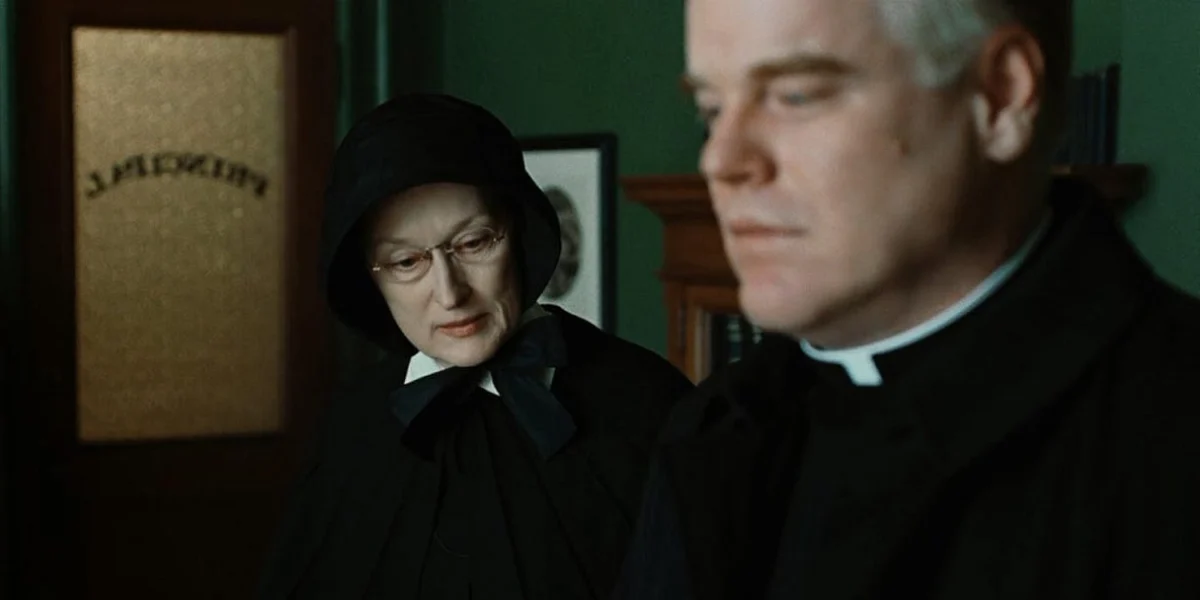
The narrative centers on the formidable Sister Aloysius, portrayed with steely resolve by Meryl Streep. As the principal of St. Nicholas, she embodies the rigid traditions and unyielding discipline that had long defined the Catholic education system. Her world, governed by strict adherence to rules and an unwavering belief in established dogma, begins to buckle under the weight of change. This disruption arrives in the form of Father Brendan Flynn, a charismatic and progressive priest played by the late Philip Seymour Hoffman. Father Flynn, with his forward-thinking approach, advocates for reforms within the school’s customs, seeking to modernize practices and make the Church more accessible to its flock. His influence is further amplified by the school’s historic acceptance of its first Black student, a symbol of the burgeoning civil rights movement and a tangible representation of the societal progress that Sister Aloysius views with suspicion.
The conflict ignites when a young, impressionable nun, Sister James (Amy Adams), confides in Sister Aloysius a deeply unsettling observation. She reports that Father Flynn appears to be paying an unusual amount of personal attention to the new Black student. While Sister Aloysius lacks concrete evidence, her deep-seated conservatism and distrust of Father Flynn’s modernizing agenda immediately fuel her suspicion. What follows is not a straightforward investigation, but a personal crusade, a relentless pursuit to expose what she perceives as a transgression, driven by her unwavering conviction and a profound fear of the unknown.
The Turbulent Backdrop of 1964
To fully grasp the power of "Doubt," one must understand the broader context of 1964 America. This was a nation grappling with profound social and political upheaval. The Civil Rights Movement was gaining unstoppable momentum, with landmark legislation like the Civil Rights Act of 1964 being signed into law. Dr. Martin Luther King Jr.’s "I Have a Dream" speech, delivered at the March on Washington in 1963, had galvanized millions and underscored the urgency for racial equality.
Simultaneously, the cultural landscape was being reshaped by the burgeoning counterculture movement. Young people were questioning authority, traditional values, and the established social order. This spirit of rebellion extended to the religious sphere. The Second Vatican Council, convened by Pope John XXIII in 1962 and concluding in 1965, represented a monumental effort to modernize the Catholic Church. Key reforms included allowing Mass to be celebrated in vernacular languages instead of Latin, positioning the priest to face the congregation, and encouraging greater lay participation. These changes, intended to make the Church more relevant to contemporary life, were met with both enthusiasm and resistance, creating generational divides within the faith itself.
The assassination of President John F. Kennedy in November 1963 had also cast a long shadow, leaving a nation reeling from the loss of a youthful, optimistic leader and fostering a sense of vulnerability. The escalation of the Vietnam War was becoming a growing concern, leading to increased anti-war protests. Betty Friedan’s seminal work, "The Feminine Mystique," published in 1963, had ignited second-wave feminism, further challenging traditional gender roles and societal expectations. This confluence of events created an atmosphere of uncertainty, where long-held beliefs were being rigorously tested, and the very definition of truth and morality was in flux.
A Clash of Ideologies and Personalities
Within St. Nicholas, this national ferment is mirrored in the ideological clash between Sister Aloysius and Father Flynn. Sister Aloysius, representing the more traditional, unyielding wing of the Church, sees Father Flynn’s reforms as a dangerous dilution of spiritual authority. His desire to use secular music in the Christmas pageant, for instance, is viewed as an affront to sacred tradition. She views his outreach to the community, his willingness to engage with students on a more personal level, with deep suspicion, interpreting it through the lens of her own strict upbringing and her unwavering adherence to a rigid moral code.
Father Flynn, conversely, embodies the spirit of Vatican II, seeking to infuse the Church with a renewed sense of relevance and community engagement. He believes that a more approachable and understanding Church can better serve its congregants, particularly the younger generation. His charismatic demeanor and genuine concern for his parishioners are, to him, expressions of his pastoral duty.
The narrative cleverly positions Sister James as the fulcrum of this conflict. Her innocence and unwavering faith make her a sympathetic character, yet her naivete also makes her susceptible to manipulation and doubt. Her initial, hesitant accusation against Father Flynn, born out of genuine concern for the student, becomes the catalyst for Sister Aloysius’s zealous investigation. Sister James, caught between the formidable authority of Sister Aloysius and the gentle persuasion of Father Flynn, finds herself in an agonizing moral quandary, constantly questioning her own judgment and the intentions of those around her.
An Acting Masterclass in Nuance and Doubt
Beyond its thematic depth, "Doubt" is an undeniable showcase of acting prowess. Meryl Streep delivers a performance that is both formidable and subtly layered. Her Sister Aloysius is not a caricature of a stern nun; instead, Streep imbues her with a palpable sense of duty, a belief that her strictness is a form of ultimate love and protection. Her every gesture, from the tilt of her head to the precise way she holds her pen, speaks volumes about a life dedicated to discipline and order. Her disdain for modern conveniences like ballpoint pens, which she believes contribute to poor posture, is a microcosm of her broader rejection of the changing world. Her commitment to her faith is so profound that it borders on the fanatical, driving her to seek absolute certainty in a world increasingly defined by ambiguity.
Philip Seymour Hoffman’s portrayal of Father Flynn is equally compelling. He avoids making the priest a one-dimensional villain or a saint. Instead, Hoffman crafts a man of genuine warmth and conviction, someone who truly believes in the power of community and the necessity of adapting the Church to contemporary life. His interactions with the students are marked by an openheartedness that makes Sister Aloysius’s suspicions all the more tragic. Even when confronted with accusations, Hoffman allows glimpses of vulnerability, of a man who may have been too open, too trusting, and perhaps, too kind. His performance ensures that the audience, like Sister Aloysius, is left to grapple with the unsettling possibility of his guilt or innocence.
Amy Adams as Sister James offers a portrait of burgeoning awareness and internal conflict. Her sweetness is her strength and her vulnerability, making her journey of doubt all the more poignant. She represents the individual caught in the crossfire of larger ideological battles, striving to uphold her faith while grappling with unsettling realities.
The addition of Viola Davis, in a relatively brief but impactful role as Mrs. Muller, the mother of the accused student, provides another crucial perspective. Davis delivers a performance of raw emotion and quiet dignity, showcasing the desperate anxieties of a mother protecting her child in a system where power imbalances are stark. Her measured responses to Sister Aloysius’s aggressive questioning highlight the chasm between institutional authority and the lived experiences of ordinary individuals.
Cinematic Storytelling: Expanding the Stage
John Patrick Shanley, adapting his own play for the screen, masterfully expands the narrative’s scope through cinematic techniques. Working with cinematographer Roger Deakins, Shanley utilizes visual language to underscore the film’s central themes of power, doubt, and moral ambiguity. Dutch angles, the deliberate positioning of religious iconography, and the manipulation of light and shadow all contribute to a heightened sense of dramatic tension. The camera becomes an active participant, drawing the audience into the internal struggles of the characters and the increasingly fraught atmosphere of the school.
The film’s visual design allows the audience to experience the school and the church in a way that a stage production might not. We witness the school’s Christmas pageant, a tangible representation of Father Flynn’s progressive ideas, and the broader environment in which this moral drama unfolds. The initial scene, where Father Flynn speaks about doubt, is juxtaposed with a powerful visual assertion of Sister Aloysius’s authority, her imposing presence dominating the space and foreshadowing the conflict to come.
The Enduring Question of Doubt
Ultimately, "Doubt" transcends a simple whodunit or a moralistic tale. The film’s true power lies in its exploration of the human condition in the face of uncertainty. By the conclusion, the question of whether Father Flynn actually committed the alleged transgression becomes secondary to the deeper, more profound inquiry into the nature of human beings and the inherent ambiguities of life.
The characters navigate a world teetering on the brink of immense change. Their anxieties are amplified by the political climate of the era – a nation still processing the trauma of presidential assassination, entangled in a distant war, and living under the specter of the Cold War. This external instability mirrors the internal turmoil experienced by the characters.
Shanley’s central question remains: in times of rapid and disorienting change, can we truly trust those in positions of power? Are their intentions always benevolent? What happens when deeply held beliefs, the very bedrock of one’s identity, are challenged by new realities? The film prompts introspection on the nature of faith, the burden of certainty, and the terrifying power of doubt. It asks us to consider whether our own convictions, however deeply felt, are sufficient to navigate the complexities of a world that refuses to offer easy answers. "Doubt" is not merely a film about a specific incident; it is a timeless exploration of the human struggle for truth and meaning in an ever-shifting landscape.