

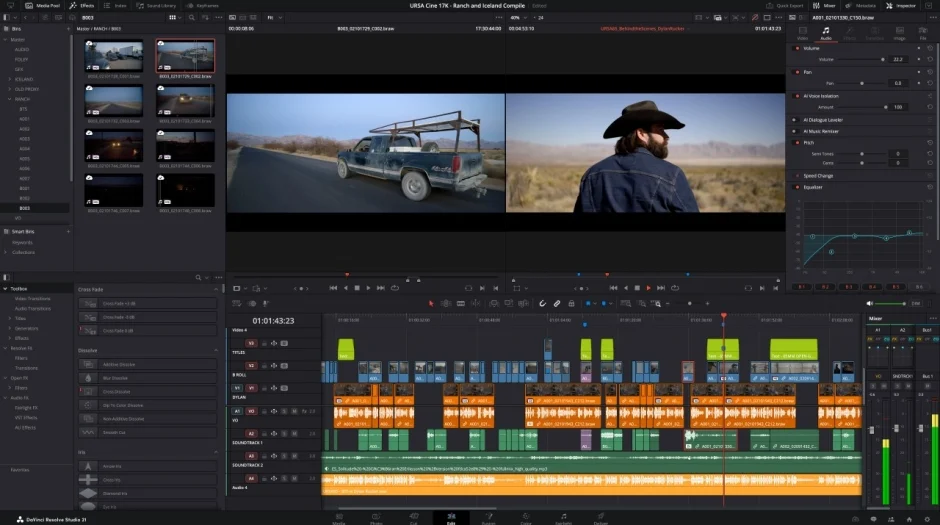
Blackmagic Design has officially released DaVinci Resolve 21.1, a substantial, feature-rich update to its industry-standard video editing, color grading, visual effects, and audio post-production software. Unveiled to the professional broadcast and film production community at the IBC 2026 convention in Amsterdam, this latest iteration introduces deep conversational artificial intelligence integrations, empowering users to delegate labor-intensive and repetitive technical workflows to advanced language models such as Anthropic’s Claude, Claude Code, and OpenAI’s ChatGPT Codex. Available immediately as a complimentary upgrade for existing license holders, version 21.1 targets efficiency bottlenecks across every stage of the post-production pipeline, bridging the gap between automated routine execution and high-level artistic creation.
Main Facts and Core Technological Additions
At the center of the DaVinci Resolve 21.1 release is the integration of advanced conversational AI assistants. Editors and facility technical directors can now interact with tools like Claude and ChatGPT Codex using natural, everyday language. Rather than navigating deep menu hierarchies or manually executing multi-step repetitive processes, users can issue direct conversational prompts to analyze incoming project assets, fine-tune application settings, build rough-cut highlight reels from extensive hours of raw footage, purge unwanted or corrupted takes, and initiate batch rendering routines for final output deliverables.
To ensure reliable performance across varying studio environments, Blackmagic Design has implemented a sophisticated decode preference system. This administrative setting allows facilities to dictate whether the integrated AI utilities rely strictly on pristine, full-resolution media files, or whether they should intelligently deploy lower-resolution proxies and fallback assets whenever the preferred high-resolution source files are offline or stored on disconnected network-attached storage arrays.
Beyond artificial intelligence, DaVinci Resolve 21.1 heavily expands the Fusion 3D and shape-based toolkits by incorporating over 25 specialized Krokodove procedural tools. These additions provide motion graphics artists and visual effects compositors with unprecedented geometric control. Key additions include Connect 3D, which generates complex vertex-to-vertex connections within three-dimensional space; Heightfield Create 3D, enabling editors to dynamically distort flat spatial planes using depth data derived from image maps; and Tube Create 3D, which constructs intricate, organic pipe and cable shapes capable of tracing custom motion paths. Furthermore, a newly designed 3D Region toolset allows artists to isolate specific visual effects and confine them strictly to defined volumetric zones within a 3D scene, dramatically streamlining render times and compositing precision.
The update also introduces the sPrimitive Create node, which automates the generation of fundamental geometric primitives such as crosses, multi-sided polygons, rectangles, and stars, paired with advanced edge manipulation utilities tailored for sophisticated graphic design and broadcast packaging workflows.
Chronology and Event Background
The debut of DaVinci Resolve 21.1 at IBC 2026 marks the continuation of Blackmagic Design’s aggressive development cycle for its flagship post-production suite. Historically, the company has utilized major international broadcasting conventions—such as the National Association of Broadcasters (NAB) show in Las Vegas and the International Broadcasting Convention (IBC) in Amsterdam—as primary stages for rolling out transformative updates that redefine software capabilities and hardware interoperability.

Over the past several years, the post-production industry has experienced an exponential increase in data volumes, driven by the widespread adoption of 8K image capture, high-frame-rate raw formats, and complex multi-camera episodic television production schedules. Recognizing that administrative burdens and media management consume a disproportionate percentage of an editor’s billable hours, Blackmagic Design initiated a multi-year engineering roadmap aimed at integrating machine learning and localized AI infrastructure directly into the Resolve environment. Version 21.1 represents a critical milestone in this ongoing evolution, shifting artificial intelligence from a supplementary background task—such as voice isolation and magic mask tracking—to an active administrative partner capable of executing complex directorial and organizational instructions.
Supporting Data and Comprehensive Feature Expansion
The scope of DaVinci Resolve 21.1 extends far beyond AI integration and Fusion enhancements, introducing more than 100 targeted refinements across the Cut, Edit, Color, Fairlight, and Fairlight-adjacent audio systems.
In the realm of color grading, the multimaster trim system has received a major architectural upgrade. Colorists working on high-end streaming and theatrical deliverables can now execute individual, discrete trim passes for Dolby Vision, HDR10+, and HDR Vivid formats simultaneously. This capability ensures that high-dynamic-range deliverables tailored for differing display specifications maintain absolute fidelity, supported by per-trim output sizing and advanced timeline caching options. Additionally, color management protocols have been broadened to include native support for GoPro Log, Leica L-Log, DJI’s D-Gamut2 and D-Log2, and Vivo’s Wide Gamut and Log profiles, alongside an expanded library of native camera transform lookup tables (LUTs) and ACES color science transform options.
Multi-cam editing workflows have been optimized to handle complex live-event and documentary productions more efficiently. Version 21.1 adds a dedicated timeline viewer multi-cam mode button, an automated routine to split multi-cam clips instantaneously at timecode gaps, and expanded keyboard shortcut mapping supporting up to 25 unique camera angles. Track selection shortcuts have similarly been doubled, allowing audio and video editors to target up to 32 independent tracks via rapid keyboard commands. The inspector panel now supports preset saving for video, audio, transition, and transform parameters, while the index panel features a newly integrated utility to export comprehensive marker lists directly as formatted PDF reports.
For photographers and hybrid digital content creators, the dedicated photo page now offers native, hardware-accelerated decoding for Fujifilm GFX and X series files, Leica SL RAW formats, and Sony A7R V1 assets. These files can be manipulated directly using Blackmagic’s dedicated hardware peripherals, including the compact DaVinci Resolve Micro Color Panel.
Technical performance has also been accelerated across hardware ecosystems. The software now incorporates GPU-accelerated HTJ2K decoding utilizing Kakadu libraries, hardware-accelerated HEIC decoding optimized for Apple Silicon architectures, and full compatibility with NVIDIA RTX Spark enterprise systems running on Microsoft Windows. Furthermore, developers benefit from 20 new scripting APIs coupled with a newly integrated console, while collaborative teams can leverage enhanced subtitle management, annotation sharing, and direct comment replies within Blackmagic Cloud Presentations.
Official Responses and Industry Reactions
Announcing the release at the Amsterdam RAI exhibition center, Blackmagic Design CEO Grant Petty emphasized the company’s core philosophy of alleviating administrative friction to foster unhindered artistic expression.

"With AI assistant support, our customers can now ask Claude or ChatGPT to handle repetitive tasks such as creating highlight edits, organizing media, or managing batch rendering, which frees them up to focus on creative decisions," stated Petty during the software’s premier demonstration at Stand 7.C49. "It is a massive update, and we cannot wait to see what our customers create with these new tools."
Industry analysts and professional post-production supervisors have responded favorably to the inclusion of conversational AI, noting that the capability to delegate time-consuming organizational and export tasks addresses one of the primary cost drivers in modern commercial and television production. Unlike proprietary, closed-ecosystem AI solutions tied exclusively to single software vendors, Blackmagic’s decision to integrate third-party frontier models like Claude and ChatGPT Codex provides facilities with the flexibility to leverage their preferred enterprise AI integrations securely.
Broader Impact and Implications for the Post-Production Industry
The introduction of DaVinci Resolve 21.1 signals a structural shift in how professional editing suites operate. For decades, the division of labor within post-production houses remained sharply defined between assistant editors—tasked with media ingestion, metadata tagging, bin organization, and proxy generation—and senior editors and colorists focused on narrative assembly and visual aesthetics.
By delegating these foundational administrative duties to conversational AI models like Claude and ChatGPT Codex, mid-sized and independent production studios can achieve operational efficiencies previously restricted to heavily staffed, enterprise-level facilities. The ability to request rough-cut highlight assemblies or execute multi-format batch deliverables via natural language prompts reduces turnaround times across tight broadcasting windows, particularly in sports broadcasting, reality television, and fast-paced digital journalism.
At the same time, the inclusion of granular professional tools—such as separate Dolby Vision, HDR10+, and HDR Vivid trim passes, alongside expanded Krokodove 3D spatial generators—ensures that the software maintains its standing among high-end feature film colorists and visual effects supervisors. As studios continue to face tightening budgetary constraints coupled with escalating technical demands for multi-platform delivery, tools like DaVinci Resolve 21.1 offer a viable pathway toward scaling operational output without sacrificing artistic integrity or technical precision.
DaVinci Resolve 21.1 is available immediately for download at no additional cost for existing users via the official Blackmagic Design website.