
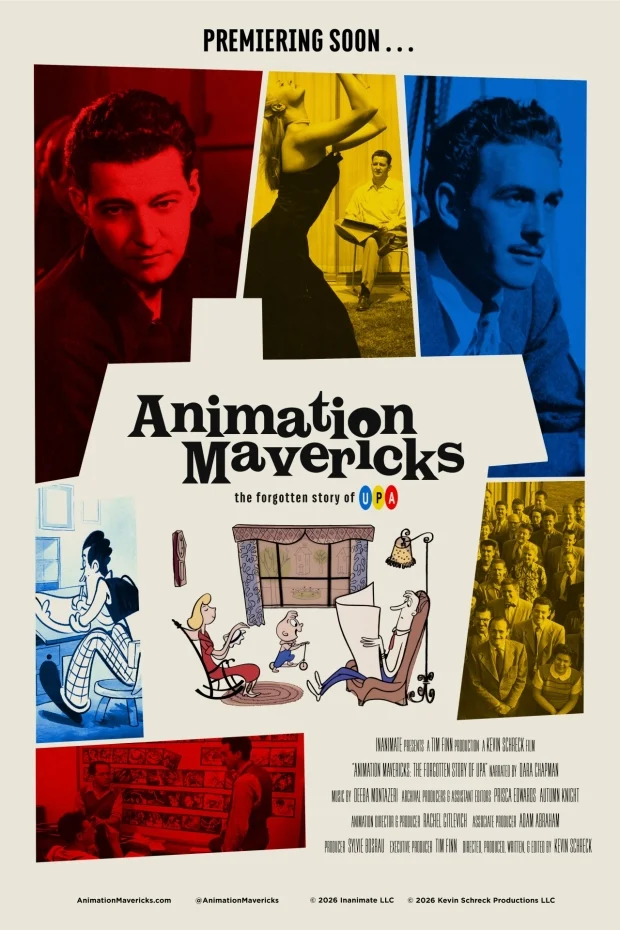
The landscape of mid-20th-century animation was defined not only by the meticulous, sweeping realism of the classical Hollywood studio era, but also by a radical, modernist counter-movement that fundamentally altered the visual vocabulary of the medium. At the epicenter of this stylistic revolution was United Productions of America, commonly known as UPA. Now, the complex history of the groundbreaking studio is being brought to the forefront in Animation Mavericks: The Forgotten Story of UPA, a feature-length hybrid documentary directed, produced, written, and edited by filmmaker Kevin Schreck. Following the recent release of the project’s inaugural trailer, the film has officially locked in a festival circuit debut slated for 2027, sparking renewed interest among animation historians, cinephiles, and industry professionals alike.
Presented by Inanimate LLC and Kevin Schreck Productions in close cooperation with the Bosustow Estate, the documentary promises an exhaustive examination of UPA’s trajectory. The studio, which gave rise to iconic and enduring properties such as the famously cantankerous Mr. Magoo and the delightfully idiosyncratic, vocal sound-effect prodigy Gerald McBoing-Boing, operated as a beacon of artistic rebellion. Rather than relying on the traditional, hyper-realistic character animation and lush background paintings championed by competitors like Walt Disney Productions, UPA pioneered a minimalist, graphic approach. Characterized by flat planes of color, abstract set designs, asymmetrical compositions, and a philosophy that prioritized conceptual design over literal representation, UPA proved that animation could function as high modern art.

The Genesis and Historical Context of UPA
To understand the weight of UPA’s legacy, one must examine the socio-political climate from which the studio emerged during the turbulent 1940s. The studio’s roots trace directly back to the historic 1941 Disney animators’ strike, a watershed labor dispute that exposed deep ideological fractures within the animation industry regarding fair compensation, creative autonomy, and union representation. Many of the creative minds who would eventually form UPA—including founding figures such as John Hubley, Steve Bosustow, and Zack Schwartz—cut their teeth during this period of labor activism, aligning themselves with progressive labor movements and radical art circles.
Initially established under the banner of Industrial Film and Poster Service, the collective initially produced training and propaganda films for the United States government and labor unions during World War II. By 1945, the enterprise was officially reorganized as United Productions of America. However, the studio’s forward-thinking ethos and progressive political leanings quickly placed it in the crosshairs of the McCarthy-era political witch hunts of the late 1940s and early 1950s. The Red Scare and House Un-American Activities Committee (HUAC) investigations heavily impacted Hollywood, leading to industry blacklists, internal purges, and the ousting of key creative figures like John Hubley.

Despite these severe institutional pressures, UPA managed to secure a theatrical releasing deal with Columbia Pictures, producing a string of critically acclaimed shorts that challenged conventional storytelling and visual norms. The studio’s bold artistic gamble paid off commercially and critically; their theatrical short Gerald McBoing-Boing (1950), directed by Robert Cannon and written by Dr. Seuss, won the Academy Award for Best Animated Short Film, proving that audiences were hungry for sophisticated, unconventional storytelling. This was followed by two more Academy Awards for When Magoo Flew (1955) and Magoo’s Puddle Jumper (1956), cementing UPA’s status as a formidable powerhouse in the animation industry.
Inside the Production of Animation Mavericks
Director Kevin Schreck is no stranger to the intricate, often turbulent history of animation. His previous directorial credits include acclaimed documentary works such as Persistence of Vision, Antarctic Voyage, and Enongo. With Animation Mavericks, Schreck marks his triumphant return to cinema history documentaries after a hiatus of over a decade.

"Animation Mavericks marks my return to making films about cinema history for the first time in over a decade," Schreck noted. "The themes and issues that our historical characters encountered and overcame are still relevant today."
The production utilizes a sophisticated hybrid format, blending rare archival footage, expert interviews with prominent film historians, and meticulously crafted animated re-enactments to vividly reconstruct pivotal moments in Hollywood history. This stylistic choice mirrors UPA’s own ethos of breaking standard visual conventions to serve the narrative.
The creative team behind the documentary boasts an impressive roster of industry veterans and academic minds. Rachel Gitlevich, a graduate of the prestigious Gobelins animation institution with 16 years of experience across television and independent film spaces, serves as the film’s animation director and producer. Tim Finn—owner of Hub Comics and author of a definitive historical text on G.I. Joe—boards the project as executive producer.

The extended production crew features Adam Abraham as associate producer, alongside archival producers Prisca Edwards and assistant editor Autumn Knight. The auditory landscape of the documentary is shaped by composer Deeba Montazeri, whose original score complements the visual rhythm of the film. Cinematography is co-led by Nathaniel Brown and Quinn Thomashow, with voice narration delivered by Dara Chapman, whose vocal delivery guides viewers through the historical labyrinth of UPA’s rise and fall. Furthermore, the documentary’s collaboration with Sylvie BosRau—producer, granddaughter of UPA co-founder Steve Bosustow, and representative of the Bosustow Estate—ensures a high degree of authenticity and access to primary source materials.
Chronology of UPA’s Corporate Evolution and Fall
The trajectory of UPA serves as a cautionary tale of how commercial pressures can erode artistic integrity. The studio’s chronology can be broadly segmented into distinct phases:

- 1941–1945: The Incubation Era. Emerging from the ashes of the Disney labor strike, founders and animators experiment with industrial and governmental shorts, fostering a tight-knit, fiercely independent collective spirit.
- 1945–1950: The Golden Age of Innovation. Rebranded as UPA, the studio partners with Columbia Pictures. Directors like John Hubley, Pete Burness, and Robert Cannon redefine theatrical cartoon aesthetics through shorts like Robin Hoodwood, Ragtime Bear (introducing Mr. Magoo), and Gerald McBoing-Boing.
- 1950–1956: Critical Acclaim and Political Upheaval. The studio wins multiple Academy Awards and achieves mainstream commercial success, even as McCarthyism forces out foundational talents due to alleged communist sympathies.
- 1956–1960s: Commercialization and Corporate Decline. Following the departure of key creative visionaries, Steve Bosustow sells his stake, and the studio pivots away from theatrical shorts toward television production, leading to a dilution of the unique artistic style that initially defined the brand. Production eventually winds down, leaving behind a profound conceptual void.
Broader Industry Implications and Modern Relevance
The release of the trailer for Animation Mavericks: The Forgotten Story of UPA arrives at a time when the animation industry is experiencing both unprecedented technological homogenization via artificial intelligence and computer-generated imagery, and a simultaneous hunger for distinct, auteur-driven graphic styles. Independent animation creators frequently look back to the mid-century modern aesthetic pioneered by UPA as a golden standard of design economy—proving that limitation can breed profound creativity.
By highlighting not only the artistic breakthroughs of UPA but also the socioeconomic struggles, labor disputes, and political persecution faced by its creators, Schreck’s documentary bridges the gap between historical retrospective and contemporary commentary. Issues of unionization, creative censorship, corporate consolidation, and ideological blacklisting remain fiercely contested topics in the modern entertainment landscape, ensuring that the struggles of the UPA artists resonate powerfully with today’s audiences.

As Inanimate LLC and Kevin Schreck Productions prepare the film for its official festival circuit premiere in 2027, anticipation continues to build within the global animation community. Through a blend of rigorous historical investigation, artistic re-enactments, and deeply personal archival access, Animation Mavericks promises to restore a vital, yet frequently overlooked, chapter of cinematic history to its rightful place in the cultural spotlight.