Sacha Baron Cohen’s iconic alter ego, Ali G, has made an unexpected and highly publicized return to the public sphere, staging a viral stunt at the 2026 Wimbledon men’s singles final. The audacious appearance, captured in a video posted to a newly established Instagram account, has ignited widespread speculation and excitement, particularly in light of recent reports confirming that a new film starring the beloved character has secretly concluded production. This surprising re-emergence marks Ali G’s first significant public act in over two decades, stirring both nostalgia and anticipation for what promises to be a major cultural moment.
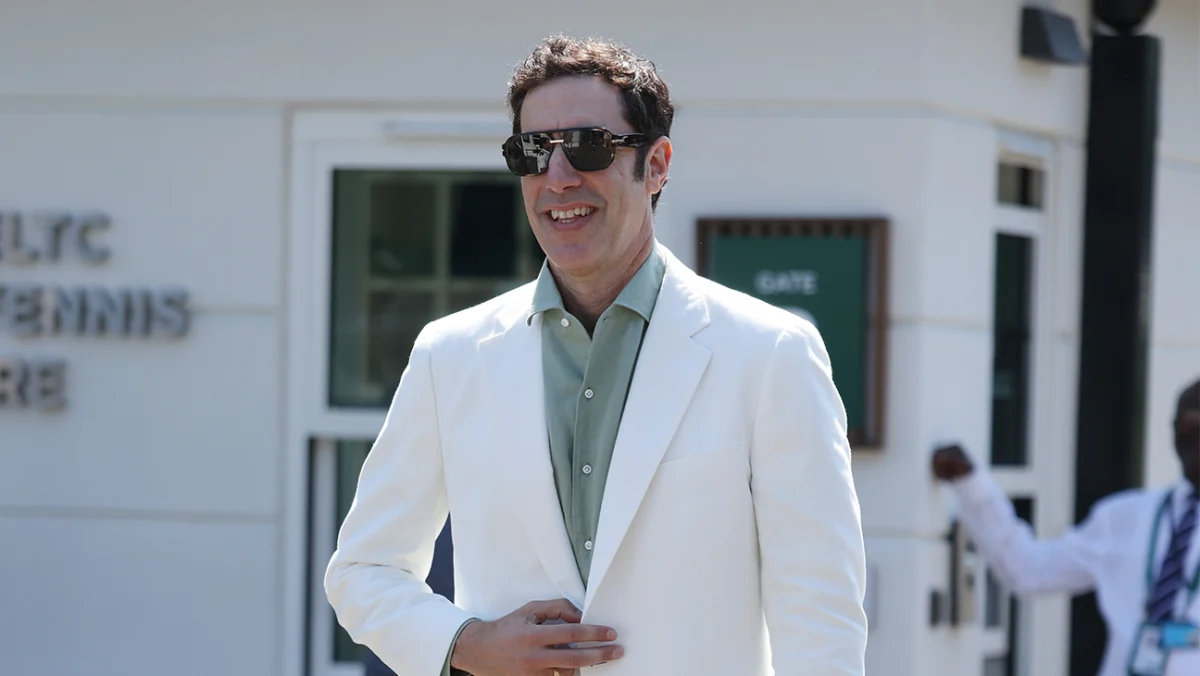
The incident unfolded on Sunday, July 6, 2026, during the climactic men’s singles final at the All England Lawn Tennis and Croquet Club, one of the most prestigious and hallowed grounds in international sports. A video uploaded to an Instagram account under the handle "@thereal_alig" showed Ali G, clad in his signature yellow tracksuit and sunglasses, addressing the camera from what appeared to be the vicinity of the Wimbledon grounds. In typical Ali G fashion, he delivered a monologue replete with his distinctive slang and misinterpretations. "Iz here at de men’s singles in Wimbledon, which actually, despite its name, ain’t a party for Gaylords. It’s like de World Cup of something called tennis, which is like a crap version of ping pong," he declared, immediately setting a tone of irreverent disruption. The most eyebrow-raising moment came when the character, known for his misguided entrepreneurial endeavors, suggested, "Them say dat tennis is better played on grass, which is why I intend to sell as much of it while iz here. So if you want some herbal remedies, me got anything you want." This thinly veiled reference to illicit substances, coupled with the caption "I iz BACK! And if u iz at dis borin wimbledore final lookin 2 get grand slammed, I iz here wif de hookup," sent shockwaves through social media and traditional news outlets alike.
The Return of a Satirical Legend
Ali G’s return is particularly significant given his prolonged absence from the public eye. Sacha Baron Cohen’s satirical character, a white middle-class man from Staines-on-Thames who adopts a perceived urban, hip-hop persona, first burst onto the scene in 1998. He debuted on the British TV program The 11 O’Clock Show, a late-night comedy and news program on Channel 4. His segments, characterized by absurd interviews with unsuspecting public figures, quickly garnered a cult following. Ali G’s genius lay in his ability to expose the pomposity, ignorance, or hidden biases of his interviewees by posing seemingly naive yet profoundly challenging questions. His early targets included politicians, academics, and celebrities, many of whom struggled to comprehend the character’s persona and often revealed more about themselves than intended.
The character’s popularity soared, leading to his own highly successful television series, Da Ali G Show, which ran for three seasons from 2000 to 2004, first in the UK and later on HBO in the United States. During this period, Ali G interviewed a remarkable array of high-profile personalities, from astronaut Buzz Aldrin to former United Nations Secretary-General Boutros Boutros-Ghali, and even future U.S. President Donald Trump. His memorable encounter with Trump, where Ali G pitched an "ice cream glove" to prevent melting, remains a classic example of Cohen’s ability to create uncomfortable yet revealing comedy. Other notable interviews included former FBI Director James Comey and political commentator Pat Buchanan, highlighting the broad appeal and incisive nature of Cohen’s satire.
The character also made the leap to the big screen with the 2002 feature film Ali G Indahouse, which saw him inadvertently elected to the British Parliament. While the film received mixed critical reviews, it solidified Ali G’s status as a cultural phenomenon, further embedding his unique slang and fashion into popular culture. Following the film and the conclusion of Da Ali G Show, Cohen largely retired the character, choosing to explore other satirical personas like Borat Sagdiyev and Bruno Gehard. This long hiatus only intensified the mystique surrounding Ali G, making his recent reappearance all the more impactful.
Wimbledon: A Stage for Unconventional Disruption
The choice of Wimbledon as the backdrop for Ali G’s comeback stunt is strategically significant. Wimbledon is one of the four Grand Slam tennis tournaments, alongside the Australian Open, French Open, and US Open. Established in 1877, it is the oldest and arguably most prestigious tennis tournament in the world, renowned for its strict adherence to tradition, including an all-white dress code for players, the consumption of strawberries and cream, and the presence of royalty. The tournament attracts a global audience of hundreds of millions, with attendance figures reaching over 500,000 spectators over the two-week event. Its highly controlled environment, stringent security protocols, and generally decorous atmosphere make it an unlikely venue for such an overt display of irreverence and implied illicit activity.
Wimbledon security is typically meticulous, involving extensive bag checks, metal detectors, and a significant presence of both uniformed and plainclothes security personnel. The All England Club prioritizes maintaining an orderly and safe environment for its elite athletes and high-profile attendees. Any suggestion of illicit drug sales, even as part of a comedic act, would be taken seriously by event organizers and law enforcement. While Sacha Baron Cohen’s stunts are meticulously planned to push boundaries without necessarily breaking significant laws or causing genuine harm, the implication of drug dealing on such a prominent stage could nonetheless trigger a response from authorities concerned with public safety and the event’s reputation.
Sacha Baron Cohen’s Satirical Genius and Marketing Strategy
Sacha Baron Cohen is widely regarded as one of the most daring and innovative satirists of his generation. His method involves creating outlandish, often offensive, characters who interact with real, unsuspecting people, thereby exposing societal prejudices, hypocrisies, and absurdities. From the Kazakh journalist Borat Sagdiyev, who hilariously (and often cringeworthily) revealed latent anti-Semitism and misogyny in America, to the flamboyant Austrian fashionista Bruno, who explored homophobia and celebrity culture, Cohen’s characters serve as distorting mirrors reflecting uncomfortable truths about society.
The timing of Ali G’s Instagram video is no coincidence. It directly follows recent reports that a new Ali G movie has secretly completed production. This strategic re-introduction of the character through a viral social media stunt is a classic move from Cohen’s playbook, effectively serving as a pre-release marketing campaign designed to generate immense buzz and anticipation. By leveraging the high visibility of an event like Wimbledon and combining it with the immediacy and global reach of social media, Cohen has expertly re-inserted Ali G into the cultural conversation. This approach bypasses traditional advertising, creating organic, word-of-mouth marketing that resonates deeply with both long-time fans and a new generation unfamiliar with the character. The digital age provides a perfect platform for Cohen’s brand of guerrilla satire, allowing him to create moments that blur the lines between reality and performance, making the audience question what is real and what is part of the elaborate act.
Reactions and Implications
The immediate reactions to Ali G’s Wimbledon video have been varied. Fans of Sacha Baron Cohen and Ali G have expressed overwhelming excitement and nostalgia, celebrating the return of a beloved character. Social media platforms were abuzz with shares, comments, and memes, quickly propelling Ali G back into trending topics. Many commented on Cohen’s continued brilliance in marketing and his ability to surprise.
However, the nature of the stunt, particularly the implied marijuana sales, is likely to draw formal responses from Wimbledon organizers and potentially law enforcement. While no official statement from the All England Club or the Metropolitan Police has been released at the time of reporting, it is reasonable to infer that such an act, even if comedic, would be viewed with disapproval. Wimbledon has a strict code of conduct for attendees, and any suggestion of illegal activity would prompt an internal review of security protocols and potentially lead to an official condemnation of such behavior, emphasizing the importance of respecting the rules and decorum of the event. For Cohen, the risk of such reactions is often part of the calculated gamble, as it amplifies the media coverage and further fuels the character’s rebellious image.
Beyond the immediate reactions, Ali G’s return and the upcoming film carry broader implications for satire and comedy in the 21st century. In an increasingly polarized and sensitive world, Cohen’s brand of provocative humor faces unique challenges. His characters often tread a fine line between satire and offense, relying on context and audience interpretation. The new Ali G movie will inevitably be scrutinized for its relevance and how it tackles contemporary issues, particularly given the evolution of social norms and discussions around cultural appropriation and representation since Ali G’s last major appearance. Will Ali G’s humor still resonate, or will it be seen as outdated? Given Cohen’s track record, it is likely that the new film will find fresh targets for its satire, adapting the character’s unique perspective to modern societal anxieties and absurdities.
The Anticipation Builds for a New Chapter
The confirmation of a secretly wrapped Ali G sequel, coming more than two decades after Ali G Indahouse, has created a vacuum of anticipation. The lack of a release date only adds to the intrigue, allowing the current viral stunt to generate maximum impact. Fans and critics alike will be eager to see how Sacha Baron Cohen updates Ali G for a new era. Will the character still be an aspiring rapper from Staines, or will his persona have evolved? What new public figures and societal institutions will he target with his uniquely naive yet piercing questions?
Sacha Baron Cohen’s career trajectory has consistently demonstrated his commitment to pushing boundaries and using comedy as a tool for social commentary. From his three Oscar nominations to his various Golden Globe and BAFTA wins, his work has consistently been recognized for its audacious originality and satirical depth. The return of Ali G is not merely a nostalgic revival; it is a calculated move by a master satirist to re-engage with contemporary culture, challenging audiences and power structures alike with his distinctive brand of humor. The Wimbledon stunt serves as a potent reminder that Ali G, for all his apparent naiveté, remains a powerful instrument in Cohen’s satirical arsenal, ready to expose the absurdities of the modern world, one "booyakasha" at a time. The world watches, eagerly awaiting the next chapter of this iconic character’s journey.