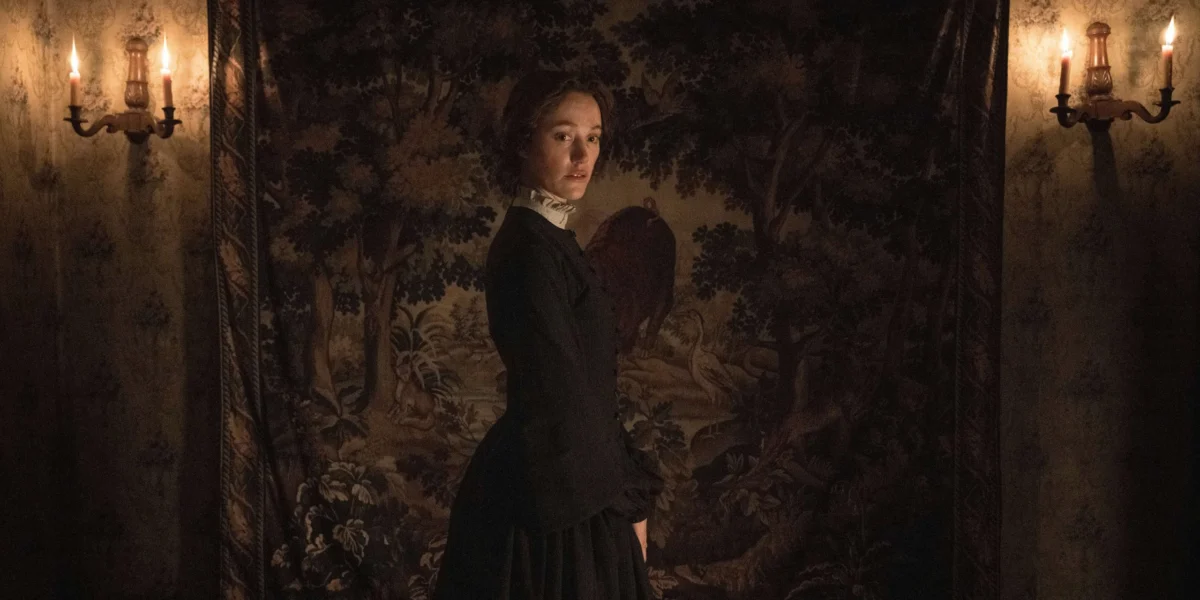
In the somber year of 1858, a new governess, Winifred Notty, arrived at the imposing and reputedly gothic estate known as Ensor House. Her mandate was ostensibly to instill proper etiquette and impart knowledge of family history upon the young charges entrusted to her care. However, beneath this veneer of Victorian propriety lay a deeply unsettling secret: Winifred Notty harbored psychopathic tendencies, a hidden darkness that would soon cast a long shadow over the secluded manor. As staff members began to vanish under increasingly mysterious circumstances, the owners of the estate, the Pounds family, found themselves grappling with the chilling suspicion that their new governess might be at the heart of the unfolding disquiet. "Victorian Psycho," a cinematic exploration helmed by director Zachary Wigon and penned by writer Virginia Feito, invites audiences into the fractured psyche of a woman battling an internal world she struggles to control, existing precariously on the precipice of rebellion and outright madness.
The film, with a concise running time of 90 minutes, draws a compelling parallel to the burgeoning "Good for Her!" cinematic sub-genre, a space dedicated to visualizing female characters reclaiming agency within restrictive societal frameworks. "Victorian Psycho" skillfully navigates this thematic territory, simultaneously satirizing and grounding its narrative with a sharp, peculiar tone and an evocative gothic atmosphere. Critics have drawn comparisons to the psychological tension of "The Innocents" and the chilling societal critique of "American Psycho," yet the film carves out its own unique niche by channeling female rage through a darkly paradoxical lens. Virginia Feito’s adaptation of her own novel, as presented by the film, unfolds as a disquieting descent, meticulously questioning the origins of its protagonist’s apparent madness, blurring the lines between righteous rebellion and outright psychopathy. The directorial vision of Zachary Wigon, coupled with a standout performance by Maika Monroe, elevates "Victorian Psycho" within the crowded field of gothic horror, offering a poignant commentary on the deep-seated anxieties surrounding societal acceptance and the desperate measures individuals may take to achieve it.
The Arrival and the Unveiling of Winifred Notty
The narrative officially commences in 1858, with the arrival of Winifred Notty (portrayed by Maika Monroe) at the opulent Ensor House. Her initial self-assurance, starkly contrasted by her internal monologue, immediately signals a potential disconnect. "I am the sanest person I’ve ever met," she declares to herself, a statement that, rather than reassuring, immediately raises questions about the underlying need for such an affirmation. This internal declaration serves as an early indicator of her precarious mental state, a carefully constructed facade designed to grant her entry into the seemingly respectable world of the Pounds family. Once inside the manor’s imposing walls, Winifred begins her duties, encountering the children under her charge: the younger Drusilla (Evie Templeton) and the elder Andrew (Jacobi Jupe). Her interactions with the patriarch, Mr. Pounds (Jason Isaacs), and matriarch, Mrs. Pounds (Ruth Wilson), as well as the household maid, Miss Lamb (Thomasin McKenzie), lay the groundwork for the escalating tensions. Winifred’s ambition to integrate and perhaps even thrive within this new environment comes with an unspoken question: at what personal cost will this assimilation be achieved?
The film’s deliberate chapter structure effectively mirrors the accelerating descent into madness. The opening chapter, marked by Winifred’s assertion of sanity, sharply contrasts with its closing scene, where she is depicted gleefully consuming a severed ear. This jarring juxtaposition sets the tone for an unhinged cinematic experience. The narrative poses questions about the nature of mischief that will befall Winifred and, more importantly, what constitutes psychopathy within the rigid confines of a Victorian society. The film deftly explores different interpretations of this term through Winifred’s characterization. While her actions undeniably deviate from socially acceptable norms, the overt bloodshed often serves as a secondary element. The true resonance of the story lies in Winifred’s intimate internal dialogues with her own madness, a darkness she nurtures and even personifies as "Fred." This internal relationship fuels her actions, grounding them in a personal quest for acceptance and understanding. Winifred emerges as an insightful, albeit disturbed, observer of an eccentric world. Her discerning gaze penetrates the superficiality of wealth, exposing the inherent ridiculousness of the Pounds family’s ostentatious lifestyle. Dialogue, such as Mrs. Pounds’s pronouncement, "No good maid should have creative aspirations," is delivered with such absurd conviction that it provokes a re-evaluation of who truly embodies the label of "psychotic" within the narrative’s context.
A Gothic Antiheroine in a Restrictive World
Winifred Notty functions as a subversive force, an unlikely conduit through which the audience escapes the suffocating confines of the wealthy Victorian sphere. The film skillfully portrays her as a gothic antiheroine, driven by a deep-seated yearning to indulge forbidden urges and unleash the primal instincts that lie dormant within. Her contemptuous perspective acts as a guide, granting viewers access to her most profound and unsettling thoughts. For Maika Monroe, whose previous roles have often featured characters defined by quiet intensity and repressed emotions, "Victorian Psycho" represents a significant and exhilarating departure. Her performance showcases a remarkable range, as she masterfully embodies the character’s outward composure while concealing her violent impulses, all while maintaining the film’s distinctively eccentric tone. Monroe’s deliberate, and at times inconsistent, English accent further adds layers of intrigue, prompting speculation about whether Winifred’s entire persona is a carefully crafted facade designed to infiltrate the Pounds family’s world. This nuanced performance is replete with subtle, impactful surprises.
The ensemble cast provides crucial depth to characters who could otherwise have devolved into predictable archetypes. Jason Isaacs and Ruth Wilson, as the parental figures, excel in their ability to oscillate between lightheartedness and profound intensity, delivering performances that elicit both humor and terror in rapid succession. Evie Templeton, portraying Drusilla, cultivates a quiet, compelling bond with Winifred, making the most of a role that, while somewhat underdeveloped, is nonetheless impactful. Jacobi Jupe, who previously garnered significant acclaim for his role in Chloé Zhao’s "Hamnet," continues to demonstrate his prodigious talent, consistently stealing scenes with his exceptional line delivery and undeniable charisma. Thomasin McKenzie, as Miss Lamb, whose unexplained disappearance becomes a pivotal plot point, imbues the character with an endearing playfulness that can swiftly transition into palpable tension.
Direction, Atmosphere, and Soundscape
Zachary Wigon, whose previous directorial work on "Sanctuary" also delved deeply into the complexities of gendered power dynamics, brings a palpable sense of passion and precision to Virginia Feito’s narrative. The film’s visual artistry is meticulously crafted to reflect its period setting. This extends from the authentic historical locations and detailed production design to the meticulously recreated costumes. Wigon employs an abstract and hallucinatory approach to framing Winifred’s character, particularly during moments of intense violence. He, in collaboration with cinematographer Nico Aguilar, captures arresting and unconventional shots, most notably a disquieting point-of-view sequence from the perspective of the ear Winifred consumes. This deliberate choice immerses the audience in the character’s unsettling reality. The film achieves an intriguing equilibrium between grounded realism and off-kilter surrealism, with certain scenes imbued with a dreamlike quality. The visual palette is rich with familiar gothic tropes, including dimly lit corridors and the warm, flickering glow of candlelight, which enhance the pervasive sense of unease. Complementing the visual storytelling, composer Ariel Marx, known for his work on "Sanctuary," delivers a lyrical and enchanting score. The music heightens the emotional rollercoaster of Winifred’s journey and perfectly encapsulates the melancholic and unsettling mood of a story set within the Victorian era.
Thematic Resonance and Narrative Trajectories
While "Victorian Psycho" distinguishes itself through its subversive elements, it is not entirely immune to certain genre conventions. The film’s final act, in particular, teeters on the brink of narrative unraveling. It is at this juncture that the meticulously constructed plotting begins to lose momentum, occasionally veering into repetition. The concluding two chapters, despite featuring some of the film’s most memorable and striking visuals, arguably overstay their narrative welcome. Nevertheless, the enduring strength of Winifred’s internal monologues consistently anchors the film, preventing it from fully succumbing to these structural weaknesses. Driven by a sensational performance from Maika Monroe and an impressively maintained tonal balance, "Victorian Psycho" offers a chilling, entertaining, and thought-provoking exploration of female rage, societal pressures, and the profound internal struggles that can shape an individual’s destiny.
Supporting Data and Contextual Background
The year 1858 was a period of significant social and cultural transformation in Victorian England. Industrialization was rapidly reshaping urban landscapes, while strict social hierarchies and expectations for behavior, particularly for women, remained deeply entrenched. The concept of the governess was a vital component of the upper-class domestic sphere, a figure expected to possess both intellectual capacity and impeccable moral character. The gothic literary tradition, which experienced a resurgence in the mid-19th century, often explored themes of madness, confinement, and the psychological impact of oppressive environments, making the setting of Ensor House a potent symbol. The film’s thematic engagement with female agency and rebellion against societal constraints taps into broader historical discussions about the limited roles available to women during this era, and the psychological toll such limitations could exact. The "Good for Her!" cinematic movement, as referenced in the critique, often draws inspiration from historical narratives where women have had to navigate patriarchal structures with cunning and resilience, sometimes resorting to extreme measures to assert their autonomy.
The presence of psychopathic tendencies within a historical context also invites consideration of how such conditions were understood and perceived. While modern psychiatric terminology was nascent, the era certainly recognized individuals who exhibited severe antisocial behavior, often attributing it to moral failing or demonic influence rather than clinical conditions. Winifred’s internal personification of her darkness as "Fred" can be seen as a coping mechanism, an attempt to externalize and perhaps control the impulses that threaten to overwhelm her. The film’s exploration of her desire for acceptance, juxtaposed with her violent actions, highlights the complex interplay between internal desires and external societal pressures.
Potential Chronological Breakdown of Key Events
- 1858: Winifred Notty arrives at Ensor House, securing her position as governess.
- Early Days: Winifred begins her duties, interacting with the Pounds children and family. Initial subtle signs of her unconventional nature emerge.
- Disappearances Begin: A staff member is reported missing. Initial suspicions are low-key, attributed to accidental departures or other mundane reasons.
- Escalating Incidents: Further disappearances occur, increasing the unease within the household. The staff’s fear and paranoia grow.
- Growing Suspicion: The Pounds family begins to question Winifred’s role and behavior. Their unease transitions into outright suspicion as the disappearances become more frequent and unsettling.
- Confrontation or Revelation: The narrative likely builds towards a point where Winifred’s true nature is either directly revealed or becomes undeniably apparent through her actions.
- Climax: The film reaches its peak tension as the consequences of Winifred’s psychopathy and the unfolding mystery come to a head within Ensor House.
- Resolution (or lack thereof): The film concludes, leaving the audience to contemplate the aftermath and the lasting impact of the events.
Broader Impact and Implications
"Victorian Psycho" contributes to a growing body of cinema that interrogates traditional notions of heroism and villainy, particularly through the lens of female characters. By presenting a protagonist whose moral compass is fundamentally flawed, the film challenges audiences to empathize with, or at least understand, motivations that lie far outside the norm. This exploration of the "psycho" as a character who is both perpetrator and, in a sense, victim of her own internal struggles has implications for how we view societal pressures and their potential to warp individual psychology. The film’s success, critically and potentially commercially, could further encourage explorations of complex female characters in genre filmmaking, pushing boundaries and inviting more nuanced discussions about rage, control, and agency in narratives that have historically been dominated by male perspectives. The resonance of its themes with contemporary concerns about mental health, societal expectations, and the reclamation of power by marginalized groups ensures its continued relevance beyond its initial release. The film’s ability to blend historical setting with timeless psychological struggles offers a potent commentary on the enduring nature of human darkness and the societal constructs that attempt, often unsuccessfully, to contain it.