


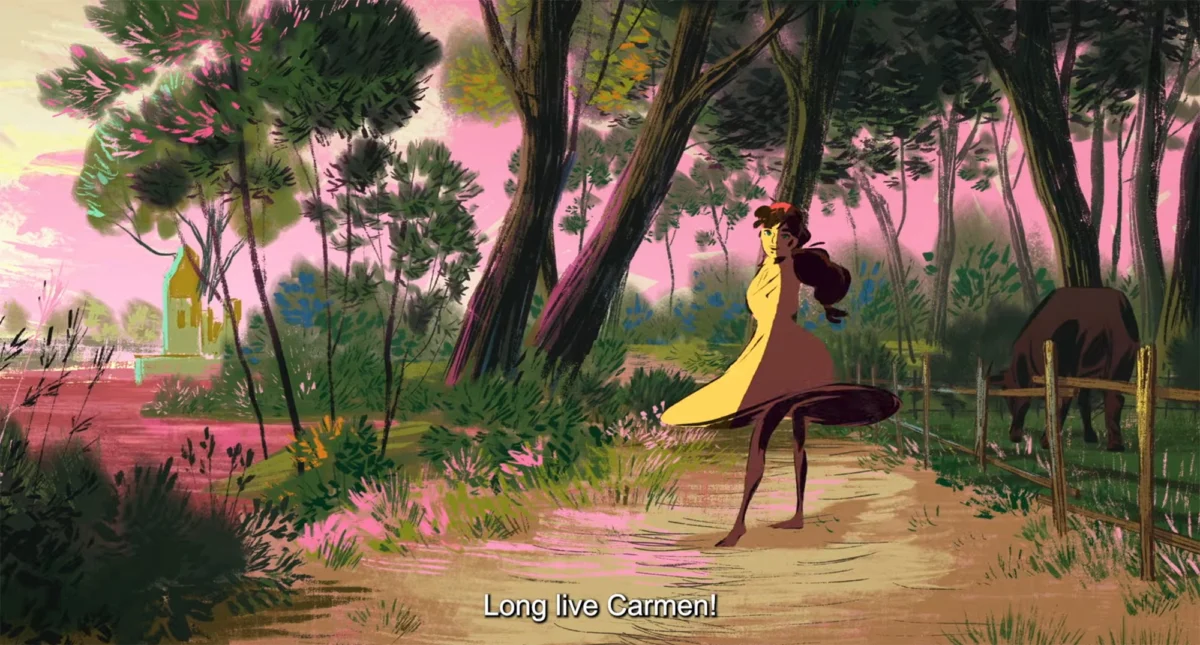
A captivating first-look teaser trailer has been released for Viva Carmen, the eagerly anticipated animated feature film from acclaimed French director Sébastien Laudenbach. The film is slated for a prestigious premiere at the 2026 Cannes Film Festival, where it will debut in the independent Directors’ Fortnight sidebar, followed by a showing at the Annecy International Animation Film Festival. This latest offering from Laudenbach, known for his distinctive hand-painted animation style, promises to be a visually stunning and emotionally resonant adaptation of the timeless Carmen narrative, reimagined through the eyes of youth and the vibrant backdrop of 19th-century Andalusia.
The teaser offers a glimpse into a world of vivid colors and fluid motion, characteristic of Laudenbach’s previous works, including the critically lauded Chicken for Linda! and The Girl Without Hands. Set in Seville, Spain, in 1840 (with some plot details placing it around 1845), Viva Carmen centers on 13-year-old Salva, who, after a three-year absence, returns to the bustling back alleys of Seville. Here, he encounters Carmen, a 20-year-old gypsy whose mesmerizing voice and fiery spirit captivate him. An ominous premonition, gleaned from an omen, foretells a tragic fate for Carmen – specifically, death at the hands of a soldier named José, as revealed through the mystical abilities of Antonio, a gifted knife grinder who can glimpse the future in sharpened blades. Driven by a fierce determination to defy destiny, Salva rallies his band of street-smart friends, including the spirited Belén, to protect Carmen from the impending danger. The narrative explores themes of fate versus free will, the power of community, and the raw intensity of a legend.
The film boasts a talented voice cast, featuring Camélia Jordana as the titular Carmen, alongside Milo Machado-Graner, Soumaye Bocoum, and Carl Malapa. The involvement of such accomplished actors, particularly Machado-Graner, a rising star recognized for his role in "Anatomy of a Fall," underscores the film’s potential for both critical acclaim and broad audience appeal. The combination of compelling vocal performances and Laudenbach’s unique visual artistry sets Viva Carmen apart as a significant entry in the landscape of contemporary animation.
The Enduring Allure of Carmen: A Legacy Reimagined

The story of Carmen is one of the most enduring and frequently adapted narratives in Western culture, originating from Prosper Mérimée’s 1845 novella and famously immortalized in Georges Bizet’s 1875 opera. Bizet’s "Carmen," despite a lukewarm initial reception, quickly ascended to become one of the most performed operas worldwide, celebrated for its dramatic intensity, memorable arias, and vivid portrayal of passionate, rebellious characters. The narrative typically follows the fiery gypsy Carmen, her entanglement with the naive soldier Don José, and her ultimate tragic demise at his hands, driven by jealousy and her unwavering pursuit of freedom.
The core themes of Carmen—fate, freedom, passion, rebellion, and tragic love—resonate across generations and cultures, making it fertile ground for reinterpretations. Over the decades, the story has been adapted into numerous films, ballets, stage plays, and even contemporary musical productions, each offering a distinct lens through which to explore its complex characters and moral ambiguities. From Otto Preminger’s "Carmen Jones" (1954) to Carlos Saura’s flamenco-infused "Carmen" (1983) and Jean-Luc Godard’s avant-garde "Prénom Carmen" (1983), artists have continuously found new ways to explore the story’s powerful themes.
Sébastien Laudenbach’s Viva Carmen positions itself within this rich tradition by offering an animated perspective, specifically through the eyes of a group of street children. This choice allows for a fresh exploration of Carmen’s legend, shifting the focus from the conventional romantic tragedy to a story of youthful courage, loyalty, and a desperate struggle against a preordained fate. By centering the narrative on Salva’s efforts to save Carmen, the film introduces an element of hope and agency into a story often defined by its tragic inevitability, while still acknowledging the powerful pull of destiny. The setting of Seville in the 1840s, a city renowned for its vibrant culture, flamenco, bullfighting, and intricate social strata, further enriches the narrative, providing an authentic and atmospheric backdrop for the unfolding drama. This historical context allows the film to delve into the social dynamics of the era, the marginalized status of gypsies, and the rigid societal expectations that often dictated individual fates.
Sébastien Laudenbach’s Distinctive Artistic Vision
Sébastien Laudenbach has established himself as a singular voice in contemporary animation, celebrated for his commitment to traditional, handcrafted techniques that imbue his films with a unique visual texture and emotional depth. His signature style, characterized by vibrant, hand-painted frames and a fluid, almost impressionistic aesthetic, stands in stark contrast to the prevalent CGI animation dominating the mainstream. This artistic choice is not merely aesthetic; it serves as a powerful narrative tool, allowing for a more evocative and less literal interpretation of reality, perfectly suited for stories steeped in folklore, emotion, and psychological complexity.

Laudenbach first garnered widespread international attention with The Girl Without Hands (2016), an adaptation of a Brothers Grimm fairy tale. This film, animated almost entirely with minimalist, hand-drawn lines and splashes of color, earned critical acclaim for its artistic bravery and profound emotional resonance, winning a Jury Distinction at the Annecy International Animation Film Festival and a César Award nomination for Best Animated Film. It demonstrated Laudenbach’s ability to strip away visual excess to reveal the raw essence of a story.
His subsequent feature, Chicken for Linda! (2023), further cemented his reputation. Co-directed with Chiara Malta, this film is a burst of exuberant color and frantic energy, depicting a mother’s desperate quest to find a chicken for her daughter. Chicken for Linda! was lauded for its playful visual style, charming narrative, and emotional authenticity, winning the Cristal for Best Feature Film at Annecy and the César Award for Best Animated Film, further solidifying Laudenbach’s position as a leading figure in European animation. The critical and commercial success of these films has built a strong foundation of anticipation for Viva Carmen. Audiences and critics alike expect Viva Carmen to continue this tradition of artistic innovation and emotional depth, leveraging his distinctive style to bring the passionate world of Carmen to life in a way that is both visually arresting and deeply moving. The "extra colorful hand-painted look" mentioned in early reviews suggests that Viva Carmen will amplify the vibrant aesthetic seen in his previous works, making every frame a piece of art. This approach is particularly effective for a story like Carmen, which thrives on intense emotion and dramatic flair, allowing the animation to convey nuanced feelings and the vivid atmosphere of 19th-century Seville.
A New Perspective on a Classic Tale: Narrative and Themes
The narrative of Viva Carmen, co-written by Laudenbach and Santiago Otheguy, delves into the well-trodden ground of the Carmen mythos but from an unconventional vantage point. By focusing on the youthful Salvador and his street gang, the film offers a fresh lens through which to explore the themes of fate, rebellion, and protection. The inclusion of Antonio, the knife grinder, and his ability to foresee Carmen’s death through sharpened blades introduces a mystical element that underscores the pervasive theme of destiny. This prophetic warning sets the stage for a dramatic conflict between preordained tragedy and the fierce will of Salva and his friends to alter the course of events.
The film’s French title, Carmen, l’oiseau rebelle (Carmen, the rebellious bird), directly references a famous aria from Bizet’s opera, highlighting Carmen’s iconic persona as a free-spirited and defiant woman. In Viva Carmen, her portrayal as a "free-spirited & flamboyant young woman" who is a "rebellious soul" remains central, but the intervention of the children adds a layer of innocence and selfless courage to the often dark and violent tale. This shift in perspective could allow the film to explore universal themes of loyalty, the bonds of friendship, and the audacious belief that one can challenge the seemingly unyielding threads of destiny.

The characters of Salva and Belén, leading their "eclectic band of misfit street kids," embody a youthful idealism that contrasts sharply with the darker, more fatalistic undertones of the original story. Their collective effort to save Carmen transforms her from a mere object of tragic romance into a symbol of freedom that inspires an entire generation. This adaptation thus has the potential to introduce the complex figure of Carmen to younger audiences, not just as a tragic heroine, but as a catalyst for heroic action and a symbol of defiance against oppression. The film’s setting in the "back alleys of Seville" also suggests an intimate, grounded perspective, far from the grand stages of opera houses, bringing the story closer to the lives of ordinary people and the often harsh realities of street life in 19th-century Spain.
Film Festival Circuit: Cannes and Annecy – A Strategic Launch
The selection of Viva Carmen for both the Directors’ Fortnight at the Cannes Film Festival and the Annecy International Animation Film Festival represents a significant endorsement of its artistic merit and potential impact. Cannes, one of the world’s most prestigious film festivals, offers unparalleled visibility, particularly for independent and auteur-driven cinema. The Directors’ Fortnight (Quinzaine des Cinéastes) sidebar is renowned for showcasing innovative and artistically daring films, often serving as a launching pad for critically acclaimed works that push cinematic boundaries. Its focus on discovery and independent voices aligns perfectly with Laudenbach’s distinctive approach to animation.
Following its Cannes premiere, the film’s inclusion in the Annecy International Animation Film Festival further solidifies its standing within the global animation community. Annecy is widely regarded as the most important event for animated films worldwide, a platform where major studios and independent animators alike unveil their latest creations. Premiering at Annecy ensures that Viva Carmen will be seen by key industry professionals, including distributors, producers, and animation enthusiasts, securing its place in the discourse surrounding the year’s most significant animated works. For an animated film, a strong showing at Annecy can be as crucial as a major award at Cannes for live-action features.
This dual-festival strategy is highly effective for generating buzz, attracting international distributors, and establishing critical momentum. Past animated films that have debuted at these festivals, such as Laudenbach’s own The Girl Without Hands (which premiered at Annecy) and Chicken for Linda! (which premiered at Cannes and won at Annecy), have gone on to achieve significant international success and critical acclaim. The strategic placement of Viva Carmen at both festivals signals a strong confidence from its producers and distributors in the film’s ability to captivate diverse audiences and critics.

Production Details and Future Outlook
Viva Carmen is a collaborative effort, with the screenplay penned by Sébastien Laudenbach and Santiago Otheguy. The production team includes Damien Brunner, Sarah Delmas, Pablo Jordi, Veronica Lassenius, and Pierre-Henri Léon, whose collective experience in European animation production suggests a commitment to high-quality, artistically driven projects. European animation often benefits from co-production models, bringing together talent and resources from multiple countries, which can enrich the creative process and broaden the film’s international appeal.
The casting of Camélia Jordana as Carmen is particularly noteworthy. As a celebrated singer and actress, Jordana brings a unique blend of vocal prowess and dramatic experience to the iconic role, which is crucial for a character deeply rooted in a musical tradition. Her involvement is likely to attract a wider audience, extending beyond traditional animation enthusiasts. Milo Machado-Graner, who delivered a standout performance in the Palme d’Or-winning "Anatomy of a Fall," adds another layer of talent, ensuring strong dramatic performances even in animated form.
Looking ahead, Viva Carmen is scheduled for release in French cinemas in October 2026. This autumn release positions it well for awards season consideration in France and potentially other European markets. While a specific US release date has not yet been announced, a successful run at Cannes and Annecy is typically a prerequisite for securing international distribution deals. Distributors often gauge critical reception and audience interest at these festivals before committing to theatrical releases in other territories. Given Laudenbach’s growing international reputation and the universal appeal of the Carmen story, a subsequent release in North America and other major markets appears highly probable.
The implications of Viva Carmen extend beyond its immediate box office performance. It further solidifies the reputation of French animation as a global leader in artistic innovation and narrative depth, capable of producing films that are both visually stunning and intellectually engaging. It also serves as a testament to the enduring power of classic stories, demonstrating how they can be continually revitalized and made relevant for new generations through creative adaptation and groundbreaking artistic vision. As the film embarks on its festival journey, all eyes will be on Sébastien Laudenbach’s latest masterpiece, eager to witness how his unique hand-painted world breathes new life into the rebellious bird of Seville.