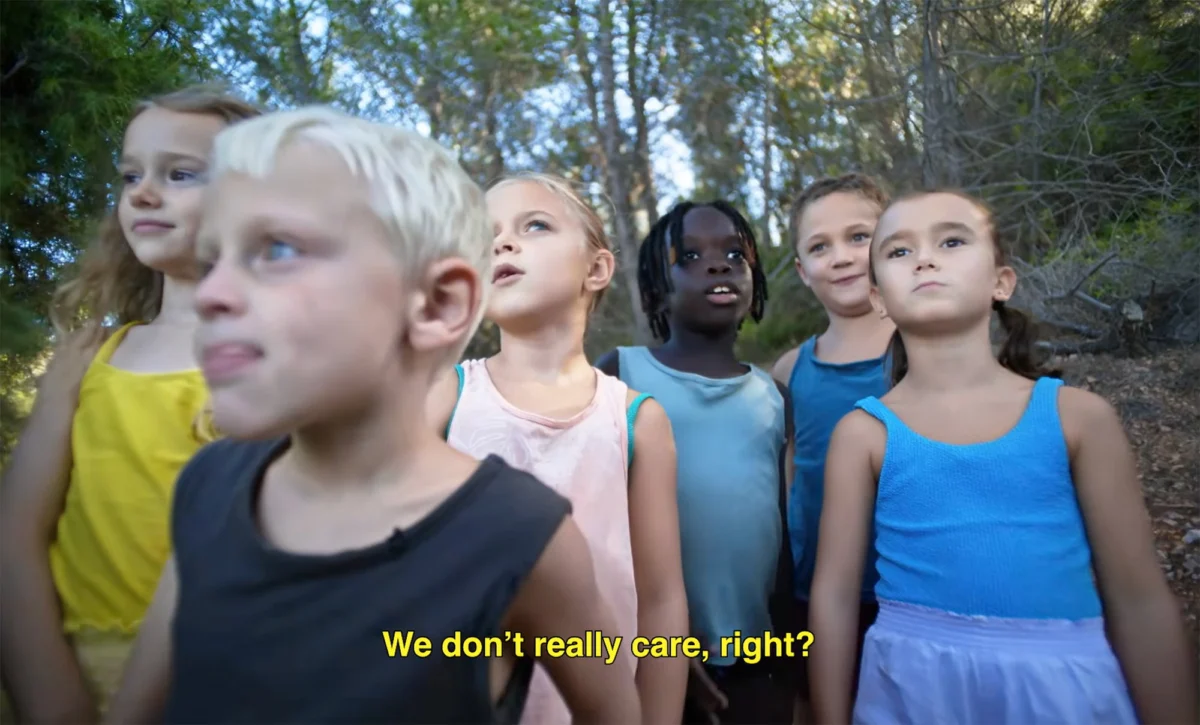
The cinematic landscape is poised for the unveiling of Bruno Dumont’s latest feature, Red Rocks, set to premiere this month at the 2026 Cannes Film Festival. The film will be featured in the prestigious Directors’ Fortnight sidebar, an independent section renowned for showcasing daring and innovative works by both established and emerging filmmakers. In a significant recognition of his distinctive contributions to cinema, the Directors’ Fortnight will also host a comprehensive retrospective of Dumont’s extensive filmography, underscoring his status as a singular voice in contemporary French and international filmmaking.
Red Rocks, known as Les Roches rouges in its original French, promises a return to Dumont’s characteristic exploration of human nature, often through the lens of young, unseasoned actors. The narrative centers on a vibrant yet perilous rivalry unfolding on the sun-drenched French Riviera. Two distinct gangs of children—locals and summer visitors—engage in a high-stakes game of cliff jumping, a dangerous pastime that serves as a crucible for burgeoning friendships, fierce competition, and the first stirrings of adolescent romance. The film specifically highlights the journey of Géo, a child barely five years old, as he navigates this complex world over a single summer, discovering a landscape where innocence confronts the harsh realities of rivalry and nascent emotional bonds. This dynamic is said to evolve into a modern-day "Romeo and Juliet"-style romance, intertwining themes of life, love, and death against the dazzling Mediterranean backdrop.
Auteur’s Vision: Bruno Dumont’s Signature Style
Bruno Dumont, born in Bailleul, France, in 1958, has forged a career defined by an uncompromising and often challenging cinematic vision. A former philosophy professor, Dumont transitioned to filmmaking in the mid-1990s, quickly establishing himself as an auteur whose works defy easy categorization. His films are frequently characterized by a stark naturalism, minimalist dialogue, and a profound engagement with existential and spiritual themes. Dumont’s distinctive approach often involves casting non-professional actors, believing their unpolished authenticity lends a unique realism and rawness to his narratives. This method cultivates performances that feel inherently grounded, blurring the lines between fiction and documentary.
His filmography is a testament to this consistent artistic philosophy, even as he ventures across genres. Early works like The Life of Jesus (1997) and Humanity (1999) earned him critical acclaim and awards at Cannes, introducing audiences to his unflinching gaze on human suffering and grace. These films, often set in his native Flanders region, explored themes of morality, faith, and the banality of evil with a stark, almost ascetic aesthetic. Twentynine Palms (2003) ventured into more explicit territory, while Flanders (2006) offered a brutal look at the psychological toll of war. Later, Dumont experimented with historical dramas such as Camille Claudel 1915 (2013) starring Juliette Binoche, and Joan of Arc (2019), demonstrating his ability to infuse historical narratives with his unique spiritual and psychological depth.
More recently, Dumont has surprised critics and audiences alike with genre-bending projects. His two-part musical comedy P’tit Quinquin (2014) and Coincoin and the Extra-Humans (2018) showcased a surprising comedic sensibility, while France (2021) offered a satirical critique of media culture with Léa Seydoux. His immediate predecessor to Red Rocks was The Empire (2024), an eccentric science fiction epic that further demonstrated his willingness to subvert audience expectations while retaining his philosophical underpinnings. The critical reception of Dumont’s work has consistently highlighted his ability to provoke thought and elicit strong emotional responses, often dividing opinion but rarely failing to leave a lasting impression. His films are not merely stories but cinematic experiences that challenge viewers to confront uncomfortable truths about humanity.

"Red Rocks": A Deep Dive into Plot and Themes
Red Rocks appears to synthesize several recurring motifs from Dumont’s oeuvre while introducing new elements specific to its setting and youthful cast. The film’s premise—a rivalry between two groups of children culminating in a "Romeo and Juliet"-esque romance—suggests a classic narrative framework, which Dumont often uses as a foundation for his more profound inquiries into human nature. The perilous game of cliff jumping itself serves as a powerful metaphor for the risks and exhilaration of youth, the testing of boundaries, and the raw vulnerability inherent in growing up. This dangerous activity mirrors the emotional precipices the young characters navigate as they confront competition, loyalty, and the nascent stirrings of love and loss.
The film’s setting on the French Riviera is particularly significant. Known for its glamorous facade and picturesque landscapes, the Riviera provides a striking contrast to the raw, unvarnished reality of the children’s lives. This juxtaposition of beauty and potential peril, of idyllic summer days and underlying tension, is a hallmark of Dumont’s ability to find profundity in unexpected places. The description of a "world where friendship blends with rivalry, and where the first stirrings of the heart emerge against the dazzling Mediterranean landscape" encapsulates this thematic richness. It suggests a coming-of-age story that transcends typical adolescent drama, delving into the primal emotions of human connection and conflict.
The inclusion of Kaylon Lancel (Géo), Kelsie Verdeilles (Eve), Louise Podolski (Manon), Mohamed Coly (Rouben), Alessandro Piquera (B), and Meryl Pires (Do) in the main cast further emphasizes Dumont’s commitment to non-professional actors. This choice is not merely an aesthetic preference but a deliberate artistic strategy. By working with individuals unburdened by conventional acting techniques, Dumont aims to capture a raw, unmediated authenticity that he believes is crucial to conveying the emotional truth of his stories. The casting of young children, particularly Géo, who is "barely five years old," adds another layer of complexity. It implies an exploration of innocence lost or challenged, and how early experiences shape identity and worldview. This focus on childhood, and the often-unfiltered emotional landscape of young people, aligns with Dumont’s past explorations of vulnerability and the human condition.
Cannes Directors’ Fortnight: A Prestigious Platform
The Cannes Film Festival remains one of the most prestigious and influential cinematic events globally, a vital platform for both established masters and emerging talents. Within its sprawling ecosystem, the Directors’ Fortnight (Quinzaine des Cinéastes) holds a unique and esteemed position. Established in 1969 in the wake of the May 1968 protests and the subsequent disruption of the Cannes Festival, the Directors’ Fortnight was conceived as an independent, non-competitive section dedicated to showcasing innovative and audacious works from around the world. It was founded by the French Directors’ Guild (Société des Réalisateurs de Films, SRF) with the explicit aim of promoting artistic freedom and critical discovery, often championing films that might be considered too avant-garde or politically challenging for the main competition.
Over its more than five-decade history, the Directors’ Fortnight has become synonymous with discovery, launching the careers of numerous legendary filmmakers and introducing groundbreaking cinematic movements. Directors like Werner Herzog, Martin Scorsese, George Lucas, Michael Haneke, Ken Loach, and the Dardenne brothers all had early works premiered in the Fortnight, cementing its reputation as a crucible for new talent and unconventional narratives. Its emphasis on a curated selection, rather than a competitive jury, allows for a more open and diverse program, often highlighting films that challenge formal conventions or explore complex social and political themes.

For Red Rocks to be selected for the Directors’ Fortnight is a testament to its artistic merit and its alignment with the section’s mission. It signifies that the film is perceived as an original, thought-provoking work that contributes to the evolving discourse of contemporary cinema. The Fortnight’s reputation for fostering unique voices makes it an ideal launchpad for a film that promises to blend a documentary-like aesthetic with a fictional narrative, a characteristic approach for Dumont.
The Retrospective: Honoring a Singular Voice
The decision by the Directors’ Fortnight to host a retrospective of Bruno Dumont’s filmography concurrently with the premiere of Red Rocks is a profound honor. Retrospectives are typically reserved for filmmakers whose body of work has demonstrated sustained artistic excellence, significant influence, and a distinct, recognizable authorial voice. For Dumont, this recognition underscores his enduring impact on French and international cinema. It allows audiences and critics to revisit his diverse yet thematically consistent output, tracing the evolution of his style and thematic concerns from his stark early works to his more recent genre experiments.
Such a comprehensive showcase provides invaluable context for understanding Red Rocks. It enables viewers to appreciate how the new film fits into Dumont’s broader artistic journey, how it reiterates or diverges from his established motifs, and how it continues his ongoing philosophical inquiry into the human condition. The Directors’ Fortnight curatorial team, known for its discerning taste, is effectively endorsing Dumont as a master whose oeuvre warrants in-depth re-examination. This retrospective solidifies his position not just as a contemporary filmmaker but as a significant figure in cinematic history, whose contributions have shaped the landscape of auteur cinema. It also serves as an educational opportunity, particularly for younger filmmakers and cinephiles, to engage with a challenging and rewarding body of work.
Casting and Cinematography: Crafting Authenticity on the French Riviera
Dumont’s deliberate choice of non-professional actors for Red Rocks is a cornerstone of his artistic methodology, deeply intertwined with his pursuit of authenticity. By eschewing established actors, he bypasses preconceived notions and trained performances, aiming to capture a raw, unmediated emotional truth. This approach, which has been a consistent feature throughout his career, allows for performances that are often described as remarkably genuine, even unsettling in their realism. The young cast of Red Rocks—Kaylon Lancel, Kelsie Verdeilles, Louise Podolski, Mohamed Coly, Alessandro Piquera, and Meryl Pires—will likely embody this unvarnished quality, bringing a fresh, untainted perspective to their roles as children navigating complex social and emotional terrains. The presence of Géo, a character "barely five years old," further amplifies this, promising a portrayal of early childhood vulnerability and nascent understanding of the world that few professional child actors could replicate.
Complementing this casting choice is Dumont’s distinctive visual style, particularly the "documentary-like approach" emphasized by the "deliberate use of wide-angle lenses." Cinematography by Carlos Alfonso Corral is expected to contribute significantly to this aesthetic. Wide-angle lenses are known for their ability to capture expansive landscapes and keep multiple subjects in focus within a single frame, offering a broader, more inclusive perspective. In Red Rocks, this technique will likely immerse the audience directly into the vibrant, sun-drenched environment of the French Riviera, allowing the natural beauty of the Cote d’Azur to become a character in itself. Moreover, the wide-angle perspective often lends a sense of observational detachment, reinforcing the "documentary vibe" by presenting events as they unfold, rather than through a highly stylized or subjective lens. This stylistic choice aligns perfectly with Dumont’s desire for naturalism, allowing the unfolding drama to feel organic and unforced, as if the camera is simply observing life as it happens. The combination of non-professional actors and a wide-angle, documentary-inspired cinematography creates a powerful synergy, enhancing the film’s gritty realism and emotional resonance.

Anticipation and Broader Implications
The premiere of Red Rocks at the 2026 Cannes Film Festival, alongside a comprehensive retrospective of Bruno Dumont’s work, marks a significant moment for the auteur and for arthouse cinema globally. For Dumont, it represents a continued evolution of his craft, demonstrating his capacity to explore new narratives and themes while remaining true to his distinct artistic philosophy. The film is expected to generate considerable buzz within the industry, attracting the attention of international distributors and film critics eager to dissect Dumont’s latest offering.
The Directors’ Fortnight is an ideal platform for Red Rocks to gain visibility and critical traction. A positive reception there could significantly enhance the film’s prospects for broader international distribution, securing its place in independent cinemas and film festivals worldwide. Historically, films launched at Cannes often go on to garner awards, influence cinematic trends, and shape the careers of their creators. For a filmmaker of Dumont’s stature, a successful showing at Cannes further solidifies his legacy and ensures continued funding and creative freedom for future projects.
Beyond its immediate impact on Dumont’s career, Red Rocks holds broader implications for the landscape of contemporary French cinema. Dumont’s persistent use of non-professional actors and his genre-defying narratives often challenge conventional filmmaking practices, inspiring new generations of filmmakers to push boundaries and explore unconventional storytelling methods. The film’s themes of youth, rivalry, and the search for identity, set against a strikingly beautiful yet potentially dangerous backdrop, resonate with universal human experiences, making it accessible to a diverse international audience despite its arthouse sensibilities. As details surrounding its eventual release dates emerge, the anticipation for Red Rocks will only grow, underscoring its potential to be a memorable and impactful contribution to the cinematic year. The film promises not just a viewing experience, but an immersive encounter with the complex, often contradictory, beauty of human existence, filtered through the uncompromising vision of one of cinema’s most singular voices.