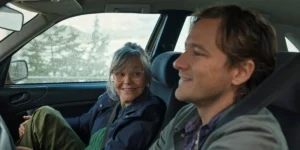



The Jeonju International Film Festival (JIFF), a celebrated platform for auteur cinema, provided the ideal backdrop for an in-depth exploration of the nuanced work of South Korean director Kim Jong-kwan. With a career spanning over two decades, Kim has cultivated a reputation for his quiet yet emotionally resonant storytelling, a characteristic particularly evident in his latest offering, "Frosted Window." Premiering at JIFF ahead of its theatrical release, the film has already garnered significant attention. Adding another layer to the festival’s programming, Kim’s 2016 film, "Worst Woman," was also screened, creating a compelling thematic dialogue between his earlier and current works.
Kim Jong-kwan’s filmography is marked by a distinctive sensibility, a contemplative approach that has earned him considerable affection in his home country. Among his most acclaimed works are his recent contribution to the anthology film "The Killers," alongside fellow directors Roh Deok, Lee Myung-se, and Chang Hang-jun; the intimate 2016 drama "The Table"; and his poignant Korean remake of Isshin Inudo’s "Josee, the Tiger and the Fish," retitled "Josee" and starring Han Ji-min and Nam Joo-hyuk. This consistent exploration of human connection and introspection solidifies his position as a significant voice in contemporary cinema.
"Frosted Window" and the Echoes of Seochon
The 27th edition of the Jeonju International Film Festival served as a pivotal moment for Kim Jong-kwan, not only showcasing "Frosted Window" but also offering audiences a chance to revisit "Worst Woman." This juxtaposition allowed for a deeper understanding of his directorial evolution and recurring thematic interests.
In an exclusive interview conducted following the screening of "Frosted Window" and a sneak peek at his upcoming project, tentatively titled "Day and Night," Kim Jong-kwan elaborated on the intrinsic connections between these films. "Both films are set in the same place, Seochon, and both use a one-day story structure," he explained. "There is a ten-year gap between them. I feel like ‘Frosted Window’ is a kind of novel written by the protagonist of ‘Worst Woman.’ Or rather, I felt like I was remaking the themes I had explored in that earlier film, revisiting them, taking them somewhere new." This sentiment suggests a continuous artistic dialogue with his own past work, a self-reflection that enriches his evolving narrative tapestry.
The choice of Seochon, a historic neighborhood in Seoul, is not arbitrary. Kim Jong-kwan resides in the area, and his deep familiarity with its streets, cafes, and ambiance is palpable in his filmmaking. This intimate knowledge allows him to imbue his settings with an authentic, lived-in quality, eschewing conventional set design for a more organic integration of environment and narrative. "I live in Seochon, the neighbourhood where the film is set. I know these streets very well, I walk them every day, I have my coffee in those cafés," Kim shared. "I didn’t decorate or alter the spaces at all. I just tried to match each space to the character of its episode." This method emphasizes a collaborative process between location and character, where the environment itself becomes an active participant in the unfolding story.
The Architecture of Time: Episodic Narratives and the Passage of Seasons
A defining characteristic of "Frosted Window" is its meticulously crafted episodic structure, a design choice that reflects Kim’s deliberate approach to storytelling. "I gave myself one rule: each episode had to take place within a single day," he stated, outlining the foundational constraint that guided the film’s architecture. "That constraint was the starting point, and the episodes grew from there. I wanted to write about people wandering through Seochon with no clear destination, just drifting, making mistakes. I didn’t want to judge them by any standard, I just wanted to let them be imperfect, and let the audience observe and feel something for themselves." This non-judgmental stance invites viewers to engage with the characters on a more personal level, fostering empathy and introspection.
The role of seasons within this structure is subtle yet significant. While the one-day constraint is paramount, the progression of seasons—from spring to autumn in "Frosted Window"—provides a broader temporal context, underscoring the cyclical nature of life and experience. "The seasons are not what drive the episodes, what matters is that each story happens in one day," Kim clarified. "The work is still structured around the idea that something may feel huge at first, but when you step back, it is rather quite small. Spring came first as an introduction, then autumn, but the emotional weight always comes back to the intimacy of a single day." This approach highlights Kim’s focus on the profound emotional resonance found within the seemingly ordinary confines of a single day.
Post-Pandemic Reflections and the Quiet Persistence of Life
The global pandemic has undeniably reshaped individual perspectives and artistic expression. For Kim Jong-kwan, "Frosted Window" holds particular significance as his first film to be both shot and released after the widespread disruption. "This is actually the first film I both filmed and released after the pandemic, what came out before was shot earlier," he confirmed. "The pandemic changed a lot in me. I wanted to hold two things at the same time in this film: the quietness and dailiness of ordinary life, and the awareness of everything we lost. Both are true. We still have to keep going." This duality—acknowledging loss while embracing the resilience of everyday existence—is a powerful undercurrent in the film, resonating with audiences who have navigated similar emotional landscapes. The film’s emphasis on quiet contemplation and the enduring rhythms of daily life can be seen as a direct response to the profound shifts brought about by the pandemic, offering solace and a sense of continuity.
The Intricacies of Creation: Set Design, Collaboration, and Character Development
Kim Jong-kwan’s involvement in "Frosted Window" extended beyond directing, encompassing set design and editing, reflecting a more independent and hands-on approach to filmmaking. "Because the film is so minimal in structure and style, I ended up taking responsibility for almost everything," he admitted. "I shot the opening sequence myself, handled the set design, and was deeply involved in the editing. It’s a more independent film than anything I’d made before, in a way that felt like a new challenge." This holistic involvement allowed him to meticulously control the visual and emotional tone of the film, ensuring a cohesive artistic vision.
His directorial process emphasizes a collaborative relationship with his actors, particularly in developing the emotional depth of his female characters, a recurring motif in his work. "I think it’s because the literature, novels, and films that have shaped me tend to tell stories from a female perspective," Kim explained when asked about his affinity for these characters. "That’s just what I’ve gravitated toward and been influenced by, and it became the natural way I work." He prioritizes allowing actors the space to inhabit their roles organically. "My scripts do not contain a lot of detailed acting directions. I write the dialogue, but I do not overdescribe facial expressions or gestures." This approach fosters a deeper connection between actor and character, encouraging personal interpretation and nuanced performance. "I want the actors to understand the characters and analyze them for themselves," he added. "For example, if a character says ‘yes,’ I do not specify whether that is a smiling yes, a sad yes, or a neutral yes. That means the actor has to imagine the character, study the role, and interpret it. In that sense, the character is created together by the director and the actor."
Rehearsals are approached with flexibility, tailored to the specific needs of each project. "It depends on the project. Sometimes I need very detailed rehearsals, almost like preparing a short play. But sometimes I do not," Kim said. For "Frosted Window," the process was largely improvisational. "For ‘Frosted Window,’ we did not rehearse much. We met on set, had a short conversation before shooting, and then started." An exception was made for Bora, Jeon So-young, in her first acting role. "One exception was Bora, Jeon So-young, who appears in the second episode. It was her first acting role, so of course she needed more preparation. She was still very new at the time, but now she is famous! We spent time talking about the character and helping her understand it. Rather than rehearsing in a formal way, we focused on helping her enter the character."
Echoes of Jarmusch and the Philosophy of Inyeon
The director’s upcoming film, "Day and Night" (working title), continues this exploration of intimate, character-driven narratives. "It is a very simple film, centered on one café and one conversation. It is a different style, closer to a short play," Kim described. The Korean title, translating to something akin to "Day and night for each other," hints at the film’s thematic focus on mutual presence and shared experience.
The comparison to American filmmaker Jim Jarmusch, particularly his works like "Coffee and Cigarettes" and "Broken Flowers," is a natural one, a sentiment Kim readily acknowledges. "Yes, I love him. I can understand the comparison. It is a very similar kind of project in some ways. I was also inspired by ‘Broken Flowers,’" he stated. However, he emphasizes the importance of individual artistic voice. "Of course, the way I make films is very different from Jarmusch’s, but I think there are a few similar elements. Still, I think the most important thing is to find your own way. If you love something, the best approach is to pay tribute to it while still discovering your own path."
A concept that permeates Kim Jong-kwan’s cinema, and which has gained recent international recognition through Celine Song’s "Past Lives," is the Korean notion of inyeon (인연). This complex idea, referring to the ties of fate or destiny that connect people across lifetimes, is central to his artistic philosophy. "Even for Koreans, inyeon is very hard to explain in words. You just feel it," Kim explained. He likens his filmmaking approach to poetry, where meaning is layered and open to individual interpretation. "I didn’t use a conventional narrative structure in this film: I wanted to make something closer to poetry. In a poem, a single word can carry many layers of meaning at once, and I wanted my film to work the same way: the same event, understood differently by each viewer." The title "Frosted Window" itself serves as a metaphor for this layered understanding. "A frosted window may not give you a perfectly clear image right away, but the closer you look, the more layers you can discover. Inyeon is the same kind of word. It’s layered and resistant to clarity. Very poetic. I like to make films that way, open enough that each person can bring their own understanding to them."
Capturing the Fleeting Human Moment
Kim Jong-kwan’s cinema is characterized by its focus on subtle emotional transitions, fleeting gestures, and moments of quiet self-recognition rather than overt dramatic climaxes. "I wanted to capture the very small moment when a character finds something within themselves, a kind of self-recognition, or likeness," he shared. "In Seochon, these people are just wandering around. I’m not interested in how they overcome their problems or change. I just want to observe how they encounter themselves, and I want the audience to observe alongside them and form their own interaction with what they see." This approach invites active participation from the viewer, transforming the act of watching into an interpretive journey. "I like it when the audience feels invited to participate, almost as if they are putting together a puzzle. And I also think it is important that my approach to the characters is never judgmental."
The Unfolding Questions of a Cinematic Journey
The continuity within Kim Jong-kwan’s filmography is not a matter of repetition but of an evolving curiosity. "I’m not a person who is drawn to dramatic change. From the outside, it might look like I’m always doing similar things. But inside, I struggle deeply with every film," he admitted. "When I finish one, a new question appears, and I follow that question." He cites the example of how the process of making "The Table" led to a deeper inquiry into the act of listening, which in turn informed his subsequent film, "Shades of the Heart." "For example: while making ‘The Table,’ I became curious not about the conversation itself, but about how people listen to a conversation. That curiosity became the next film, ‘Shades of the Heart.’ One question leads to the next." This iterative process fuels his creative drive, allowing him to explore complex human experiences with increasing depth and nuance.
Looking ahead, Kim Jong-kwan is engaged in two significant projects: a Japanese film that continues his exploration of creative curiosity and a new seasonal film project, moving from summer into autumn. He expresses a desire to establish these seasonal films as a signature series. "After ‘Frosted Window,’ I’ve been working on two things. One is a Japanese film, I went to Japan to shoot it, and it’s a continuation of my curiosity as a creator. The other is a new seasonal film, picking up from summer through to autumn. I’d like this kind of seasonal project to become something of a signature for me, a series I can return to and keep building." This ambition underscores his commitment to developing a distinct cinematic language that evolves organically over time, inviting audiences to join him on his ongoing journey of discovery. The Jeonju International Film Festival, with its commitment to showcasing such thoughtful and personal cinematic visions, has once again provided a vital platform for directors like Kim Jong-kwan to share their profound insights with the world.