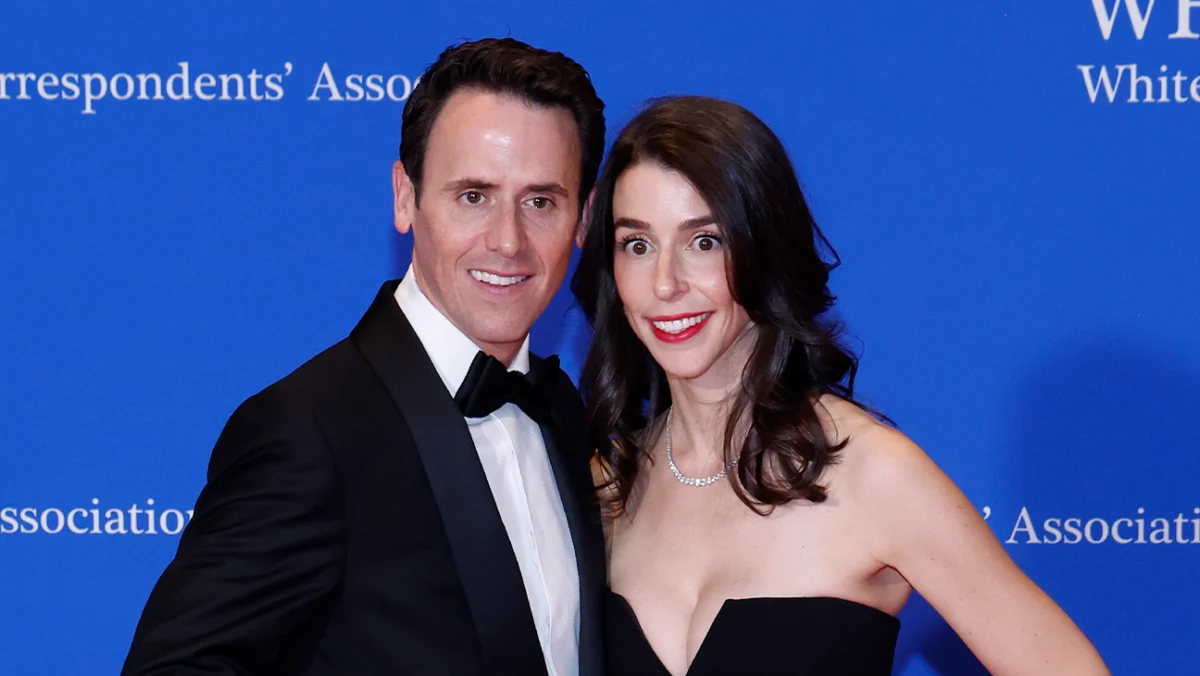
The glittering spectacle of the White House Correspondents’ Association Dinner, an annual convergence of media, politics, and celebrity, was abruptly shattered on Saturday night by a violent security breach, moments after mentalist Oz Pearlman performed a seemingly innocent magic trick for President Donald Trump, First Lady Melania Trump, and White House press secretary Karoline Leavitt. The surreal juxtaposition of a moment of lighthearted wonder giving way to chaos and terror underscored the fragility of high-profile public events and the ever-present shadow of security threats. Pearlman, a renowned mentalist and the evening’s host, found himself at the epicenter of this extraordinary sequence, revealing later the name he had divined for Leavitt’s unborn daughter just as shots rang out, transforming a celebratory occasion into a scene of panic and rapid evacuation.
The White House Correspondents’ Dinner: A Tradition of Unity and Critique
Held annually at the Washington Hilton, the White House Correspondents’ Association Dinner (WHCD) is one of Washington D.C.’s most anticipated events. Established in 1914, the association’s primary mission is to promote and protect the interests of White House journalists, advocate for access to the presidency, and raise money for journalism scholarships. The dinner itself, often dubbed "Nerd Prom," serves as a unique platform where the President, members of the administration, journalists, and Hollywood celebrities gather, typically marked by humorous speeches, self-deprecating jokes, and an underlying sense of mutual respect, despite the often adversarial nature of their daily interactions. For decades, it has been a symbol of the First Amendment and the robust, if sometimes strained, relationship between the press and the presidency.
The 2019 dinner, like its predecessors, promised an evening of camaraderie and a brief respite from the often contentious political landscape. Attendees, ranging from seasoned correspondents to network executives and a smattering of film and television personalities, filled the grand ballroom, anticipating the traditional roast and the rare sight of political rivals sharing a laugh. Security for such an event, especially with the President of the United States in attendance, is always paramount, involving multiple layers of Secret Service, local law enforcement, and private security contractors. Access to the venue is meticulously controlled, with guests undergoing rigorous screening, and the presidential motorcade subject to extensive protective measures.
A Trick Interrupted: The Unfolding Chronology
The evening’s early proceedings were typical of the WHCD. Attendees mingled, exchanged pleasantries, and settled into their seats, anticipating the program. Oz Pearlman, known for his captivating mentalist performances, was slated to host, bringing a unique blend of entertainment to the political gathering. Backstage, prior to the formal program, Pearlman had a casual but intriguing encounter with Karoline Leavitt, the White House press secretary, who was pregnant and expecting her daughter the following week. During their conversation, Leavitt playfully challenged Pearlman, asking if he could divine the name she had chosen for her unborn child. Pearlman, a father himself, agreed to the challenge, suggesting they save the reveal for the main stage, adding an element of suspense to the night’s entertainment. This impromptu interaction set the stage for a moment of personal connection amidst the formal proceedings.
As the dinner progressed, Pearlman made his way to the dais, where President Donald Trump and First Lady Melania Trump were seated alongside other dignitaries. Approaching the presidential table, Pearlman began to perform the mentalism trick he had promised Leavitt. He reportedly engaged Leavitt in a focused exchange, attempting to guess the name letter by letter, while the President and First Lady watched with discernible interest. This interaction was captured on camera, showing Pearlman presenting a mysterious piece of paper, presumably with his guess, to the group. As First Lady Melania Trump leaned in, her expression shifting to one of surprise, exclaiming, "Oh! Is that the name?" the atmosphere was charged with anticipation, a brief, lighthearted interlude in the evening’s schedule.
It was precisely at this climax, as Leavitt was poised to confirm or deny Pearlman’s astonishing guess, that the celebratory veneer of the dinner was violently stripped away. A sudden eruption of gunfire pierced the ballroom’s festive murmur. Attendees described a moment of collective confusion quickly giving way to instinctual terror. The President, First Lady, and other officials on the dais, including Leavitt and Pearlman, immediately ducked to the ground, seeking cover behind the substantial banquet table. Within seconds, Secret Service agents, trained for such contingencies, moved with lightning speed, physically securing President Trump and First Lady Melania Trump and rushing them out of the ballroom, evacuating them from the immediate threat. The organized chaos of the evacuation, captured by multiple cell phone cameras and broadcast footage, highlighted the swift activation of presidential protection protocols.
The Breach: Suspect, Motive, and Official Response
The source of the gunfire was quickly identified as 31-year-old Cole Tomas Allen. According to initial reports and subsequent official statements, Allen reportedly charged through a security checkpoint at the Washington Hilton, gaining unauthorized access to the ballroom. He was armed with multiple weapons, though the exact number and types were not immediately specified beyond being described as "multiple firearms." The rapid deployment of security forces, including Secret Service agents and local law enforcement, led to a confrontation with Allen. During the ensuing struggle, an officer was reportedly shot, though their life was saved by a ballistic vest, a testament to the effectiveness of modern protective gear and the immediate response of security personnel. The quick containment of the suspect prevented further casualties within the densely populated ballroom, though the psychological impact on the thousands present was undeniable.
U.S. Attorney Jeanine Pirro later addressed the media, confirming that Cole Tomas Allen would face severe charges. These included, but were not limited to, using a firearm during a crime of violence and assaulting a federal officer with a dangerous weapon. Pirro indicated that "many more charges" were likely to follow as the investigation unfolded, suggesting a comprehensive legal pursuit for the grave breach of security and the direct threat to the President and other high-ranking officials. President Trump, speaking at a separate news conference at the White House following his safe return, confirmed the officer’s injury and the protective role of the bulletproof vest, expressing gratitude for the swift action of his security detail. The incident immediately triggered a high-level review of security protocols for all presidential events, particularly those in public venues with large gatherings.
The Post-Chaos Revelation: "Vivian"
In the immediate aftermath of the evacuation and the stabilization of the scene, amidst the lingering tension and the palpable shock, ABC News chief Washington correspondent Jonathan Karl caught up with Oz Pearlman. The mentalist, still reeling from the sudden turn of events, recounted the details of the trick, confirming what had transpired just before the gunfire. He revealed the name he had written on the paper, the name Leavitt was about to confirm. "I believe the name is Vivian," Pearlman stated to Karl, adding, "So yeah, that’s what I guessed." Leavitt, having been safely escorted away, later granted Pearlman permission to share the name, completing the story of a trick that was both spectacular and tragically unfinished in its original context. The reveal, while small in the grand scheme of the security breach, provided a poignant human detail to an otherwise terrifying event, a small piece of normalcy salvaged from chaos.
Broader Implications and Enduring Questions
The shooting at the White House Correspondents’ Dinner carries significant implications for event security, presidential protection, and the symbolic future of the dinner itself. The breach, despite the immediate and effective response of security forces, exposed a vulnerability in the layers of protection surrounding the President at a public gathering. It will undoubtedly lead to an exhaustive review and potential overhaul of security protocols for all high-profile events in Washington D.C., particularly those attended by the Commander-in-Chief. This could include stricter access controls, enhanced screening technologies, and a re-evaluation of venue choices for such gatherings. The incident serves as a stark reminder that even the most secure environments can be targeted, necessitating constant vigilance and adaptation of protective measures.
For the White House Correspondents’ Association, the incident raises questions about the future format and location of their annual dinner. While the event is a cherished tradition, the inherent risks associated with gathering thousands of prominent individuals, including the President, in a large, accessible venue may prompt a re-evaluation. Balancing the desire for a public, interactive event with the absolute necessity of presidential security will be a critical challenge. There might be calls for smaller, more controlled gatherings, or even a move to a more secure, government-controlled venue, potentially altering the character of the dinner.
Beyond the immediate security and logistical concerns, the event leaves a lasting psychological impact on all who were present. The sudden shift from a festive, lighthearted atmosphere to one of terror and the immediate threat of violence is a traumatic experience. For Oz Pearlman, the mentalist, the memory of his triumphant reveal being interrupted by gunfire will undoubtedly be indelible. For Karoline Leavitt, the moment her daughter’s name was guessed will forever be intertwined with the terrifying sound of gunshots. The incident serves as a sobering reminder of the ever-present threats in an increasingly polarized world, where even moments of shared celebration can be shattered by acts of violence. The WHCD, designed to foster dialogue and understanding, became a testament to the unpredictable nature of security challenges and the enduring resilience required to navigate them.