


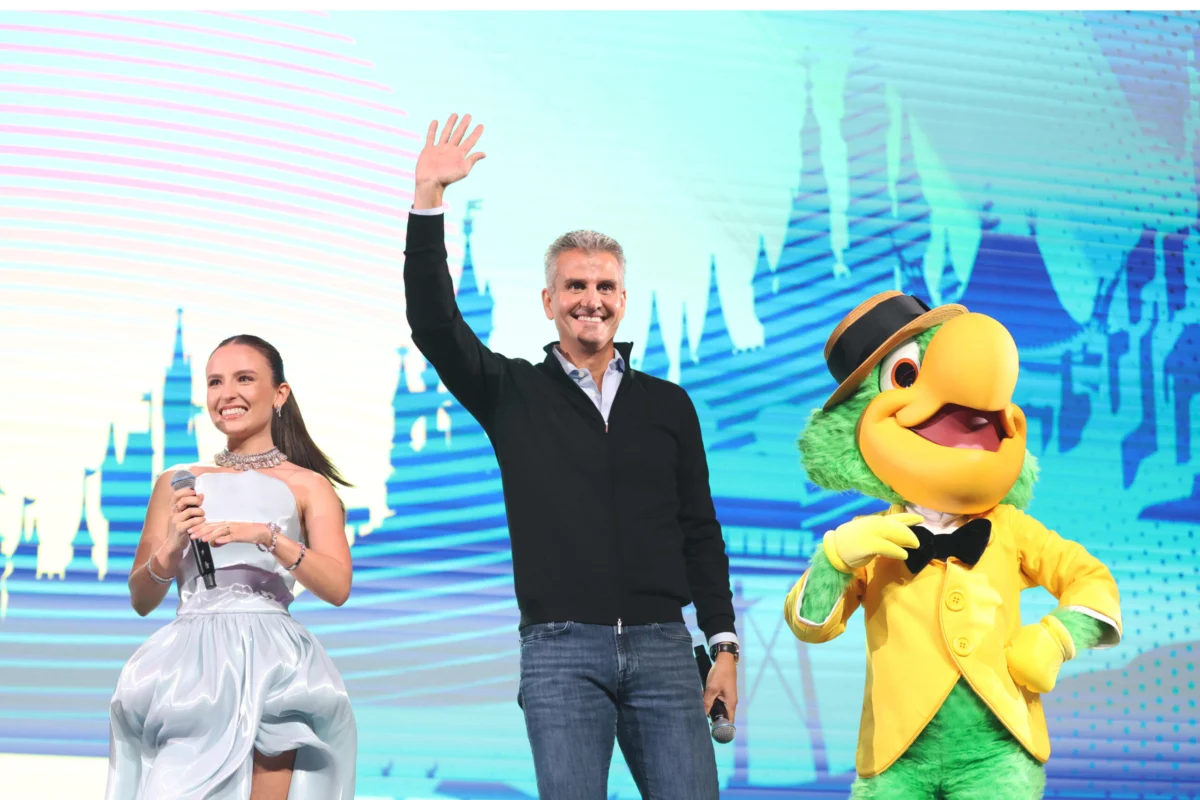
The Walt Disney Company entered a pivotal new era on Wednesday as Josh D’Amaro officially took the helm as Chief Executive Officer, succeeding Bob Iger during the company’s annual shareholder meeting. The transition marks the conclusion of a multi-year leadership search and the start of a chapter focused on technological integration and the "One Disney" philosophy. D’Amaro, a 28-year veteran of the company who most recently served as Chairman of Disney Experiences, inherits a global entertainment empire that is currently navigating a complex landscape of shifting consumer habits, intense streaming competition, and a volatile stock market.
The formal handover occurred following an announcement in early 2026, ending a period of intense speculation regarding who would lead the century-old institution. Iger, who served as CEO for two separate stints totaling two decades, will remain with the company as a senior advisor and board member until his final retirement on December 31, 2026. In his final remarks to shareholders, Iger characterized the transition as a necessary step for the company’s long-term health, expressing "absolute confidence" in D’Amaro’s ability to navigate the digital-first future of media.
A Legacy of Leadership and the Path to Succession
The road to D’Amaro’s appointment has been a subject of significant scrutiny within the entertainment industry and on Wall Street. The succession saga began in earnest in 2020 when Iger initially stepped down, naming Bob Chapek as his successor. However, Chapek’s tenure was marked by internal friction, legal battles, and a pandemic-strained economy, leading to Iger’s unexpected return in November 2022. Iger’s second term was explicitly focused on restructuring the company, achieving profitability in the streaming sector, and finding a permanent successor.
D’Amaro emerged as a frontrunner due to his highly successful management of the Disney Experiences division. Under his leadership, the division—which encompasses theme parks, cruise lines, resorts, and consumer products—became the primary engine of Disney’s financial growth. His ability to maintain high margins and guest satisfaction while overseeing massive capital investments, such as the $60 billion expansion plan for parks and cruises over the next decade, solidified his standing with the board of directors.
In his first official memo to employees as CEO, D’Amaro acknowledged the weight of the role. "As I step into the CEO role today, I am humbled and honored to help write the next chapter of this company alongside this team," he wrote. He noted that while the pace of global change can feel "daunting," it presents an "exciting" opportunity for innovation.
Financial Landscape and Market Performance
Despite the internal stability brought by the clear succession plan, D’Amaro faces immediate pressure from the financial sector. Disney’s stock has faced headwinds, trading down more than 10% year-to-date as of early 2026. Analysts attribute this performance to broader concerns regarding the decline of linear television and the high costs associated with maintaining a dominant position in the streaming market.
However, the company’s recent quarterly earnings provided a foundation of optimism. Disney’s streaming business, led by Disney+ and Hulu, has reached consecutive quarters of profitability—a feat that many industry peers are still struggling to achieve. The integration of Hulu into the Disney+ app is expected to be finalized later this year, a move D’Amaro described as creating a "digital centerpiece" for the company. This consolidation is aimed at reducing churn and increasing the average revenue per user (ARPU) by offering a more comprehensive content library.
In the theatrical space, Disney reclaimed its position at the top of the box office in 2025. Following a period of underperformance, the company saw a resurgence with hits such as the live-action "Lilo & Stitch," "Zootopia 2," and the latest installment of the "Avatar" franchise. These successes have reaffirmed the value of Disney’s intellectual property (IP) and its ability to drive revenue across multiple platforms, from cinema screens to theme park attractions.
The Three Pillars of the D’Amaro Era
During the shareholder meeting, D’Amaro outlined three strategic priorities that will guide his tenure: creative excellence, technological innovation, and a unified operational structure known as "One Disney."
1. Storytelling as the North Star
D’Amaro emphasized that "great storytelling and creative excellence" would remain the company’s primary focus. He signaled a commitment to taking "smart risks" in content creation, moving away from a reliance on existing franchises to foster new original stories. This is particularly evident in Disney’s international strategy, which recently saw the release of seven original series produced outside the United States, aimed at capturing growth in emerging markets.

2. Technological Integration and AI
The new CEO underscored the necessity of embracing technology to unlock new possibilities. Disney is increasingly looking toward artificial intelligence and augmented reality to enhance guest experiences in parks and personalize content delivery on streaming platforms. D’Amaro’s vision involves using technology not just as a tool for efficiency, but as a medium to create more immersive and interactive storytelling environments.
3. The "One Disney" Philosophy
Central to D’Amaro’s strategy is the "One Disney" approach, which seeks to break down silos between the company’s various divisions. By aligning the creative units, the sports division (ESPN), and the experiences segment, the company aims to create a seamless ecosystem. For instance, a successful film release can be immediately leveraged through merchandise, themed park expansions, and exclusive streaming content, maximizing the lifecycle of every piece of IP.
Global Expansion and the "Experiences" Engine
The theme parks and resorts division remains the cornerstone of Disney’s financial health, and D’Amaro’s expertise in this area is expected to drive further global expansion. A major highlight of this strategy is the development of a new theme park and resort in Abu Dhabi, United Arab Emirates. This move represents a significant push into the Middle Eastern market, following the successful models of Disney’s parks in Shanghai and Hong Kong.
Domestically, the company is moving forward with "historic investments" in its existing properties. This includes the expansion of the Disneyland Resort in California, which celebrated its 70th anniversary in 2025, and major updates to the Magic Kingdom and Animal Kingdom at Walt Disney World in Florida. These investments are designed to stave off competition from Universal Destinations & Experiences, which has been aggressively expanding its own footprint.
Industry Reactions and Analyst Perspective
The reaction from industry analysts has been largely constructive, though many remain cautious. "Josh D’Amaro is a known quantity who understands the Disney culture and the importance of the brand’s physical touchpoints," said one senior media analyst. "The challenge will be whether he can apply that same magic to the rapidly evolving media and ad-tech landscape, which is far more volatile than the theme park business."
Peer companies in the media space have also taken note. During his remarks, D’Amaro acknowledged the ongoing consolidation in the industry, citing recent deals and mergers among competitors. He asserted that "Disney is in a category of one," suggesting that the company is more likely to focus on internal innovation rather than large-scale acquisitions in the immediate future.
Internal Culture and the Employee Memo
To the thousands of "Cast Members" and employees worldwide, D’Amaro is seen as a charismatic and approachable leader. His internal memo drew on personal nostalgia, recalling his first trip to Disneyland more than 40 years ago and the "joy" of riding Peter Pan’s Flight with his father. This personal touch is a hallmark of his leadership style, aimed at boosting morale following years of corporate restructuring and layoffs.
He praised Bob Iger for leading with "vision, ambition, integrity, and optimism," and committed to maintaining that spirit. "It is a privilege to follow in his footsteps and lead this team, and I do so with a deep sense of responsibility and excitement about our future," D’Amaro told employees.
Looking Ahead: The Challenges of 2026 and Beyond
As D’Amaro settles into the CEO suite at Disney’s Burbank headquarters, several hurdles remain on the horizon. The transition of ESPN to a fully direct-to-consumer model is a high-stakes gamble that will test the company’s ability to migrate traditional sports fans to digital platforms. Additionally, the company must continue to navigate the political and regulatory environments in the various countries where it operates.
The legacy of Bob Iger looms large, but the D’Amaro era represents a shift toward a leader who is deeply rooted in the operational and experiential side of the business. With a clear focus on the "One Disney" strategy and a massive capital investment plan underway, the company is betting that D’Amaro’s blend of operational discipline and creative passion is the right formula to navigate the next century of Disney magic.
The eyes of Wall Street and the global audience will be on the company’s next quarterly report, which will serve as the first financial scorecard for the D’Amaro administration. For now, the transition appears to be a calculated move toward stability and growth in an era of unprecedented industry disruption.