The 2025 edition of CPH:DOX, the Copenhagen International Documentary Film Festival, has reaffirmed its standing as a premier global forum for non-fiction cinema, balancing high-concept aesthetic ambition with rigorous political mediation. As the third-largest documentary festival in the world, CPH:DOX continues to serve as a critical barometer for the industry, showcasing over 200 films that navigate the increasingly blurred lines between journalism, art, and activism. This year’s programming arrived at a moment of heightened geopolitical instability, characterized by the expansion of regional conflicts and a shifting international order, prompting a selection that prioritizes both the "rough digital immediacy" of modern reporting and the "exalted visual registers" of traditional cinematography.
Geopolitical Context and the Opening Selection
The festival commenced with the world premiere of Facing War, directed by Tommy Gulliksen. The documentary offers a rare, behind-the-scenes look at the Russo-Ukrainian war through the lens of Jens Stoltenberg’s final year as NATO Secretary General. While the film faced some scrutiny for its perceived caution regarding the intricacies of high-level political lobbying, its debut coincided with a period of profound anxiety regarding the future of European security alliances. The timing underscored CPH:DOX’s reputation for selecting "uniquely well-timed" content that mirrors current headlines.
Facing War serves as a continuation of the festival’s commitment to documenting the Ukrainian crisis. Since the full-scale invasion in February 2022, CPH:DOX has consistently utilized its opening slot to highlight the human and structural costs of the conflict. By focusing on the administrative and diplomatic maneuvers within NATO headquarters, Gulliksen provides a counter-narrative to the visceral frontline footage that has dominated news cycles, offering a study of institutional resilience under duress.
Aesthetic Rigor on the Frontlines: The Case of Mariinka
While many contemporary war documentaries rely on the portability and speed of digital technology, Pieter-Jan De Pue’s Mariinka represents a significant departure in form and methodology. Filmed over a decade in the Donbas region, specifically around the small city of Mariinka—which fell under full Russian occupation in early 2024—the film utilizes 16mm celluloid to document the lives of orphaned children and young soldiers.
De Pue, known for his 2016 Sundance-winning film The Land of the Enlightened, employs a "celluloid dreamlike fable" approach. By choosing 16mm over digital, De Pue sacrifices mobility for a "visceral force" and a texture that grants a sense of timeless dignity to his subjects. The film follows characters like Natascha, a young paramedic whose lyrical narration guides the viewer through trenches and active combat zones. Industry analysts note that Mariinka highlights a growing trend in documentary filmmaking where the "aesthetic register" is used not to sanitize war, but to provide a more profound, surreal expression of its reality. The film’s ability to remain "visually immaculate while relentlessly graphic" marks it as a standout in the 2025 competition.
Humanizing the Crisis: Award-Winning Narratives from China
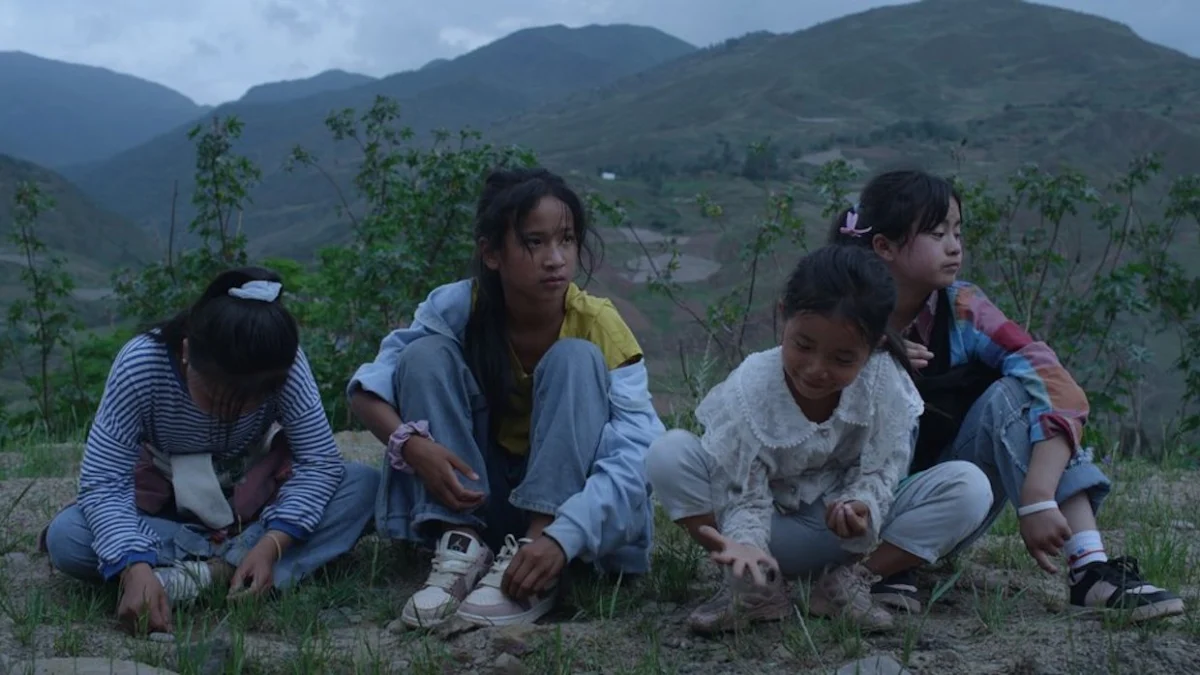
The festival’s top honor was awarded to Whispers in May, directed by Dongnan Chen. The film exemplifies the "character-driven, sensitive documentary" style that defined much of the 2025 selection. Set in the Liangshan Mountains of China, the film follows fourteen-year-old Qihuo and her friends as they navigate the transition to adulthood in a region marked by economic migration and traditional patriarchal structures.
Chen utilizes a method she describes as "improvised fiction," a hybrid technique that blends documentary observation with narrative pacing. The film addresses the phenomenon of "left-behind children" in rural China—a demographic estimated by the Ministry of Civil Affairs to include over 6 million children whose parents have migrated to urban centers for work. Through the lens of a coming-of-age road trip, Whispers in May explores the transactional nature of marriage and the pressure on young women to enter factory labor. The film was praised by the jury for its "lyrical celebration of innocence" and its persistent, attentive camerawork that grants its young subjects a sense of agency and distance.

The Global Surveillance Machine: Data and Border Control
In contrast to the intimate portraits of Mariinka and Whispers in May, Kenya-Jade Pinto’s debut feature, The Sandbox, offers a macro-level investigation into the "global surveillance machine." The film tracks the deployment of AI, drones, and robotics in managing migration at the borders of North America, Europe, and Africa.
According to data from Allied Market Research, the global border security market is projected to reach $70 billion by 2027, driven largely by the integration of "smart border" technologies. The Sandbox posits that these zones of patrol have become "profitable trial grounds" where human lives are reduced to test cases for invasive technology. Formally, the film utilizes thermal imaging and drone perspectives to mirror the "inhuman gaze" of state surveillance. While some critics noted that the film’s vast geographic scope occasionally sacrificed depth for breadth, its "harrowing unease" serves as a stark warning about the erosion of human rights in the name of technological efficiency.
Forensic Aesthetics and Historical Memory
The intersection of technology and justice was further explored in Manuel Correa’s Atlas of Disappearance. A member of the Forensic Architecture research agency, Correa spent eight years documenting the efforts of families to locate the remains of citizens disappeared during the Franco dictatorship in Spain.
The historical context is significant: it is estimated that over 114,000 people remain missing from the Spanish Civil War and the subsequent regime, making Spain the country with the second-highest number of disappeared persons in the world, after Cambodia. Correa’s film details the use of 3D reconstructions and digital mapping to bypass bureaucratic obstruction. The film argues that "bones carry a particular symbolic weight" from which truth cannot be erased. By presenting evidence in a "cultural forum" like CPH:DOX, Correa expands the definition of legal proof, positioning the filmmaker as a critical actor in the pursuit of historical justice.
The Evolution of Social Experiments: Christiania
Representing the local Danish context, Karl Friis Forchhammer’s Christiania provides a historical and contemporary analysis of the eponymous freetown in Copenhagen. Founded in 1971 by anarchists and idealists in a former military barracks, Christiania has long been viewed as a utopian experiment in consensual democracy.
Forchhammer’s documentary eschews "didactic nostalgia," instead focusing on the "inconvenient cracks" in the community’s history, including issues with organized crime and the commercialization of the district. The film incorporates rare archival footage and animated sequences to depict the "local legend" of the community. In the context of the 2025 festival, Christiania serves as a reflection on the "limits of total tolerance." As the Danish government moves toward more traditional urban development for the area, the film functions as both an ode to a radical vision and a "warning of increasingly dystopian times" where open dialogue is increasingly suppressed.
Chronology of the 2025 Edition
- March 13: Festival opening with the premiere of Facing War.
- March 15-18: International competition screenings, including Mariinka and The Sandbox.
- March 19: Special forum on Forensic Architecture and the screening of Atlas of Disappearance.
- March 21: Award ceremony; Whispers in May receives the DOX:AWARD.
- March 23: Closing screenings and industry wrap-up.
Broader Impact and Industry Implications
The 2025 edition of CPH:DOX has highlighted several key shifts in the documentary landscape. First, there is a clear move toward high-production-value cinematography (such as the use of 16mm film) in conflict zones, suggesting that audiences are seeking more than just raw information; they are seeking "artful expressions" of complex realities. Second, the rise of "hybrid" or "improvised fiction" indicates a growing comfort with blending genres to reach deeper emotional truths.
Furthermore, the festival’s focus on surveillance and forensic technology reflects a broader societal concern with data privacy and state accountability. By providing a platform for films like The Sandbox and Atlas of Disappearance, CPH:DOX reinforces the role of the documentary filmmaker as an essential watchdog in the digital age. As the festival concludes, the consensus among participants is that the "familiar impulse to pair aesthetic ambition with political mediation" is no longer just a choice, but a necessity for the survival of the genre in a fractured global landscape.