

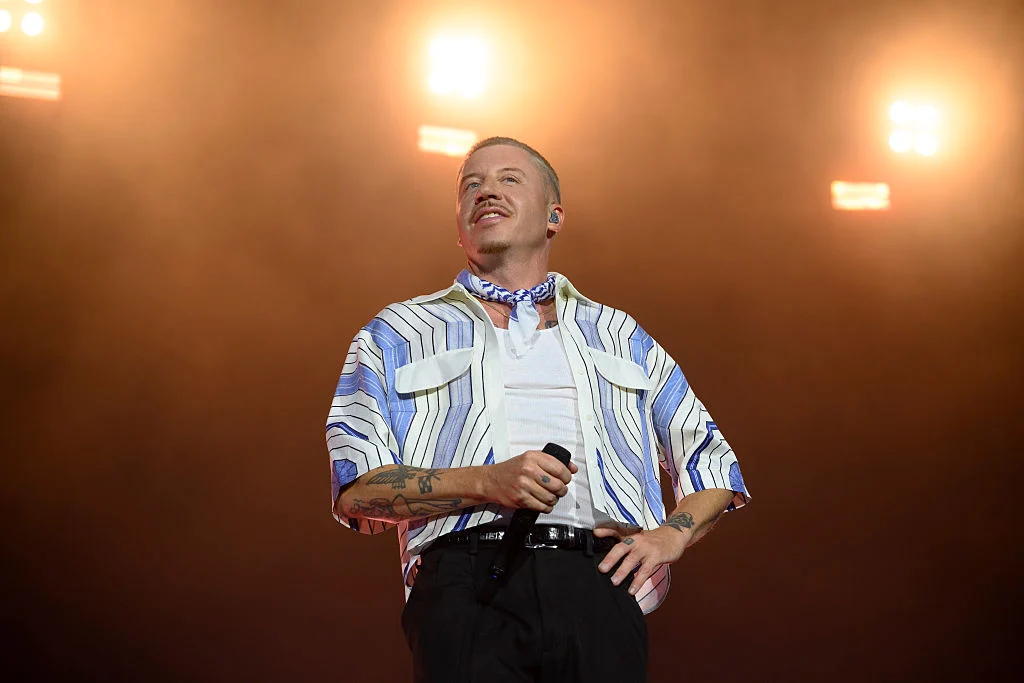
American rapper Macklemore returned to the live stage on Thursday, October 22, delivering an impassioned 17-song set at Colorado’s iconic Red Rocks Amphitheatre that demonstrated his unwavering commitment to political activism. The performance marked his first live appearance since a turbulent sequence of events in September, which saw him removed from Ed Sheeran’s global Loop Tour due to outspoken advocacy for Palestinian rights. Rather than tempering his rhetoric following corporate pushback and venue bans, the hip-hop artist used the high-profile platform to broaden his humanitarian critique, calling for international justice across several global conflict zones and domestic flashpoints.
The Red Rocks Address: A Broadening Humanitarian Message
During a deliberate pause in his Colorado performance, Macklemore addressed the sold-out amphitheater crowd, framing his advocacy not as partisan politics, but as a fundamental humanitarian obligation. Footage captured from the event shows the artist speaking directly to the audience about international suffering and marginalized communities.
"Being a human being in this moment is not complicated," Macklemore told the audience. "It is not political. It is human to have a heart, to watch others suffering and to say, ‘Not anymore!’ So I say, free Palestine. I say, free Palestine!"
Expanding beyond the Middle East, the rapper explicitly tied his message of liberation and equity to other geopolitical crises and domestic human rights concerns. "I say, free Sudan. I say, free Congo, Lebanon, to Haiti, to all the people that are affected by ICE in America, who are afraid to leave their houses," he continued, concluding with the sentiment that "the message will always be love."
Chronology of the Tour Controversy
The Red Rocks concert serves as a critical milestone in a rapidly escalating conflict between the artist’s political expression and corporate-managed live music infrastructure. The timeline of the dispute traces back to September, illuminating the friction between independent artist advocacy and commercial tour operations:
- Mid-September: Serving as a prominent opening act on Ed Sheeran’s Loop Tour, Macklemore utilized high-profile stadium dates at MetLife Stadium in New Jersey to perform his protest track "Hind’s Hall." Named after Hind Rajab, a six-year-old Palestinian girl killed in Gaza, the song was accompanied by graphic imagery from the conflict.
- Immediate Fallout: The performances drew sharp rebukes from advocacy organizations, including the Israeli-American Council. Shortly thereafter, tour promoters and venue owners intervened. The Messina Touring Group announced that several upcoming U.S. venues refused to host dates featuring the rapper.
- Venue Bans and Ownership Intervention: Robert Kraft, whose Kraft Group owns Gillette Stadium in Massachusetts, publicly confirmed that he had barred Macklemore from performing at the venue. Kraft cited rhetoric and imagery that he argued caused distress within the Jewish community.
- Ed Sheeran’s Response: Pop star Ed Sheeran released a statement clarifying that Macklemore’s removal was orchestrated entirely by promoters and venue executives rather than his own management. While praising Macklemore’s conviction, Sheeran defended his own preference for quiet diplomacy.
- Financial Retribution and Counter-Donations: In response to his removal, Macklemore pledged the entirety of his $1 million earnings from the Sheeran tour to humanitarian aid organizations supporting Palestinians. In a reciprocal move, Robert Kraft announced a subsequent $2 million contribution toward regional humanitarian efforts.
- Support Act Attrition: The controversy caused a broader ripple effect across the tour lineup. Supporting acts Finneas, Aaron Rowe, and Lukas Graham, alongside Sheeran’s backing band Beoga, withdrew from scheduled performances in solidarity or protest against the unfolding environment.
- Late October: Macklemore transitioned from support acts to headlining his own independently organized Free Palestine Tour, with sold-out dates scheduled across major European capitals, including Dublin, Paris, and London.
Streaming Surge and Commercial Impact
While the physical tour fallout presented significant logistical hurdles, data indicates that the public controversy catalyzed a dramatic increase in public consumption of Macklemore’s catalog. According to early metrics compiled by Luminate and reported by Billboard, the artist experienced an unprecedented surge in digital streaming metrics immediately following his removal from the MetLife Stadium concerts.

Between September 13 and September 15, official on-demand U.S. streams of Macklemore’s solo catalog escalated sharply from 282,000 to 767,000—marking a 172% increase in a 48-hour window. Furthermore, his broader catalog, which includes collaborative work with producer Ryan Lewis, nearly doubled, rising 97% from just over 1 million daily streams to nearly 2 million.
The most pronounced surge was recorded by the catalyst track itself, "Hind’s Hall." The protest anthem jumped from slightly more than 5,000 U.S. streams on September 13 to nearly 87,000 streams on September 15. Industry analysts noted that this represented the song’s largest single-day consumption total in more than two years, demonstrating that political friction can significantly elevate niche and protest-driven musical output in the digital marketplace.
Broader Implications for Live Music and Artist Activism
The clash between Macklemore and major tour promoters underscores a growing tension within the contemporary live entertainment industry. As artists increasingly leverage their global platforms to comment on contentious geopolitical matters, venue owners, corporate sponsors, and promoters face difficult decisions regarding liability, public relations, and audience safety.
Historically, mainstream pop and hip-hop acts have navigated political commentary with calculated ambiguity to protect commercial viability. Macklemore’s pivot toward direct, uncompromised activism—culminating in self-funded international dates where proceeds are channeled directly to grassroots aid organizations like the Gaza Soup Kitchen, Medical Aid for Palestinians, and the Palestine Children’s Relief Fund—suggests a viable alternative business model for artists willing to bypass traditional corporate tour structures.
Furthermore, the willingness of supporting acts to withdraw from Ed Sheeran’s tour indicates a growing solidarity among contemporary musicians regarding freedom of expression on stage. Observers note that this event may prompt promoters to draft more explicit conduct clauses or political neutrality agreements for future stadium-level bookings, fundamentally altering how major tours manage ideological friction.
Macklemore’s successful deployment of the Free Palestine Tour, alongside his continued defiance at Red Rocks, signals that the rapper intends to maintain his outspoken stance regardless of mainstream industry pushback. As his catalog metrics demonstrate strong commercial resilience amidst the controversy, the intersection of pop music, corporate stadium ownership, and international human rights advocacy remains an increasingly volatile frontier in modern entertainment.