
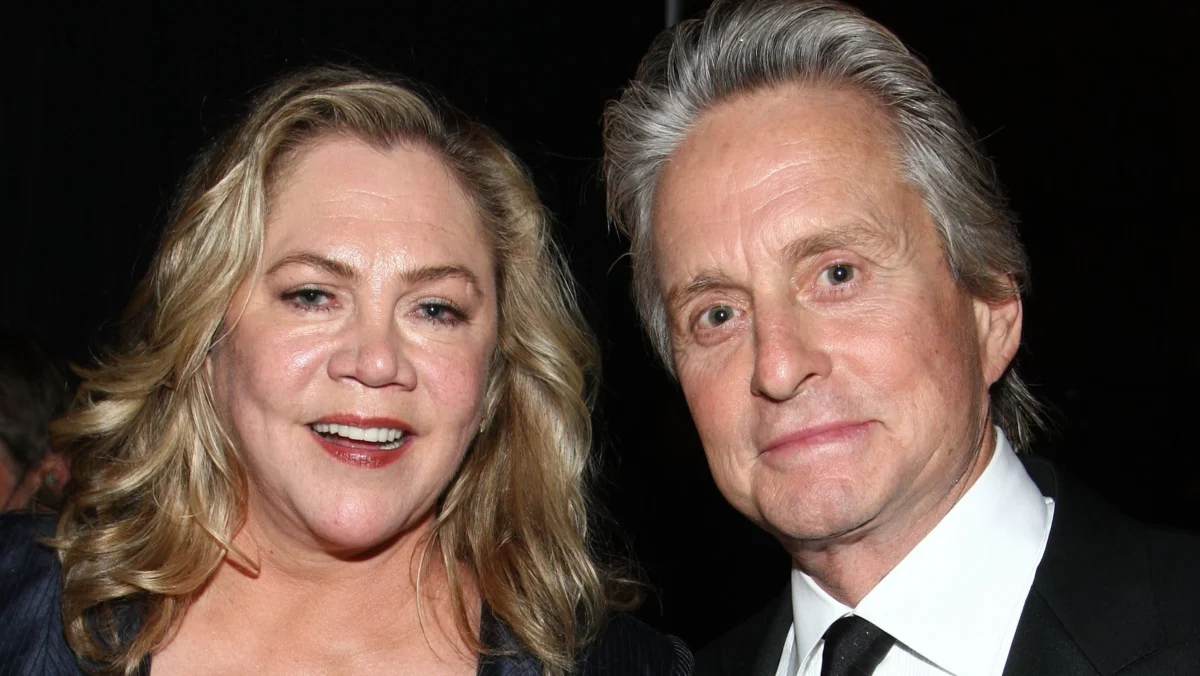
The cinematic history of Hollywood is replete with on-screen pairings that audiences have long suspected possessed a depth beyond the script. For four decades, the electric chemistry between Michael Douglas and Kathleen Turner—a hallmark of mid-1980s adventure and dark comedy—was dismissed by both parties as mere professional performance. That narrative, however, has been officially dismantled. In a candid excerpt from his forthcoming memoir, One Helluva Ride, the two-time Academy Award-winning actor has confirmed that he and Turner engaged in a secret romantic relationship during the production of their breakout 1984 film, Romancing the Stone.
The admission serves as a significant postscript to one of the most successful collaborative partnerships in modern cinema. Douglas and Turner, who would go on to star together in The Jewel of the Nile (1985), The War of the Roses (1989), and reunite on screen decades later in the acclaimed series The Kominsky Method, had maintained a consistent public stance: they were "terrible flirts" with undeniable chemistry, but they had never crossed the line into a physical affair. Douglas now concedes that this public denial was a strategic fabrication, maintained to preserve the privacy of his personal life during a period of marital turbulence.
A Chronology of Collaboration and Deception
The timeline of the duo’s professional and personal intersection began in the early 1980s, a period when Douglas was navigating a complex marriage to Diandra Douglas. According to the memoir, the spark between Douglas and Turner was immediate, fueled by the grueling, high-pressure environment of shooting the Robert Zemeckis-directed Romancing the Stone.
The production, which took place largely on location, created a crucible for the two leads. Douglas writes that the relationship was not a fleeting encounter but a genuine emotional and physical connection born from mutual respect, shared creative vision, and the intense intimacy required of their roles. While the film would go on to gross over $86 million domestically against a $10 million budget—becoming one of the defining hits of 1984—the off-screen reality remained a closely guarded secret.
The secrecy was so absolute that, according to Douglas, even the film’s inner circle—including director Robert Zemeckis and co-star Danny DeVito—remained unaware of the burgeoning romance. For the next 40 years, the actors adhered to a "party line" during press junkets, talk show appearances, and retrospective interviews, characterizing their bond as strictly platonic. This narrative was reinforced even as recently as their collaborative work on The Kominsky Method, where they played former flames, effectively blurring the lines between their actual history and their scripted performances.
The Catalyst for the End: A Marital Intervention
The dissolution of the affair was as abrupt as its inception, triggered by a visit from Douglas’s wife at the time, Diandra. In the memoir, Douglas recounts that as rumors and suspicions grew, Diandra traveled to the set to clarify the state of their marriage.
Douglas writes that his wife’s arrival served as a sobering reality check. Diandra made her position clear, not just to Douglas, but directly to Turner. The intervention highlighted a divergence in how the couple viewed their separation; while Douglas felt the marriage had effectively ended, his wife maintained that the legal and emotional bonds remained intact. Recognizing the potential for professional and personal fallout, and not wanting to be the source of domestic interference, Turner reportedly stepped back. Following the confrontation, the affair ceased, and Douglas attempted to reconcile his marriage, effectively closing the chapter on the brief, intense romance.
Industry Context and the "Golden Era" of Screen Chemistry
The revelation provides a fascinating look into the mechanics of 1980s Hollywood, an era where the private lives of A-list stars were protected by a different standard of media scrutiny than exists in the digital age. During this period, the "will they, won’t they" dynamic was a standard marketing trope for romantic comedies and adventure films. The fact that Douglas and Turner managed to keep their affair hidden for four decades is a testament to the level of discretion maintained by both actors and their respective management teams.
Data regarding the film’s performance highlights why this chemistry was so valuable to the studio. Romancing the Stone was instrumental in launching Douglas as a major romantic lead and cementing Turner’s status as a quintessential leading lady. Their subsequent pairing in The War of the Roses, a film that deconstructed the very idea of domestic bliss, was bolstered by their familiarity with one another—a familiarity that now, in hindsight, carries an added layer of narrative irony.
Reactions and Public Response
Kathleen Turner’s reaction to the revelation has been characteristically pragmatic. In a statement provided to People magazine, the actress addressed the admission with a sense of bemusement. "Good heavens, what a fuss about something 40 years ago!" she wrote. She added that she retains a deep affection for Douglas, noting, "I love Michael and I look forward to enjoying the book."
This response suggests that while the affair was a significant moment in their early careers, it has not altered the professional respect they hold for one another today. By framing the revelation as an ancient, "fussed-over" detail, Turner effectively minimizes the potential for public scandal, shifting the focus back to the historical context of their work rather than the salacious nature of the past.
Implications of the Memoir
The decision by Douglas to publish these details in One Helluva Ride reflects a broader trend in celebrity memoirs, where long-standing rumors are either confirmed or debunked as the subjects reach the twilight of their careers. For historians and fans of film, the admission provides a necessary piece of context that colors the perception of their performances.
The implication here is twofold. First, it underscores the intense personal stakes often involved in film production, where the lines between character and actor frequently blur under the pressure of location shoots and long hours. Second, it highlights the evolution of the "celebrity narrative." In the 1980s, the goal was to keep the mystery alive to sustain the fantasy of the screen partnership. Today, the "tell-all" memoir serves a different purpose: it provides a sense of closure and authenticity for an audience that has followed these careers for nearly half a century.
As Douglas prepares for the broader release of his memoir, the focus remains on his reflections regarding his family, his career, and the complexities of navigating personal relationships under the constant glare of the public eye. The revelation concerning Turner, while perhaps the most "Hollywood" aspect of his life story, is presented as part of a larger, more complex history of a man who spent decades managing the delicate balance between his private desires and his public identity.
In retrospect, the secret that Douglas and Turner carried for four decades serves as a reminder of the artifice that often surrounds the film industry. While their romance was a private matter, its impact on the energy they brought to their roles is undeniable. Audiences who suspected the truth for years were, in a sense, right—their chemistry was not merely the result of great acting, but the product of a genuine, if short-lived, connection that defined the most successful period of their professional partnership. With the truth finally out, the legacy of Romancing the Stone and their subsequent collaborations remains intact, perhaps even enhanced by the revelation of the hidden human drama that took place behind the scenes.