

The animated television landscape was forever altered in October 2010 when Hasbro Studios and DHX Media Vancouver introduced a modernized reboot of a legacy toy property that few industry insiders expected to succeed. Spanning 221 episodes across nine seasons, My Little Pony: Friendship is Magic defied initial critical skepticism, earned widespread critical acclaim, and generated a massive, demographically diverse global fandom. Behind this cultural milestone was creator and executive producer Lauren Faust, an industry veteran who nearly declined the assignment due to entrenched institutional biases regarding media targeted toward young female audiences.
The Genesis of a Modern Classic
When Faust was first approached by Hasbro to oversee the development of a new iteration of its decades-old My Little Pony intellectual property, her initial reaction was one of hesitation. Having previously collaborated on critically acclaimed projects such as Cartoon Network’s The Powerpuff Girls and Foster’s Home for Imaginary Friends alongside her husband and creator Craig McCracken, Faust was acutely aware of the systemic undervaluation of girls’ entertainment within the broader television industry.

"It is crazy, looking back nine seasons," Faust reflects on the series’ longevity. "To last as long as it did was completely unexpected. But it’s funny. I still stand by the reasons I was skeptical. It’s going to sound a bit extreme, but there was, for lack of a gentler word, a prejudice against shows for little girls. It’s still there, too. And at the time, I felt like My Little Pony might have even been the poster child for what people think is ‘dumb girly stuff.’"
Despite her early reservations, Faust accepted the position upon realizing that Hasbro was willing to grant her substantial creative latitude. By infusing the series with sophisticated storytelling, robust character arcs, and high fantasy world-building, she sought to elevate the source material beyond traditional commercial limitations. "What I’m really proud of is that I did get a lot of creative freedom when I was developing this show," Faust notes. "And when somebody loves something and cares about it and wants to respect it and treat it seriously, they can make it into something more than the stereotype."
Building the World of Equestria
The narrative framework of Friendship is Magic broke away from standard episodic children’s television by establishing an expansive, lore-rich fictional universe known as Equestria. Drawing clear inspiration from classic high fantasy literature such as J.R.R. Tolkien’s The Hobbit and C.S. Lewis’s The Chronicles of Narnia, Faust designed distinct cultural and geographical hubs for the various pony sub-species that populated the realm.

Ponyville, the primary setting for the series, was conceptualized around pastoral village life, incorporating visual cues from traditional Tudor architecture and Disney’s classic animated film Snow White. In contrast, the floating pegasus city of Cloudsdale drew heavily from ancient Greek architecture and mythology, referencing structural paradigms like the Parthenon. Meanwhile, Canterlot—the mountainous capital city inhabited by unicorns and royalty—utilized majestic, castle-oriented designs reminiscent of Sleeping Beauty, which Faust jokingly described to colleagues as her attempt to construct "Gondor for girls."
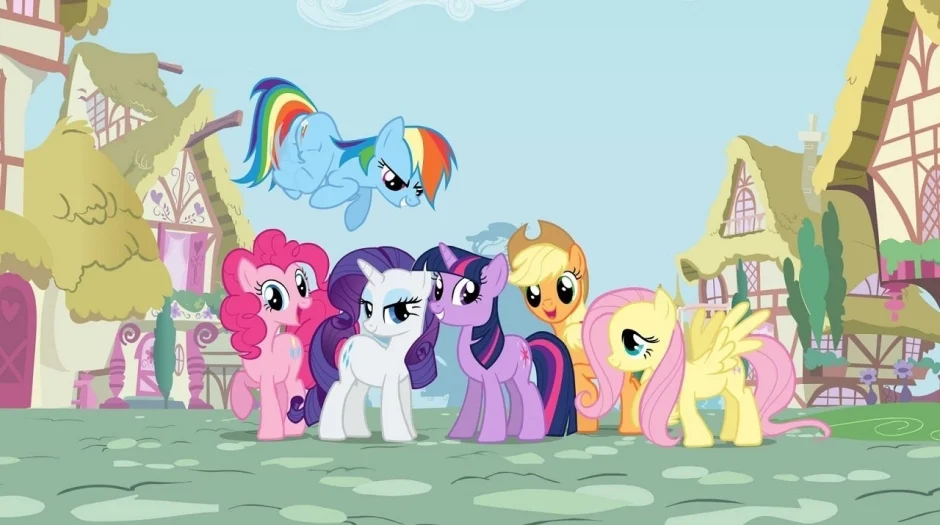
The central cast, collectively dubbed the "Mane Six," featured a diverse ensemble designed to showcase contrasting personalities and interpersonal dynamics:
- Twilight Sparkle (voiced by Tara Strong), a studious and ambitious unicorn scholar.
- Spike (voiced by Cathy Weseluck), her loyal young dragon assistant.
- Applejack (voiced by Ashleigh Ball), a hardworking, down-to-earth farm pony.
- Rarity (voiced by Tabitha St. Germain), an artistic and fashion-forward unicorn.
- Fluttershy (voiced by Andrea Libman), a gentle, nature-loving pegasus.
- Rainbow Dash (voiced by Ashleigh Ball), a bold, athletic pegasus with dreams of greatness.
- Pinkie Pie (voiced by Andrea Libman), an energetic and eccentric party enthusiast.
Rather than relying solely on simplistic moral lessons, the series focused heavily on how individual differences and personal flaws could create friction within relationships, ultimately strengthening the collective bond of the group. Early episodes such as "Suited for Success"—in which Rarity struggles to balance her artistic vision with the conflicting aesthetic demands of her friends—and "The Ticket Master," which tested the loyalty of the group over scarce resources, established a tone that prioritized genuine emotional stakes.
Visual Aesthetics and Narrative Evolution

The distinctive visual style of the series was heavily informed by Faust’s prior work on Cartoon Network. Just prior to her engagement with Hasbro, Faust and McCracken produced an episode of Foster’s Home for Imaginary Friends that explored the imagination of an eight-year-old character named Frankie. Convinced that this vibrant, stylized aesthetic was superior to traditional, dated pastel designs associated with historical girls’ programming, Faust recruited artists Dave Dunnet and Martin Ansolabehere to adapt the look for the new pony series.
As production moved into its first season, Faust continually pushed the writing staff to embrace higher dramatic stakes. "For the first several episodes of the first season, I was still trying to push people," Faust shares. "I kept telling the writers, ‘Don’t make it so soft. Don’t be afraid.’ I was like, there’s absolutely no reason something for girls can’t have these more compelling, more risky stories with more conflict in them."
A crucial turning point for the creative direction of the series arrived with the episode "Sonic Rainboom." In this narrative, Rainbow Dash experiences severe performance anxiety ahead of a major flying competition, leading to a complex chain of events involving misplaced hubris, magical mishaps, and a high-stakes rescue. Faust identified this episode as the creative threshold where the series successfully bridged epic narrative moments with grounded, personal emotional resonance.
The Unforeseen Rise of the Brony Phenomenon

While the production team initially calibrated the series to appeal to children aged six to eleven—while remaining palatable to parents sharing viewing time—Friendship is Magic unexpectedly transcended its primary demographic. Shortly after its 2010 premiere on The Hub network, the show attracted a massive, dedicated following of adult viewers, predominantly young men who subsequently adopted the moniker "Bronies."
Initial online reception to the announcement of a new My Little Pony series was marked by skepticism and internet mockery. However, this early wave of derision ironically drove curious viewers to sample the program, many of whom discovered genuine narrative and artistic merit in the production. As user-generated discussion forums and video compilations expanded across platforms like YouTube—with tacit allowance from Hasbro—an unprecedented subculture began to take shape.
The phenomenon grew to such a scale that filmmakers Laurent Malaquais and John de Lancie (who voiced the recurring chaotic entity Discord in the series) produced a feature-length documentary titled Bronies: The Extremely Unexpected Adult Fans of My Little Pony, with Faust serving as an executive producer. The documentary captured the inaugural BronyCon convention, highlighting fans who found personal connection, community, and comfort in the show’s themes of empathy and inclusion.
Legacy and Future Outlook

Over its nine-season run, Friendship is Magic garnered widespread industry recognition, accumulating five Leo Awards and three Daytime Emmy Award nominations. The conclusion of the flagship series in late 2019 did not spell the end of the franchise, however. It paved the way for subsequent iterations, including the Pony Life shorts, My Little Pony: Make Your Mark, and My Little Pony: Tell Your Tale.
Continuing the expansion of the intellectual property, Hasbro announced at San Diego Comic-Con plans for a new YouTube-based series titled My Little Pony: Forever Friendship. Scheduled to launch in early 2027, the project will consist of biweekly, nine-minute animated episodes following the core characters on new adventures in magic and self-discovery.
Although Faust is not currently attached to the upcoming 2027 production, she participated in its promotional announcement and remains open to a potential return under the right conditions. "Never say never," Faust remarks regarding a possible future collaboration with the franchise. "I think it would depend a lot on circumstances. I was trepidatious about working for a toy company because they have their research and their toy goals. Going back would very much depend on the parameters and how much freedom I would have… I just care about these characters and I’d want to do it right. So, yeah. I’d say it’s a solid maybe."
Through a combination of uncompromising creative vision, sophisticated writing, and a willingness to challenge industry preconceptions, Lauren Faust and her production team successfully transformed a commercial toy adaptation into a modern cornerstone of contemporary animation history.