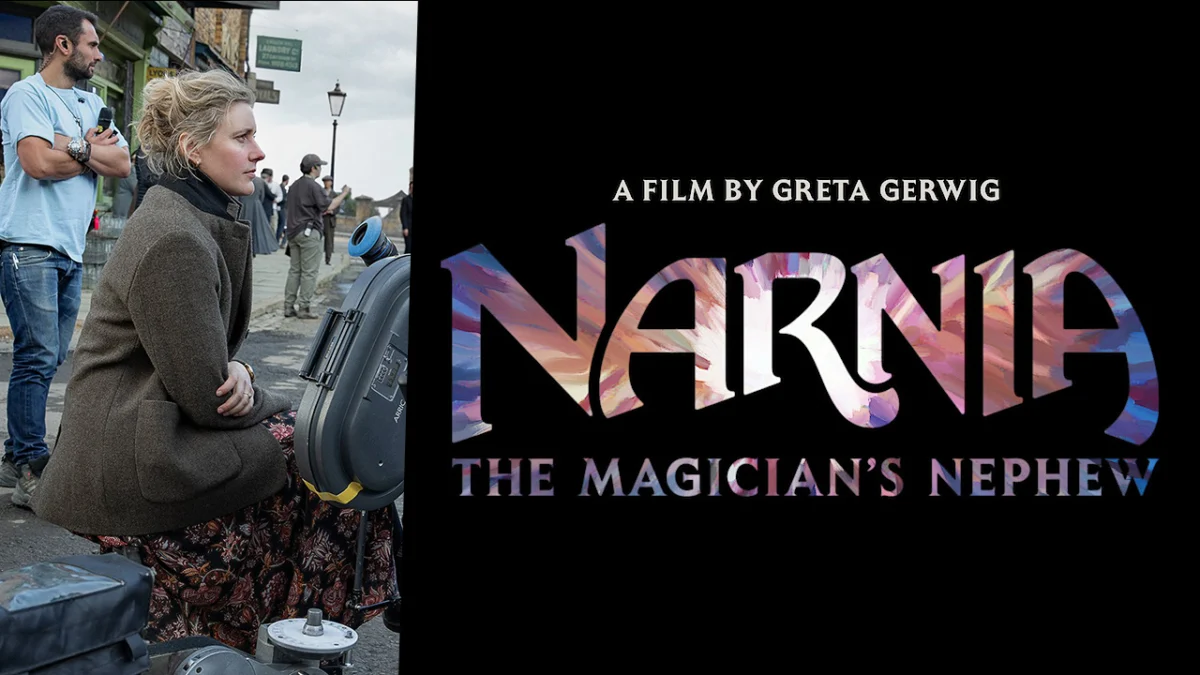
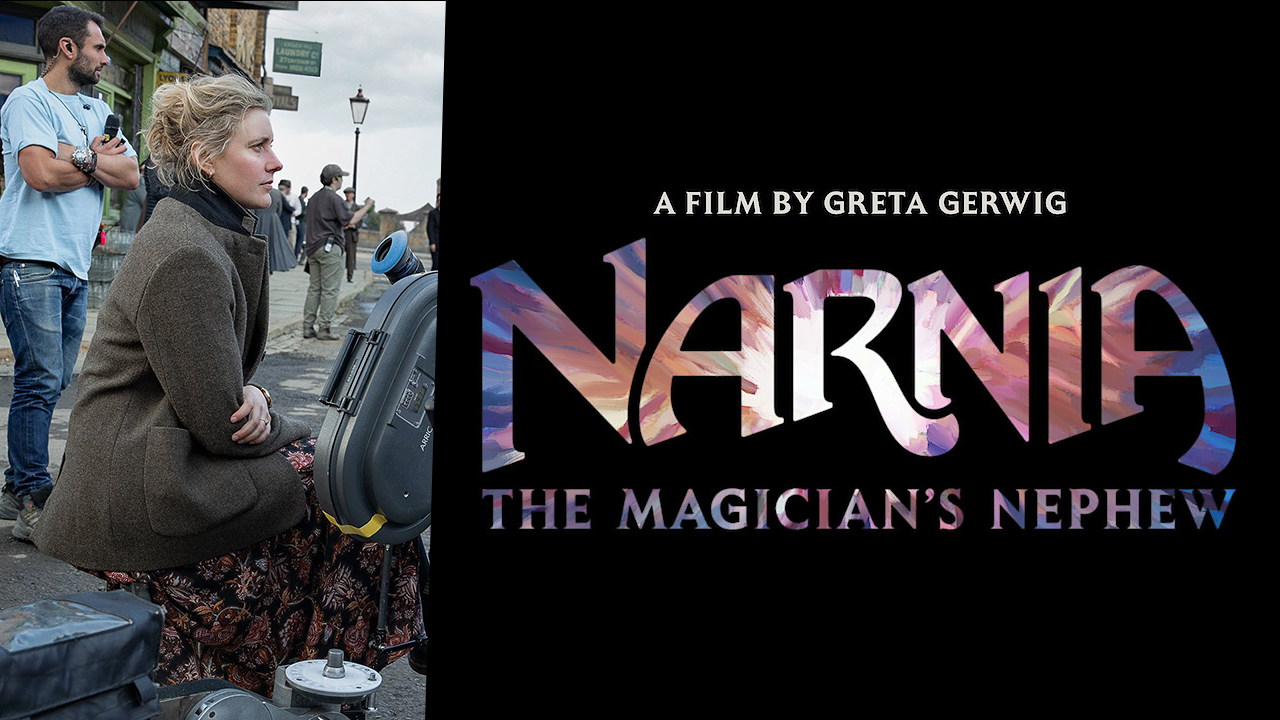
After years of speculation and intense production secrecy, Netflix has finally provided the public with its first official glimpse into the highly anticipated reimagining of C.S. Lewis’s literary classic, The Chronicles of Narnia. The streaming giant took to social media to debut a stylized animated logo for the project, officially titled Narnia: The Magician’s Nephew, accompanied by a behind-the-scenes photograph of director Greta Gerwig on the London set. This unveiling marks a significant milestone in a development cycle that has spanned several years and carries substantial weight for Netflix’s long-term strategy in the high-fantasy genre.
The behind-the-scenes image captures Gerwig in a period-appropriate setting, dressed in a heavy tweed coat and focused intently on an ARRI camera. The surrounding environment—featuring vintage automobiles and extras adorned in early 20th-century attire—confirms the production’s commitment to capturing the Edwardian-era aesthetic of the source material. This visual confirmation aligns with the ongoing reports of elaborate, practical street sets constructed in London throughout 2025, signaling that the production is prioritizing tactile, grounded filmmaking to complement its heavy reliance on visual effects.
A Chronology of Development and Delays
The journey to bring Narnia to the Netflix platform began in October 2018, when the streamer announced a multi-year deal with The C.S. Lewis Company to develop series and film projects based on the beloved books. For several years, the project remained in a state of developmental flux, with various writers and producers attached to shape the creative direction.
The project gained significant momentum in July 2023 when it was confirmed that Greta Gerwig, fresh off the global success of Barbie, would write and direct at least two of the planned films. The announcement solidified Netflix’s intent to position the Narnia franchise as a cornerstone of its tentpole content strategy. However, the path to the screen has not been without logistical hurdles. Initially targeted for an earlier release, the film’s premiere was pushed back to allow for an extended post-production schedule, a decision deemed necessary given the project’s scale. The current, finalized release date is set for February 10, 2027, providing the creative team with ample time to refine what is expected to be a technically demanding visual experience.
The Scope of Production and Casting
The scale of The Magician’s Nephew is underscored by an ambitious casting roster that suggests a high-prestige approach. The confirmed lineup includes Daniel Craig, Carey Mulligan, Emma Mackey, David McKenna, and Beatrice Campbell. By securing established dramatic actors alongside rising stars, Netflix is clearly aiming to ground the fantastical elements of the story in strong, character-driven performances.
The decision to adapt The Magician’s Nephew—the chronological origin story of the Narnia universe—is a calculated narrative choice. Unlike The Lion, the Witch and the Wardrobe, which focuses on the Pevensie children, The Magician’s Nephew explores the genesis of the world, the creation of Aslan, and the origin of the White Witch. This narrative framework allows for a fresh entry point that does not require prior knowledge of the 2005-2010 film franchise, providing Netflix with a clean slate to build a new cinematic mythology.
Analysis of Test Screenings and Creative Direction
In the months leading up to this official reveal, the film has undergone a series of private test screenings in various markets, including New York, New Jersey, and Nashville. These screenings are a standard component of major studio productions, designed to gauge audience engagement and identify narrative pacing issues before the final edit is locked.
Reports from these early screenings indicate a mixed reception. Sources close to the production have noted that while the fidelity to C.S. Lewis’s source material is high, some early viewers have expressed concerns regarding the pacing of the film, with the term "boring" appearing in some early feedback. Industry analysts caution, however, that such reactions are common for unfinished cuts of high-fantasy epics. At this stage, many of the visual effects are incomplete or temporary, and the absence of final sound mixing and color grading can significantly diminish the impact of the final product.
The questionnaires distributed at these screenings provide insight into the film’s intended atmosphere. By inquiring about audience familiarity with films such as The NeverEnding Story, Labyrinth, Wicked, and Spider-Man: Into the Spider-Verse, the production team has signaled a stylistic blend of musical elements, rock-and-roll influences, and a deep appreciation for 1980s-style practical creature effects. The emphasis on practical sets, as seen in the recent behind-the-scenes photography, further supports the hypothesis that Gerwig is striving for a tangible, "lived-in" world rather than one purely dominated by computer-generated imagery.
Strategic Implications for Netflix
The release of these marketing assets serves several strategic purposes. First, it effectively manages fan expectations by confirming the production’s progress, mitigating the anxiety that often accompanies long-delayed projects. Second, it serves as a "soft launch" for the promotional campaign, allowing Netflix to test audience engagement metrics and social media sentiment.
For Netflix, the success of this Narnia adaptation is critical. As the streamer seeks to compete with established cinematic universes like Disney’s Marvel and Lucasfilm, the Narnia franchise represents one of the few remaining literary properties with sufficient brand recognition and depth to sustain a multi-film narrative. Should the film succeed, it could pave the way for a long-running series that could define the platform’s fantasy output for the next decade.
However, the risk remains high. The fantasy genre has become increasingly saturated, and audiences are showing a growing preference for original concepts over established IP that has been previously adapted. Gerwig’s ability to inject her distinct, critically acclaimed directorial style into the rigid structure of the Narnia books will be the deciding factor in whether the film finds a broad, enthusiastic audience or fails to capture the magic of the original novels.
The Path to 2027
As the production moves toward its 2027 release, the focus will likely shift from filming to the massive post-production task of rendering the magical elements of the film. The technical challenges involved in bringing the world of Narnia to life—from the creation of non-human characters to the depiction of the "Wood Between the Worlds"—require an unprecedented level of coordination between the director and the visual effects teams.
With the first official look now in the public domain, the pressure on Netflix to deliver a high-quality trailer in the coming months will only increase. The initial marketing materials provide a baseline, but the true test will be the release of the first teaser, which will need to convey the tone, visual quality, and narrative stakes of the film to a skeptical public. For now, the wardrobe remains firmly, if only slightly, open—offering a tantalizing glimpse into a world that, for better or worse, is poised to dominate the cultural conversation in early 2027.
The industry will continue to monitor the progress of The Magician’s Nephew, not only as a potential box-office (or rather, stream-count) juggernaut but as a litmus test for how established, beloved intellectual property can be successfully revitalized for a modern audience under the guidance of a visionary auteur. Whether the final product meets the high expectations set by fans and critics alike remains to be seen, but for now, the first tangible step has been taken.