The Japanese film industry of the late 1960s and early 1970s stands as a testament to a period of extraordinary creative fervor and stylistic experimentation. This era witnessed the emergence of cinematic titans who pushed the boundaries of established genres, producing works that continue to resonate with audiences and scholars alike. Alongside the visually audacious and narrative-bending films of Seijun Suzuki, whose works like "Tokyo Drifter" (1966) redefined yakuza cinema, and the politically charged, often confrontational features of directors such as Nagisa Oshima, known for his groundbreaking explorations in films like "Gohatto" (1999), the landscape of Japanese genre cinema experienced an unparalleled creative peak. This fertile ground yielded some of Japanese cinema’s most enduring and iconic characters, from the indomitable Nami in Shunya Ito’s visceral "Female Prisoner Scorpion" (1972) to the legendary Zatoichi, the blind masseur and master swordsman whose adventures spanned over two dozen films.
Among the prominent leading men who defined this dynamic period, Tomisaburo Wakayama carved out a significant niche. His portrayal of Itto Ogami in the acclaimed "Lone Wolf and Cub" series, beginning with "Sword of Vengeance" (1972), remains a cherished fixture among fans of samurai cinema and action films. However, Wakayama’s impact predates his iconic role as the disgraced executioner walking a path of vengeance. Before embodying the stoic intensity of Ogami, Wakayama starred in the "Bounty Hunter" series, a trilogy of films that masterfully blended action, adventure, and the historical drama genre known as jidaigeki. These films not only solidified his status as a leading star of the era but also served as a vivid embodiment of the remarkable creative energy that characterized Japanese genre filmmaking during this transformative period.
The Political Intrigue of the Shogunate and the Rise of the Bounty Hunter
The narrative of the "Bounty Hunter" series, particularly its opening installment often referred to as "Killer’s Mission" (1969), is intricately woven into the volatile political climate of feudal Japan. The arrival of Dutch trading ships, seeking to establish lucrative arms deals with powerful figures within the shogunate, created a ripple effect of instability. This impending influx of advanced weaponry threatened to upset the delicate balance of power that had long been maintained by the ruling Tokugawa government. In an effort to thwart this potentially destabilizing agreement and maintain their authority, the shogunate government tasked the skilled bounty hunter and physician, Ichibei Shikoro, portrayed by Tomisaburo Wakayama, with a perilous mission.
Ichibei Shikoro was no ordinary operative. Beyond his formidable prowess as a swordsman, honed through years of conflict and experience, he possessed an exceptional talent for disguise and deception. His arsenal was augmented by an impressive array of ingenious gadgets and tools, which often provided him with a crucial tactical advantage in his clandestine operations. The mission, however, was fraught with peril: infiltrating the territory of the powerful Satsuma clan, a formidable force known for its autonomy and influence, and disrupting their potential alliance with the foreign powers. This undertaking proved to be a mission of immense danger, requiring more than just individual skill.
Forging Alliances in a Treacherous Landscape
Ichibei’s solitary mission takes an unexpected turn when he encounters Tokuro (Kenji Ushio), a wandering ronin with his own agenda, and Kagero (Yumiko Nogawa), a woman equally determined to penetrate the heavily guarded Satsuma territory. Despite their disparate motivations, the precariousness of their shared objective leads them to form an unlikely alliance. Their common adversary is the Satsuma clan, whose forces have been actively engaged in the execution of shogunate spies operating along the border. As Ichibei, Tokuro, and Kagero venture deeper into enemy territory, their individual quests converge, revealing a conspiracy far more complex and dangerous than Ichibei initially anticipated. The machinations at play are driven by layers of political intrigue and competing economic interests, a testament to the complex web of power dynamics within the shogunate. To navigate this perilous environment and ensure their survival, Ichibei must rely not only on his honed combat skills but also on every stratagem at his disposal, and crucially, on the nascent trust he develops with his newfound companions.
Tomisaburo Wakayama’s Charismatic Portrayal of Ichibei Shikoro
The "Bounty Hunter" series, and "Killer’s Mission" in particular, are undeniably anchored by the compelling performance of Tomisaburo Wakayama. Ichibei Shikoro emerges as a character of significant depth, transcending the archetype of a mere skilled warrior. Much like Wakayama’s later, iconic role as Itto Ogami in "Lone Wolf and Cub," Ichibei is a multifaceted protagonist. His combat repertoire extends beyond the traditional sword and dagger; he skillfully employs a variety of ingenious gadgets and devices, many of which bear a striking resemblance to the tools that would later define Ogami’s arsenal. These include, for instance, a telescopic sight capable of remarkable magnification, which Ichibei utilizes for reconnaissance, and other cleverly concealed mechanisms that enhance his effectiveness in combat. Furthermore, Ichibei demonstrates proficiency as a marksman, adding another layer to his formidable skill set. This embrace of advanced technology, when it serves a strategic purpose, highlights a character who, while deeply rooted in tradition, is pragmatically adaptable.
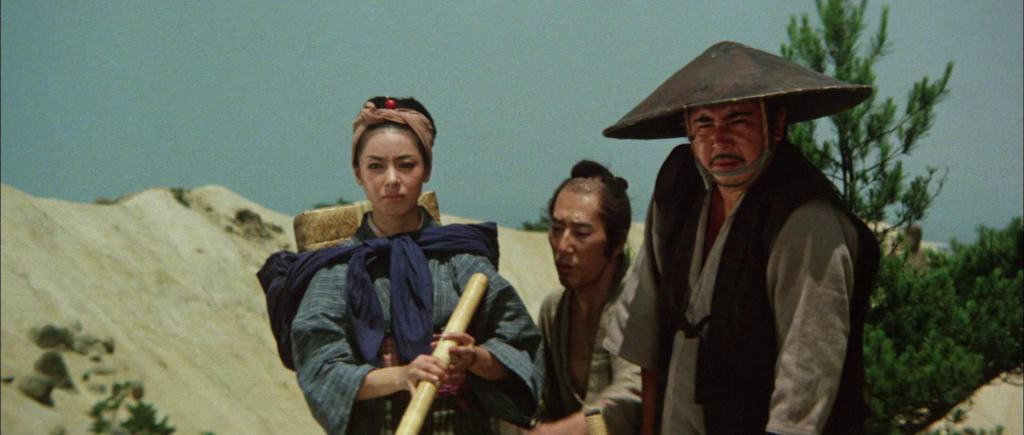
Equally crucial to Ichibei’s characterization is his sharp intellect and his adeptness at deception. The film features an extended sequence where Ichibei masterfully impersonates a blind masseur, a clear and deliberate homage to the beloved Zatoichi series, underscoring the cultural dialogue within Japanese cinema of the era. Wakayama imbues Ichibei with a restrained charisma and an understated performance style that makes him a profoundly engaging anti-hero. Certain aspects of his conduct, particularly in his interactions with women, are ethically ambiguous. However, similar to Itto Ogami, Ichibei constantly navigates the fine line between eliciting audience sympathy and inviting critical judgment. Even when his methods are difficult to unequivocally defend, viewers find themselves rooting for him as he confronts adversaries whose true influence and power are revealed gradually, adding to the suspense and intrigue of the narrative.
Historical Context and Thematic Undercurrents
While it would be an overstatement to categorize "Killer’s Mission" as a direct political allegory, the film is undeniably shaped by its historical context. Although Ichibei is employed by representatives of the shogunate, he never fully aligns himself with the system he ostensibly serves, preferring to operate with a degree of autonomy whenever circumstances allow. He is not a revolutionary figure, yet his actions place him in opposition to an oppressive force embodied by the Satsuma clan. The clan’s ambition to assert dominance over the political landscape is significantly bolstered by the acquisition of Dutch weaponry, a critical plot point that highlights the era’s burgeoning foreign influence and its impact on internal power struggles.
A key thematic divergence emerges when comparing Ichibei to Itto Ogami. While "Lone Wolf and Cub" presents a protagonist who ultimately embraces his fate as an outcast after recognizing the inherent unchangeability of the regime, "Killer’s Mission" offers a considerably more optimistic perspective. Despite its pervasive violence and bloodshed, the film suggests that determined individuals, operating within the system, can still exert influence on the course of history. Alternatively, they can at least empower those who are willing to enact change. This subtle but significant distinction positions "Killer’s Mission" as a narrative that, while acknowledging the pervasive corruption and power imbalances, retains a belief in the potential for individual agency to shape societal outcomes.
The Supporting Cast: Pillars of Resistance and Comic Relief
The optimism that pervades "Killer’s Mission" is further amplified by the strength of its supporting cast. Yumiko Nogawa’s portrayal of Kagero is pivotal, representing those who actively resist a corrupt and power-hungry establishment. Her character embodies a spirit of defiance against overwhelming odds. Kenji Ushio, as Tokuro, provides much-needed moments of comic relief. His performance offers a lighter counterpoint to Wakayama’s stoic and intense presence, creating an enjoyable dynamic that enriches the viewing experience. Simultaneously, Nogawa expertly captures the emotional toll of opposing such a formidable enemy, making Kagero not only a vulnerable but arguably the most emotionally resonant character in the narrative. Her journey highlights the personal sacrifices inherent in challenging entrenched power structures.
Legacy and Critical Reception
"Killer’s Mission" stands as a robust and engaging opening chapter to the "Bounty Hunter" series. Under the direction of Shigehiro Ozawa, the film successfully crafts an entertaining genre piece that not only reflects the vibrant creativity of Japanese popular cinema in the late 1960s but also subtly engages with the social and political tensions of its time. While perhaps less overtly cynical than landmark films such as "Female Prisoner Scorpion" or the "Lone Wolf and Cub" saga, it nevertheless delivers a compelling portrait of individuals grappling with and striving against systems far larger and more powerful than themselves. The series, as a whole, offers a valuable lens through which to examine the artistic innovation and thematic depth of Japanese genre filmmaking during a period of significant cultural and political flux. The "Bounty Hunter" trilogy, through its blend of thrilling action, intricate plotting, and nuanced character development, cemented Tomisaburo Wakayama’s legacy and provided a significant contribution to the rich tapestry of Japanese cinema.
Archival Data and Industry Context
The period of the late 1960s and early 1970s in Japan was a golden age for studio filmmaking, with major players like Toho, Toei, and Shochiku producing a vast output of films across diverse genres. The jidaigeki genre, in particular, experienced a resurgence, fueled by popular demand for samurai epics, historical dramas, and swordplay adventures. The "Bounty Hunter" series, produced by Toei, capitalized on this trend, offering a fresh take on familiar tropes. Tomisaburo Wakayama, a seasoned actor with a background in sumo wrestling, was a natural fit for these physically demanding roles. His collaborations with directors like Kenji Misumi ("Lone Wolf and Cub") and Shigehiro Ozawa were instrumental in shaping the visual and narrative language of these films. The success of these franchises not only contributed to the economic health of the studios but also provided a platform for exploring complex societal issues within the accessible framework of popular entertainment. The films’ international distribution further cemented their place in global cinematic history, influencing filmmakers and captivating audiences worldwide. The "Bounty Hunter" trilogy, with its blend of historical setting and innovative action, remains a significant artifact of this dynamic period in Japanese film history.