


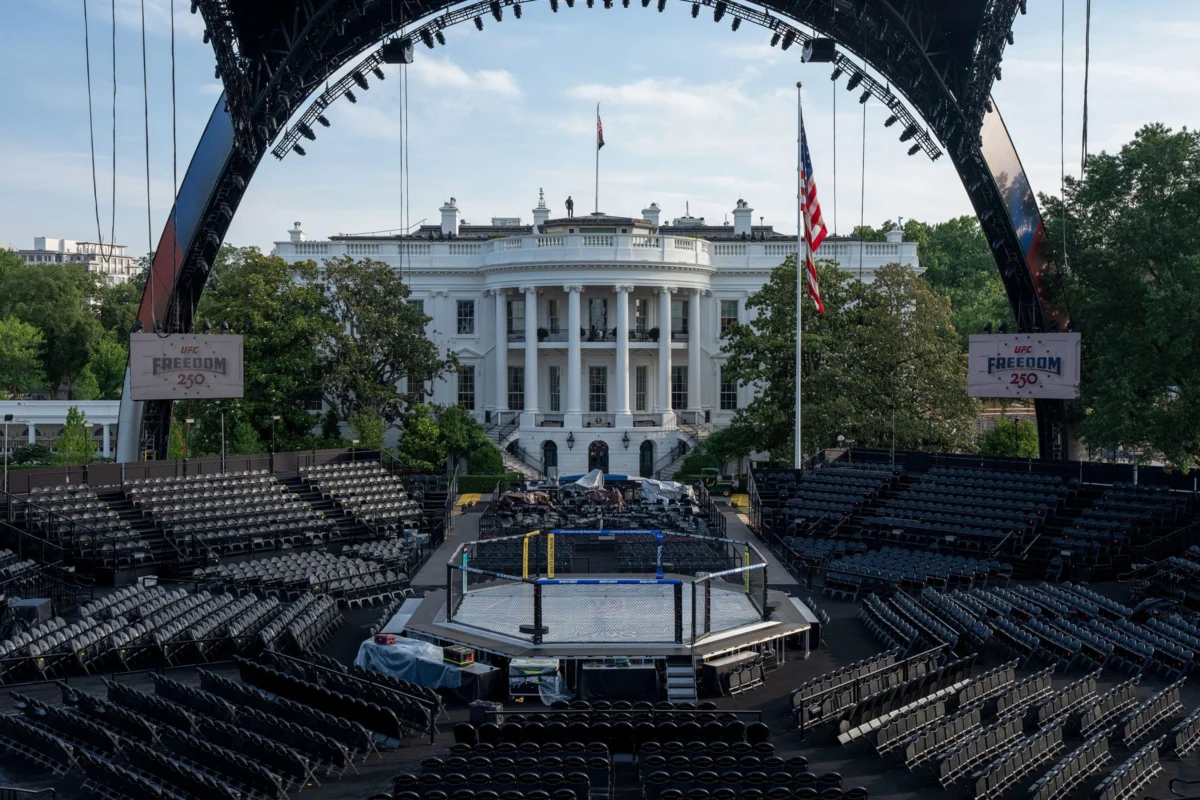
The administration of Donald Trump has officially confirmed the scheduling of UFC Freedom 250, a mixed martial arts (MMA) event set to take place on the South Lawn of the White House, marking an unprecedented intersection of professional combat sports and the United States presidency. The event, timed to coincide with the celebration of America’s independence and the president’s own birthday, is being promoted as a "historic" achievement by Ultimate Fighting Championship (UFC) leadership. While the spectacle aligns with President Trump’s long-standing affinity for the wrestling and boxing industries—stemming from his history as a casino mogul and his induction into the WWE Hall of Fame—the logistics and diplomatic underpinnings of the event have drawn significant scrutiny from both sports analysts and political observers.
The Memorandum of Understanding and Sports Diplomacy
On Thursday, Secretary of State Marco Rubio joined UFC CEO Dana White in Washington, D.C., to formalize a partnership between the federal government and the MMA promotion. The ceremony centered on the signing of a "Memorandum of Understanding" (MOU), a document intended to integrate the UFC into the administration’s broader sports diplomacy initiatives. During the event, Secretary Rubio drew a direct comparison between the founding of the UFC and the 1969 moon landing, characterizing the organization as a uniquely American success story.
However, the historical context provided during the signing has been a subject of debate among sports historians. While Rubio credited the UFC with pioneering rules and weight classes, the sport’s origins are more complex. The UFC was founded in 1993 primarily to showcase Brazilian jiu-jitsu, and it followed other international MMA organizations, such as Japan’s Pancrase, which had already begun exploring the transition from scripted professional wrestling to legitimate competitive fighting.
The MOU aims to leverage the UFC’s global reach to project American soft power, though the move has raised questions regarding the vetting of international partners. The UFC has frequently navigated controversies involving figures such as Chechen leader Ramzan Kadyrov, whose associations with various fighters have been a point of contention. The UFC maintains that these relationships do not extend to the corporate entity itself, yet the inclusion of the promotion in official State Department diplomacy marks a significant shift in how the U.S. government engages with professional sports.
A Technical Breakdown of the Fight Card
The centerpiece of the event is UFC Freedom 250, featuring a lineup of ranked fighters. The main event will see Ilia Topuria, the undefeated 155-pound champion, face off against interim 155-pound champion Justin Gaethje. Gaethje is widely regarded as one of the most consistently entertaining athletes in the sport, and the matchup is expected to be a high-level display of technical striking and endurance.
The card also includes an interim heavyweight title bout and several other matchups featuring top-tier contenders. Despite the "historic" branding, the event has noted omissions. Most notably, the card features no female bouts, a departure from the UFC’s standard pay-per-view structure. Furthermore, several of the organization’s most recognizable stars are absent from the lineup.
Jon Jones, often cited as the greatest mixed martial artist in history, will not compete. Reports suggest a breakdown in negotiations, with Jones alleging that the UFC "lowballed" his compensation for the White House appearance. This occurs against the backdrop of a recent $375 million settlement of a class-action antitrust lawsuit, in which former fighters accused the UFC of systematic wage suppression. Similarly, Conor McGregor, the sport’s most commercially successful figure, remains sidelined. Official statements from the White House cite McGregor’s status in the anti-doping testing pool and a desire to avoid the appearance of executive favoritism as the reasons for his exclusion. McGregor’s absence follows a week of intense media scrutiny regarding his adherence to anti-doping protocols and his recent legal liabilities in civil court.
Logistics and the White House Transformation
The physical transformation of the South Lawn for UFC Freedom 250 has been described as an immense logistical undertaking. The setup appears to mirror the "UFC Apex" facility in Las Vegas, a Meta-branded warehouse environment used for smaller-scale events. For Sunday’s event, the octagon will be positioned against the backdrop of the executive mansion, with fighters reportedly scheduled to make their entrances directly from the Oval Office.
Attendance for the event is strictly controlled. Tickets are not available for public purchase; instead, approximately 1,900 invitations have been distributed by President Trump, Dana White, and Ari Emanuel, the CEO of TKO Group Holdings (the parent company of both the UFC and WWE). A significant portion of the remaining audience will consist of active-duty service members. However, attendance for these troops is contingent upon specific physical fitness criteria. Reports indicate that service members must maintain a waist-to-height ratio of less than 0.55 to be eligible for a seat. Analysts have noted the irony of this requirement, pointing out that based on the president’s most recent public medical records—listing him at 6’3” and 238 pounds—he himself might struggle to meet such a stringent metric.
Viewership Projections vs. Market Reality
Dana White has publicly stated that he expects "Super Bowl type numbers" for the broadcast of UFC Freedom 250. However, current data suggests a significant gap between these projections and historical viewership trends. While MMA has seen a surge in popularity, particularly with the recent Ronda Rousey bout on Netflix peaking at 11.6 million U.S. viewers, these figures represent less than 10 percent of the average audience for a Super Bowl, which typically exceeds 125 million viewers.
The event’s success will likely be measured not just by domestic viewership but by its impact on the UFC’s branding as a pillar of American cultural identity. The promotion has leaned heavily into "freedom" and "patriotism" as marketing themes, a strategy that aligns with the current administration’s messaging but risks polarizing segments of the global sporting audience.
Chronology of Key Events Leading to UFC Freedom 250
- January 2023: Dana White launches "Power Slap," a controversial slap-fighting promotion, amid public scrutiny following a domestic incident involving his wife.
- Late 2023 – Early 2024: Negotiations begin between the White House and TKO Group Holdings to host a large-scale sporting event on federal grounds.
- May 2024: A $375 million settlement is reached in a long-standing antitrust lawsuit against the UFC regarding fighter pay and contractual practices.
- June 2024: A 3,000-square-foot American flag at WWE headquarters in Stamford, Connecticut, is blown into power lines during a storm, causing a massive power outage for 40,000 residents.
- Thursday, June 2024: Secretary of State Marco Rubio and Dana White sign the Memorandum of Understanding for sports diplomacy.
- Sunday, June 2024 (Scheduled): UFC Freedom 250 takes place on the White House South Lawn.
Broader Implications and Institutional Impact
The hosting of a professional cage fight at the White House represents a departure from traditional uses of the executive residence. Historically, the South Lawn has hosted events such as the Congressional Baseball Game, Easter Egg Rolls, and state dinners. By introducing a commercial, high-impact combat sport into this space, the administration is signaling a shift toward a more populist and entertainment-oriented use of federal symbols.
Critics argue that the event risks commodifying the presidency and blurring the lines between government functions and private corporate interests. Proponents, however, view it as a modern evolution of the "bully pulpit," using popular culture to connect with a demographic that may feel alienated by traditional political discourse.
The long-term impact on the UFC is equally significant. By securing an official partnership with the U.S. State Department, the organization gains a level of institutional legitimacy that was unthinkable during its "human cockfighting" era in the late 1990s. Yet, this legitimacy comes with increased responsibility. As the UFC becomes a tool of American diplomacy, its internal labor practices, fighter safety protocols, and associations with controversial international figures will likely face unprecedented levels of government and public oversight.
As Sunday approaches, the forecast calls for evening thunderstorms. Dana White has remained adamant that the event will proceed regardless of the weather. Whether UFC Freedom 250 achieves the "historic" status its promoters claim or serves as a fleeting moment of spectacle, it has already succeeded in redefining the boundaries of presidential engagement with professional sports. The event stands as a testament to the enduring partnership between Donald Trump and the world of combat sports—a relationship that has moved from the casinos of Atlantic City to the very center of American political power.