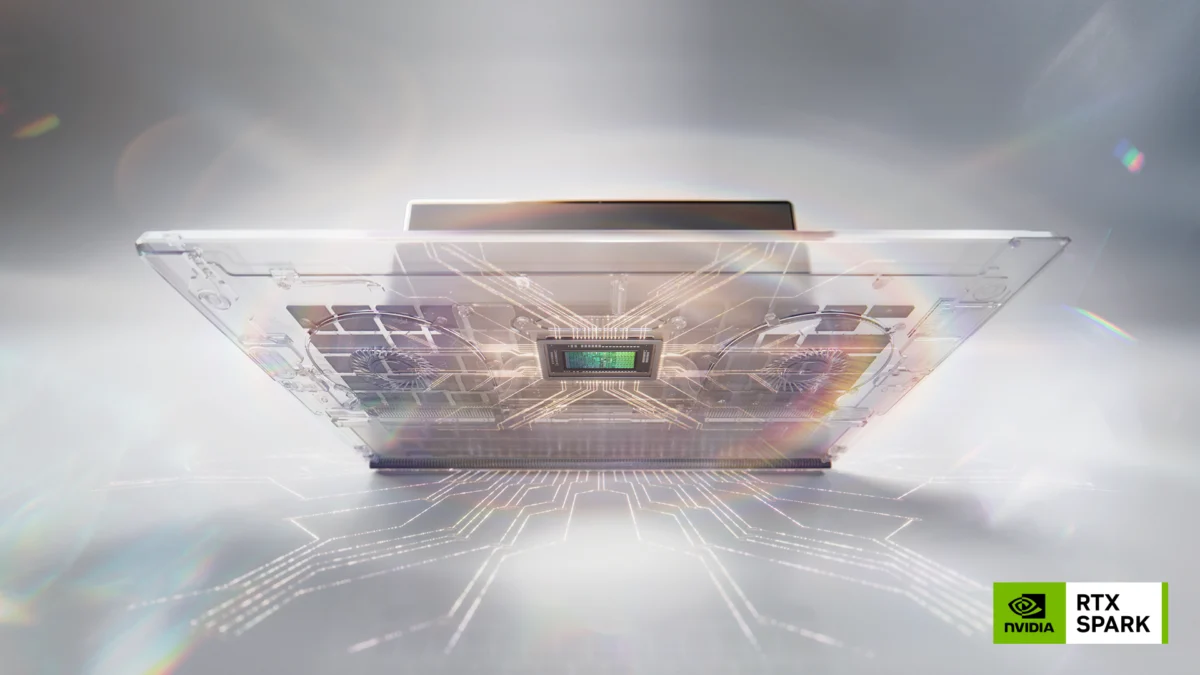
Nvidia has officially announced the RTX Spark, a specialized computer superchip designed to fundamentally alter the architecture of personal computing through integrated artificial intelligence performance. The hardware manufacturer confirmed that the new silicon will be integrated into upcoming product lines from major industry partners, including Dell, Lenovo, Asus, and HP, with a commercial release scheduled for the fall of this year. According to technical specifications released alongside the announcement, the RTX Spark is engineered to deliver 1 petaflop of AI computing power, a metric that positions the chip at the forefront of the consumer hardware market. This performance is supported by up to 128GB of unified memory and the full integration of Nvidia’s proprietary AI and graphics stack, representing a significant leap over current-generation discrete graphics cards and mobile processors.
The RTX Spark is being positioned as more than a traditional component; it is described by the company as a "superchip" that unifies CUDA cores, RTX graphics technology, and a dedicated AI platform into a single package. This architecture is specifically designed to facilitate "local agents"—AI programs that run directly on a user’s hardware rather than relying on cloud-based servers. By moving the processing of frontier models and creative workflows to the local machine, Nvidia aims to reduce latency and enhance data privacy, two of the primary hurdles currently facing the widespread adoption of generative AI in the consumer sector.
A Strategic Pivot in Computing Philosophy
The introduction of the RTX Spark marks a transition in how Nvidia views the relationship between the user and the operating system. During the unveiling, Nvidia CEO Jensen Huang emphasized that the traditional model of software interaction—launching applications through manual inputs like clicking and typing—is being superseded by an intent-based model. Huang noted that for four decades, the PC has functioned as a tool for executing specific, user-triggered applications. With the RTX Spark and its integration into the Microsoft Windows ecosystem, the PC is intended to act as a proactive assistant that processes natural language requests to perform complex tasks.
"The PC is being reinvented," Huang stated in an official blog post. "With RTX Spark and Microsoft Windows, you ask—and the PC does the work. RTX Spark brings everything NVIDIA has built into a single superchip. This is the new PC: the personal AI computer." This shift toward "AI agents" suggests that the RTX Spark will be the hardware foundation for Windows’ future AI features, allowing for real-time video editing, automated coding, and sophisticated digital assistance that operates independently of an internet connection.
Technical Specifications and Gaming Performance
Beyond its implications for productivity and general computing, the RTX Spark is designed to maintain Nvidia’s dominance in the high-end gaming market. The chip incorporates the latest iterations of Nvidia’s core gaming technologies, including raytracing, Deep Learning Super Sampling (DLSS), and Reflex. Specifically, Nvidia highlighted the capabilities of DLSS 5, the next generation of its AI-driven upscaling technology. The company claims that the RTX Spark will allow users to run modern, high-fidelity titles at 1440p resolution while maintaining frame rates exceeding 100 frames per second.
The inclusion of 128GB of unified memory is particularly noteworthy for both gamers and creators. In a unified memory architecture, the CPU and GPU share a single pool of high-speed memory, eliminating the need for data to be copied between separate VRAM and system RAM banks. This is expected to significantly reduce loading times and allow for the rendering of vastly more complex environments in open-world games. For AI developers, this large memory pool is essential for running large language models (LLMs) locally, as these models often require significant memory capacity to function efficiently.
The Economic Context: Rising Costs and Market Shifts
The announcement of the RTX Spark comes during a period of significant volatility in the hardware market. The rapid expansion of the generative AI sector has led to an unprecedented demand for high-performance silicon, much of which is being diverted to massive datacenters operated by tech giants like Google, Meta, and Amazon. This "AI gold rush" has had a cascading effect on the consumer market. Industry analysts have noted that the competition for shared components, such as high-bandwidth memory (HBM) and specialized capacitors, has caused the prices of personal computer parts to rise steadily over the last 24 months.
This economic pressure has extended to the console gaming market. In recent months, Sony and Microsoft have both implemented price adjustments for their flagship consoles, the PlayStation 5 and Xbox Series X/S, citing increased manufacturing and supply chain costs. Even Valve’s Steam Deck, which was initially praised for its aggressive pricing, has seen adjustments in various regions. By introducing the RTX Spark as a high-end, all-in-one solution for OEMs like Dell and HP, Nvidia appears to be attempting to stabilize its consumer segment by offering a premium "AI PC" category that justifies its price point through expanded functionality.
Timeline and Market Availability
Nvidia’s roadmap for the RTX Spark indicates a phased rollout beginning in the third quarter of this year. The initial wave of devices will consist of high-end laptops and workstations from the aforementioned partners.
- Summer: Technical briefings and developer kit distributions for AI software creators.
- Early Fall: Official launch of RTX Spark-powered laptops from Dell (XPS and Alienware lines), Lenovo (Legion and Yoga), Asus (ROG and Zenbook), and HP (Spectre and Omen).
- Late Fall: Integration of Spark-specific AI features into Windows 11 and subsequent updates.
- Winter: Expansion of the Spark architecture into small-form-factor desktop units and specialized creative hardware.
This timeline suggests that Nvidia is aiming to capture the lucrative back-to-school and holiday shopping seasons, positioning the "AI PC" as the must-have upgrade for 2024 and 2025.
Growing Skepticism and Societal Impact
Despite the technical enthusiasm from hardware manufacturers, the broader reception of generative AI remains mixed. While Nvidia’s stock price has soared due to its central role in the AI infrastructure, a growing chorus of skeptics has raised concerns regarding the long-term impact of the technology. A 2025 study conducted by the Massachusetts Institute of Technology (MIT) suggested that over-reliance on AI-driven agents and generative tools may be eroding critical thinking and problem-solving skills among students and young professionals. The study found that users who frequently utilized AI for drafting and research showed a measurable decline in their ability to synthesize complex information independently.
Furthermore, the games industry itself is divided on the utility of generative AI. According to the 2026 State of the Industry report from Game Developer, approximately 50% of surveyed professionals expressed the belief that generative AI is detrimental to the industry. Concerns range from the displacement of entry-level creative roles—such as concept artists and junior writers—to the potential for AI-generated content to dilute the artistic quality of interactive media.
Broader Implications for the Tech Ecosystem
The launch of the RTX Spark represents a gamble that the consumer market is ready to embrace AI as the primary interface for computing. If successful, the RTX Spark could force a major realignment of the semiconductor industry, putting pressure on competitors like AMD and Intel to match Nvidia’s petaflop-scale local AI performance. It also solidifies the partnership between Nvidia and Microsoft, potentially making the Windows operating system more dependent on Nvidia’s hardware proprietary stack than ever before.
For the end user, the RTX Spark promises a future where the computer is a collaborator rather than just a tool. However, the success of this vision depends on whether the software ecosystem can produce "AI agents" that provide genuine value beyond the current capabilities of chatbots and automated image generators. As the fall release date approaches, the tech industry will be watching closely to see if the RTX Spark can deliver on its promise to reinvent the personal computer, or if it will be seen as another high-priced entry in an increasingly crowded and controversial AI market.