
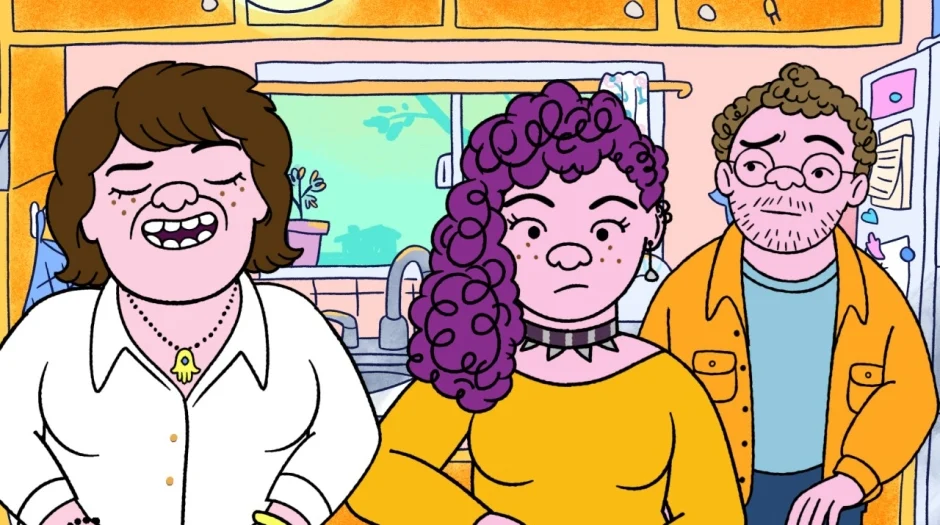
Netflix’s latest animated offering, Long Story Short, presents a bold narrative experiment, weaving together the fragmented tapestry of a middle-class Jewish family’s life. Creator and showrunner Raphael Bob-Waksberg, known for his acclaimed work on BoJack Horseman and his involvement with Undone and Tuca & Bertie, has embraced the inherent complexities of a non-linear storytelling approach. This innovative series, which debuted on the streaming giant in August and has already secured a second season renewal, challenges conventional narrative structures by featuring significant time jumps, flashbacks, and a sprawling cast of characters depicted at various life stages. The production, handled by Tornante Television with animation by ShadowMachine, delves into the triumphs, disappointments, joys, and compromises that define the Schwooper family, primarily focusing on siblings Avi (Ben Feldman), Shira (Abbi Jacobson), and Yoshi (Max Greenfield).

The genesis of Long Story Short‘s distinctive structure can be traced back to Bob-Waksberg’s personal experiences navigating multiple demanding creative projects during the height of the COVID-19 pandemic. He recalls a period of intense multitasking, juggling responsibilities for Undone and Tuca & Bertie simultaneously, often with two laptops open and participating in virtual meetings. This demanding, multi-threaded approach to production, he felt, ultimately proved his capacity to manage the intricate demands of a show like Long Story Short. The series’ unconventional timeline is intentionally designed to mirror the way an individual, particularly someone with Attention Deficit Disorder (ADD) like Bob-Waksberg himself, might recount family narratives to a therapist. This deliberate fragmentation of time and memory is not merely a stylistic choice but a fundamental element that shapes the viewer’s experience, encouraging a more active and interpretative engagement with the characters’ lives.
Navigating the Labyrinth of Continuity
The non-chronological nature of Long Story Short presents a significant challenge for maintaining narrative consistency. Bob-Waksberg acknowledges the immense effort required to meticulously track character development, relationships, and even minute details such as hairstyles and the age of family pets. The production relies heavily on a dedicated script coordinator, Scout Comm, who serves as a crucial archivist of the show’s intricate timeline. Comm’s role extends to flagging any anachronisms, such as referencing advertising campaigns that hadn’t yet been released or ensuring character names remain consistent across episodes. This rigorous attention to detail is paramount, as Bob-Waksberg emphasizes that "every detail has to feel deliberate."

The commitment to deliberate detail is evident in the very design of the characters. Supervising producer Lisa Hanawalt, alongside Alison Dubois, played a pivotal role in establishing the show’s visual identity. The nuanced approach to character design, particularly the subtle interweaving of familial resemblances through features like noses and hair, was a deliberate choice to visually represent the Schwooper family’s interconnectedness. Bob-Waksberg elaborates, "Families come in all types, and not every family has physical resemblances or genetic relations. But it felt like an important way to visualize this specific family—the connections they have and their inability to escape each other, since those ties are literally part of their faces." This approach underscores the show’s adherence to the "show, don’t tell" principle, where visual cues carry significant narrative weight.
Animation as a Catalyst for Emotional Resonance
The choice of animation as the primary medium for Long Story Short is not merely aesthetic; it is integral to the show’s ability to convey complex emotional landscapes. Bob-Waksberg posits that animation possesses a unique capacity to "syringe things straight to the heart in a way that live-action can’t." This allows for moments of profound emotional impact that might be more challenging to achieve through traditional filming techniques. He cites specific examples, such as a scene in the dance recital episode where siblings Avi and Shira, after a heated argument, move towards each other with the apparent intention of reconciliation, only to pass by without embracing. This subtle yet powerful visual, born from the animators’ interpretation of the script rather than explicit direction, highlights the unspoken dynamics within the family. Similarly, a moment in the "wolf situation" episode, where a character closes one eye to visually align her thumb over her father and then her mother, offers a potent, wordless commentary on family observation and perception.

The layered dialogue, a hallmark of family interactions, also benefits significantly from animation. While actors record their lines separately, the editing process allows for an exceptional degree of precision in orchestrating overlapping conversations and subtle vocal inflections. Bob-Waksberg explains, "In animation, you can raise the volume of certain people and certain words at certain times—sometimes by mere milliseconds—to get a better sense of what’s going on in the scene. We can make things overlap at the exact right time." This meticulous audio layering, executed by a dedicated editing team, recreates the authentic, sometimes chaotic, rhythm of family communication, where individuals frequently speak over one another, anticipating each other’s thoughts and finishing sentences. This technique is not just for comedic effect but serves to reinforce the shared language, running jokes, and deep-seated understanding that characterize the Schwooper family.
A Collaborative Canvas of Family Experiences
Beyond its innovative narrative structure and visual artistry, Long Story Short distinguishes itself through its deeply collaborative spirit. Bob-Waksberg actively encourages every member of the production team to imbue the series with their personal experiences and insights. He states, "The joy of the show is in the collaboration." This philosophy extends to granting ownership of specific elements to team members, fostering a sense of shared investment. Examples include a writer’s assistant meticulously defining the astrological signs of the characters, which, while not initially a focus for Bob-Waksberg, sparked a wealth of creative ideas. Similarly, actress Lisa Edelstein reportedly channeled her own mother’s New York accent for her character, Naomi.

This collective contribution transforms Long Story Short into a rich mosaic of diverse family histories and relatable dynamics. The show’s visual palette, characterized by vibrant colors, is a direct reflection of Hanawalt’s artistic vision. Bob-Waksberg notes, "She very smartly saw that the more muted the emotions, the more you want the colors to contrast with them." This deliberate use of color creates a visually engaging experience, even when characters are grappling with somber or introspective themes, ensuring that the audience remains captivated by the unfolding narratives.
While the series draws heavily on Bob-Waksberg’s own upbringing in a Jewish family, its resonance extends far beyond a singular cultural experience. The core themes—sibling rivalries, the dynamics of dinner table conversations, and the generational anecdotes shared with grandparents—are universally recognizable. The show aims to capture the essence of what it means to be part of a family, with all its inherent complexities and enduring bonds. The commitment to authenticity in depicting these dynamics, from the rapid-fire dialogue to the recurring inside jokes, serves to build a sense of familiarity and connection with the audience, inviting them to recognize patterns within their own family lives.

Implications and Future Prospects
The critical reception and early renewal of Long Story Short for a second season suggest a strong audience connection to its unique approach. The series is also reportedly in consideration for Emmy nominations, a testament to its artistic merit and innovative storytelling. This success underscores a growing appetite for animated content that pushes creative boundaries and explores nuanced human experiences. The show’s ability to blend humor, pathos, and observational detail within a non-linear framework positions it as a significant contribution to the evolving landscape of television storytelling.
Bob-Waksberg’s vision for Long Story Short is one that embraces the inherent messiness and beauty of family life, translated through the powerful medium of animation. The series not only entertains but also offers a profound exploration of connection, memory, and the enduring impact of familial relationships. As the show continues to develop, the anticipation for further seasons suggests a promising future for this ambitious and deeply personal narrative endeavor. The success of Long Story Short also implies a broader trend in the animation industry towards more sophisticated and emotionally resonant storytelling, demonstrating the medium’s capacity to tackle complex themes with a unique visual and narrative flair.