

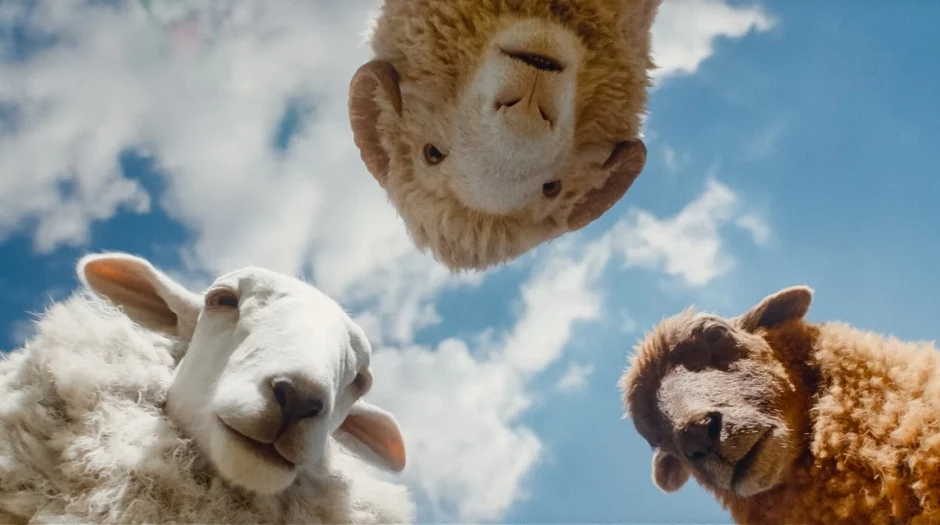
Kyle Balda’s ambitious leap from the vibrant, animated worlds of global blockbusters like Minions and Despicable Me 3 to the intricate landscape of live-action filmmaking marks a significant directorial evolution. His latest project, The Sheep Detectives, is not merely a change in medium but a testament to the compelling power of a story that explores profound themes of grief, loyalty, and the unexpected courage found within a flock of sheep determined to solve the murder of their beloved shepherd. This hybrid feature, adapting Leonie Swann’s bestselling novel Three Bags Full: A Sheep Detective Story, masterfully weaves together photorealistic CG sheep, ensemble comedy, and classic whodunnit suspense, a combination producer Lindsay Doran aptly describes as "a very unusual murder mystery."
Balda, whose animation career boasts unparalleled success in the family entertainment genre, revealed that the decision to move into live-action was less about a mandate for change and more about the emotional resonance of the source material. "My reps brought the script to me back in 2022," Balda explained. "And I had expressed that I was really open to live-action film even though animation is my wheelhouse. But the most important thing was that it was the kind of story I wanted to tell. It’s the kind of story I love. It’s about misfit characters trying to do something incredibly difficult and sort of bumbling their way through it, which for me feels very much like the Minions. That’s what the Minions are trying to do. So the fact that it was live-action made it a very interesting and appealing challenge. But really, the story and its themes were the main appeal for me."
The PG-rated film centers on a flock of sheep who take it upon themselves to investigate the suspicious death of their shepherd, George, portrayed by acclaimed actor Hugh Jackman. The production’s innovative approach seamlessly blends live-action performances with the meticulously crafted, fully animated sheep brought to life by Framestore. This technical prowess is matched by the narrative depth of Craig Mazin’s screenplay. Mazin, a celebrated writer known for his work on critically lauded projects such as Chernobyl and The Last of Us, found himself immediately captivated by the unique premise.
A Premise That Captivated the Creative Team
The genesis of The Sheep Detectives for Mazin began with a simple yet intriguing proposition from producer Lindsay Doran. "Lindsay Doran came to me and said, ‘Hey, I have a book,’" Mazin recalled. "I don’t know if you’ve heard of it, but it’s called ‘Three Bags Full,’ and it’s a murder mystery. And I went, ‘Ooh.’ And she said, ‘Where sheep have to solve the murder of their shepherd.’ And I said, ‘I’m in. I’ll do it. I’ll do it. What do I have to do?’ And then she said, ‘Well, read the book. Read the book first, just to see if you like it.’ And I did. And then I went, ‘I’m in, I’m in, I’m in, I’m in, I’m in. I want to do it.’"

Doran elaborated on what made Swann’s novel stand out in a crowded literary and cinematic landscape. "The material immediately stood apart from conventional family entertainment," she noted. "I immediately thought this was one of the best ideas for a movie I’d ever heard. I could see why it would be funny, why it would be emotional, and why it would be a very unusual murder mystery."
Leonie Swann’s original novel, first published in German in 2005 and subsequently translated into over 30 languages, provided the filmmakers with a rich tapestry of comedy, philosophy, and mystery. A key element that distinguishes the novel, and consequently the film, is the sheep’s unique perspective on the world. They possess an inherent intelligence and innocence, often misunderstanding human behavior, creating their own unique cosmology, and interpreting reality through instinct and emotion rather than pure logic.
"The way the sheep are both intelligent and innocent – their misunderstandings of how the world works, their belief that clouds are simply sheep that have moved on, their joy in discovery, and their sadness as they begin to encounter the difficulties of reality – these beautiful, unique qualities were essential for us to preserve," Mazin emphasized. "I’m incredibly grateful the book gave us so much to work with."
Designing Sheep That Retain Their Natural Essence
Swann herself has embraced the adaptation’s creative liberties, acknowledging that film and literature operate under different artistic principles. "Of course, the plot deviates from the novel quite a bit," she stated. "But I never expected it to be an exact replica – film is a different genre with its own dynamics, and a faithful adaptation and a good adaptation are two very different things."
For Balda, the principal challenge lay in striking a delicate balance between the animals’ inherent realism and their capacity for emotional performance. From the outset of development, the production team established a rigorous set of guidelines for the sheep’s depiction. They were to remain physically believable animals, grounded in their natural behaviors, even as they carried the weight of the narrative.

"We always knew it was going to be fully animated," Balda explained. "And the main sort of guidelines or rules were that these are sheep no matter what. They don’t walk on their hind legs or gesture with opposable thumbs or do things like that. And the rules also follow the fact that the humans don’t even recognize them as anything other than sheep. So, it’s not as if they’re interacting with the human world in the sense that they’re talking to humans. You have all those rules, and you already have a really good foundation: ‘Okay, this is just like real animal physicality, but there’s a lot of emotion here.’"
The creature design and animation work relied heavily on extensive research into various sheep breeds and their typical behaviors. VFX supervisor Graham Page collaborated closely with Balda and the animation team to imbue each member of the flock with distinct visual personalities.
"We started talking about the different characters and all the different traits of the sheep," Page recounted. "And I started going to all the different farms around the UK, looking at rare-breeds farms and different breeds that could become different sheep, breeds that had different characteristics that could convey something unique to each character."
Creature Supervisor Dorothy Ballarini underscored the commitment to realism as the bedrock of the project, even as the characters’ performances became increasingly expressive. "We try to keep the models grounded in realism, as close as possible to the original reference and concept art," she explained. "Then we layer in the voice performances. The animators sync the movement to the actors’ dialogue; it’s a bit like solving a puzzle."
The simulation of the sheep’s fleece presented one of the production’s most technically demanding challenges. Framestore’s specialized teams dedicated significant effort to creating believable wool simulations, utilizing millions of individual strands to achieve the desired visual fidelity. "It’s all about the tiny twists and curls," said Oliver Armstrong, VFX Supervisor and Head of VFX in London. "Each one requires multiple points along the curve. Getting that right was a huge challenge, because the believability of the fleece was absolutely essential."

An Animation Pipeline Integrated into a Live-Action Production
For animation veteran Balda, the core animation process itself remained remarkably familiar, despite the shift into a live-action production framework. "It was really the same, because it’s the same process for the animated sheep as in a Minions film," he observed. "You don’t have that flexibility with the live-action characters, obviously. But even though they’re photorealistic sheep, you still have that freedom."
This creative freedom extended to the refinement of performances throughout the post-production phase. Balda likened the process to a unique hybrid between traditional animation and live performance. "My favorite analogy, which I use from time to time, is that animation films are like working with studio musicians, while a live-action film is like being on stage in a live performance," Balda elaborated. "What happens, happens. But with the animated sheep, this is a kind of hybrid. You do have that possibility to go in and reshape and refine and try things."
Despite the advanced animation capabilities, the production quickly confirmed that relying on real sheep for extensive filming would have been logistically prohibitive and creatively limiting. "One of the main things we learned from bringing real sheep to the production office was how happy we were to be animating them," Balda quipped. "Sheep have very short attention spans – they mostly just want to eat grass. So they were wandering all over the place, heads down, and it became very clear that we made the right decision."
Cinematographer George Steel echoed this sentiment. "They move around all the time like a boxer, like Muhammad Ali," he commented. "I’m glad we’re not shooting with real sheep."
To facilitate actor performances and maintain consistent eyelines, the production employed articulated puppets and practical stand-ins, meticulously operated by puppeteer Tom Wilton. Executive Producer Tyson Hesse highlighted the crucial role these physical references played during rehearsals. "That kind of thing is really helpful for an actor, because not only does it give them a good eyeline for exactly where they’re supposed to be looking, but it also gives them so much more to work off of than just looking at a tennis ball or nothing at all," Hesse explained. "So we do a couple of rehearsal passes where the actor has this stand-in to get their performance all locked in, and after that we’ll do a pass where we just take it out and they have to remember what they did in the rehearsals. And Hugh Jackman is one of the best I’ve ever seen when it comes to this. He remembers every single small movement and acting choice that he had in the puppet pass. It’s really kind of incredible how exactly he lands his performance while looking at nothing at all."

Hugh Jackman himself shared his experience, noting how the collaborative process transformed what could have been a standard VFX-heavy performance into something far more immersive. "I’m used to acting with tennis balls on sticks," Jackman remarked. "This was so much more. I got to perform opposite incredibly lifelike puppets, operated by Tom Wilton – a brilliant puppeteer and actor. Honestly, it felt like the sheep were talking to me."
Constructing a World Through the Sheep’s Lens
Balda’s extensive animation background profoundly influenced every stage of the production. The entire film, including sequences devoid of visual effects, was meticulously storyboarded and assembled into a complete animatic before principal photography commenced. He also utilized his iPhone to capture location footage, subsequently working with storyboard artists to overlay staging directly onto these real-world environments.
"Trying to do as much as possible in prep, knowing that when you shoot it, you can’t go back to a lot of these places again," Balda stated. "And using this team of storyboard artists to really get the entire movie – even shots that don’t have any visual effects in them – into an animatic, which is really an animation way of doing it. Not so much of a live-action way of doing it."
This integrated workflow proved instrumental in fostering seamless communication across all departments. "I got great feedback from my DP, assistant director, and crew, like, ‘Wow, we can see the movie, we can see what’s in your head.’ So when we went on location, I would shoot things on my iPhone, talk about staging, send that video to my storyboard artist, and then they would board it, but with the actual place as the background," he added. "So you find a method that’s sort of a hybrid between live action and animation."
Balda also placed significant emphasis on visual geography when designing the fictional Oxfordshire village of Denbrook and its surrounding valley locations. "Because it’s a locked-room mystery, the farm and town needed to feel enclosed, nestled in the valley, and cut off from the outside world," Balda noted. "At the same time, we wanted a clear sense of geography so the audience would always understand how the locations connect, even as that world closes in. During prep, I shot video of the real locations so the storyboard artists could establish that geography while keeping the staging kinetic."

Production designer Suzie Davies explained how the sheep’s perspective fundamentally reshaped many design decisions. "I’ve never worked on a project that blends animation and live action like this before, so it’s been exciting to learn as we go," she shared. "As a designer, you want to fill a space – but here, we had to leave room for the sheep. That changed everything. We paid special attention to details lower to the ground – floors, textures, carpets – because we knew we’d often be seeing the world from their perspective."
Costume designer Rosa Dias similarly approached the human cast as heightened archetypes operating within a slightly stylized world. "I giggled through the whole script, but what I really loved was that it felt like a slightly imagined world," she commented. "There was so much room to be playful and inventive – a real license to create something fresh and unique, especially because there are talking sheep. I could immediately see the potential to make each character distinct."
The Heart of the Matter: Emotion, Humor, and the Shepherd’s Bond
At its core, The Sheep Detectives is anchored by the profound emotional connection between George and his flock. Jackman described the shepherd as a fundamentally nurturing figure, emphasizing his protective nature. "George is a fierce protector who refuses to harm his sheep. None of them will end up on your dinner plate – but their wool might keep you warm," Jackman stated. "I’ve played superheroes before, but George is a different kind of hero. The way he looks at his sheep – it’s somewhere between how you’d look at a pet and a child. And honestly, whether you’re a sheep or a human, we all want to be cared for like that."
Balda further elaborated on the character’s depth, noting, "George is a man with regrets, trying to make amends, while navigating complicated relationships in the town. But what really matters is his bond with the flock. You have to believe he shows up for them, and that they feel it deeply enough to go to extraordinary lengths for him. Hugh makes that connection completely believable, and that’s what anchors the film."
This emotional warmth extends to Christophe Beck’s score, which artfully blends grand orchestral themes with folk-inspired instrumentation and unique sonic textures. "We wanted to create a score that was heartfelt and emotional: big melodies played by a big string section, so you get that sort of classic film score sound, but we didn’t want it to only be that," Beck explained. "We also wanted to have some unique elements that you maybe wouldn’t have heard in another film."

For Balda, the project ultimately transcended a mere shift in medium, becoming an opportunity to apply animation storytelling instincts to a new format. "I think a lot of it helped me in terms of thinking visually, because animation films are so visually driven," he revealed. "And when I think about some of the directors I’m a big fan of, like Edgar Wright or the Coen Brothers, I think they make these great visual storytelling films. They’re almost like animated live-action movies to some degree because the visual storytelling is so strong."
In an era where photorealistic CG work continues to evolve, particularly with the advancements in AI, Balda expressed particular pride in the fact that the film’s performances remain firmly rooted in human artistry. "Especially these days, with AI," he remarked. "It’s like, ‘Is that AI? No, this is all human-driven.’ But that’s the thing: you get that warmth through the performances and the animators behind them."
The film’s production timeline began with Balda receiving the script in 2022, followed by intensive development and pre-production throughout 2023. Principal photography took place in early 2024, with extensive post-production, including the complex CG animation work by Framestore, occurring throughout the remainder of the year. The film’s release in 2026 marks the culmination of a four-year creative journey. The implications of The Sheep Detectives extend beyond its unique genre blend; it signifies a potential new pathway for veteran animators to explore live-action storytelling, leveraging their visual expertise to create emotionally resonant and technically innovative cinematic experiences. The success of this hybrid approach could inspire further collaborations between animation studios and live-action productions, pushing the boundaries of visual storytelling and audience engagement.