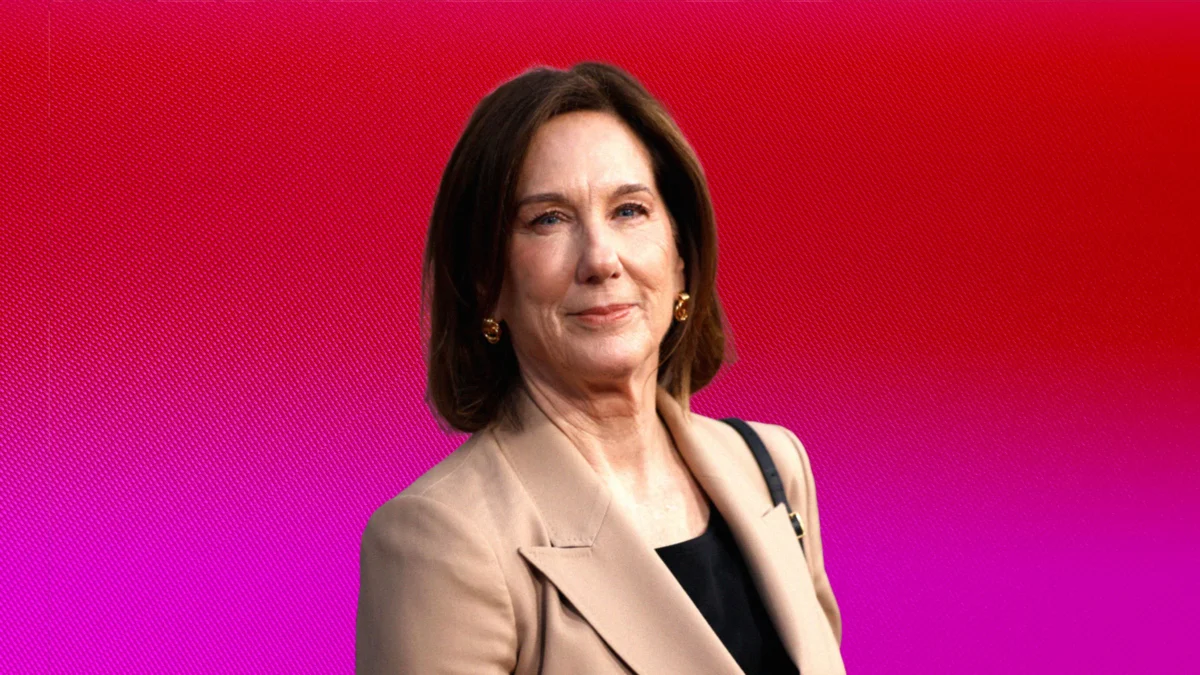
The Runway AI Summit, held recently in Manhattan, served as a pivotal flashpoint for the ongoing dialogue between the traditional bastions of Hollywood and the burgeoning sector of generative artificial intelligence. At the center of this discourse was Kathleen Kennedy, the prolific producer behind landmark franchises such as Jurassic Park and Star Wars, who challenged the rapid integration of automation in the creative arts with a fundamental inquiry directed at the American Film Institute (AFI). Kennedy’s question—"How are you going to teach taste?"—resonated through a crowd of industry insiders, highlighting a growing philosophical and practical divide between those who view AI as a revolutionary "magic" and those who see it as a tool that lacks the essential human discernment required for high-quality storytelling.
As the former head of Lucasfilm, Kennedy’s skepticism stems from decades of navigating technological shifts, from the birth of digital effects to the current era of machine learning. During her fireside chat, she revealed that the AFI has begun incorporating AI tools into its curriculum, prompting her to ask the institute’s dean how the school intends to cultivate a generation of filmmakers who are more than mere "prompt generators." For Kennedy, "taste" is the foundational element that dictates every creative choice, from script development to final edit, and it remains a quality that algorithms have yet to replicate.
The Technological Hype Cycle and the Comparison to Elemental Discoveries
The summit occurred during a period of significant volatility for the AI industry. Only days prior to the event, OpenAI announced the suspension of its video-generation application, Sora, a move that reportedly disrupted a potential $1 billion partnership with Disney. Despite this setback, the atmosphere at the Manhattan summit remained overwhelmingly optimistic among technology executives. Leaders from Runway, Paramount, and Adobe characterized the advent of generative AI not merely as an incremental improvement in software, but as a technological milestone on par with the discovery of fire or the invention of the printing press.
Cristóbal Valenzuela, co-founder and CEO of Runway, opened the proceedings with a keynote titled "The Normalization of Magic: AI and What’s Ahead of Us." Drawing on Arthur C. Clarke’s third law—which posits that any sufficiently advanced technology is indistinguishable from magic—Valenzuela argued that the industry is entering an era where the barriers between imagination and visual realization are dissolving. To illustrate this, the event featured AI-generated imagery and videos, including a surreal depiction of Steve Jobs walking through an ancient Athenian agora alongside Socrates.
This sentiment was echoed by Phil Wiser, the Chief Technology Officer at Paramount. Despite an initial caveat that he wished to avoid "hypey" rhetoric, Wiser categorized generative AI as one of the top five technology trends in human history. This level of superlative praise has become a hallmark of industry conferences, where AI is frequently compared to the most transformative inventions of Western civilization.
Chronology of AI Integration in the Film Industry (2023–2025)
The integration of AI into Hollywood has followed a rapid and often contentious timeline over the past 24 months.
- Early 2023: Generative AI tools like Midjourney and ChatGPT began to be utilized in pre-production for concept art and script doctoring, leading to immediate concerns from creative guilds.
- Summer 2023: The Writers Guild of America (WGA) and the Screen Actors Guild (SAG-AFTRA) launched historic strikes, with AI protections serving as a primary point of contention. The eventual contracts established guardrails against the unauthorized use of actors’ likenesses and the replacement of human writers with AI.
- Early 2024: OpenAI introduced Sora, a text-to-video tool that promised to generate photorealistic footage. This sparked widespread speculation that traditional B-roll and VFX pipelines would be rendered obsolete.
- Late 2024: Major studios began exploring enterprise-level partnerships with AI firms. However, technical limitations and copyright concerns led to the stalling of several high-profile deals, including the Disney-OpenAI collaboration.
- Current State (2025): The industry is seeing a shift toward specialized, "artist-in-the-loop" tools like those offered by Runway and Adobe Firefly, which prioritize user control over autonomous generation.
Supporting Data and Economic Implications
The push for AI adoption is driven largely by the escalating costs of traditional film production. According to industry data, the average budget for a tentpole superhero or sci-fi film now exceeds $200 million, with visual effects accounting for 30% to 50% of that expenditure. Proponents argue that AI could reduce VFX timelines by up to 60%, potentially saving studios tens of millions of dollars per project.
However, the economic benefits are weighed against significant infrastructure challenges. The energy requirements for training and running large-scale video models are immense. Recent environmental reports indicate that the data centers necessary for the current AI boom are contributing to a projected 20% increase in energy consumption for major tech firms by 2030. Furthermore, the "efficiency" promised by AI is viewed as a threat to entry-level positions in the industry, such as rotoscoping artists, junior copywriters, and production assistants, who have traditionally used these roles as training grounds to develop the "taste" Kennedy referenced.
Perspectives from Creative and Technical Leadership
The summit featured a variety of official responses regarding the role of the human creator in an automated environment. Mihir Vaidya of Electronic Arts (EA) asserted that "the origin of creativity is the human mind," suggesting that AI serves as a bridge to close the "gap between imagination and creation." Adobe’s Hannah Elsakr presented a mathematical framework for this relationship: (Humanity x Creativity) raised to the power of AI equals Unlimited Possibility.
Despite these idealistic equations, Kathleen Kennedy provided a grounding perspective by citing practical failures of recent technological trends. She noted that on a recent Star Wars production—widely believed to be the upcoming The Mandalorian and Grogu—the use of 3D-printed props resulted in significant delays. Because the items were produced by machines rather than skilled prop masters, they lacked the structural integrity required for physical stunts and broke during filming. Kennedy used this as a metaphor for the broader AI movement: a tool that understands how something "looks" but does not understand how it "behaves" or "feels" is inherently limited.
The Backlash Against Synthetic Aesthetics
A recurring theme throughout the summit was the tension between the technical capability of AI and the aesthetic quality of its output. While executives applauded AI-generated clips, critics and some attendees noted that the results often appear "conspicuously synthetic" and "inhuman."
A notable point of contention was the discussion of a completely AI-generated holiday advertisement for Coca-Cola, produced by the studio Silverside. While Silverside’s managing director, Rob Wrubel, touted the project as a success, the advertisement faced significant public backlash upon its release. Audiences on social media platforms mocked the uncanny valley effect of the characters and the lack of the "human touch" that had defined the brand’s previous iconic campaigns. This disconnect suggests that while industry leaders are focused on the "magic" of the generation process, the consuming public remains sensitive to the loss of human artistry.
Broader Impact and Future Implications
The long-term impact of generative AI on Hollywood will likely be defined by the resolution of three key issues: legal copyright, environmental sustainability, and the evolution of film education.
From a regulatory standpoint, the U.S. Copyright Office has maintained that AI-generated content without significant human intervention cannot be copyrighted. This creates a massive financial risk for studios; if a film’s visual elements cannot be protected as intellectual property, the business model of Hollywood collapses. This legal uncertainty is a primary reason why major entities like Disney have remained cautious despite the technological allure.
In the realm of education, the challenge for institutions like the AFI will be to integrate these tools without eroding the craft of filmmaking. As Kennedy argued, creativity is often found in the "toil" and the "accidents" of the process—the very things AI aims to eliminate. If a student can generate a perfect image with a prompt, they may never learn the lighting, composition, and storytelling principles required to troubleshoot a difficult shot on a physical set.
Ultimately, the Runway AI Summit demonstrated that while the technology for "generating" content is advancing at an exponential rate, the ability to "create" art remains a uniquely human endeavor. The industry stands at a crossroads where it must decide if it will prioritize the efficiency of the machine or the discernment of the artist. As Kathleen Kennedy’s remarks suggested, the most sophisticated algorithm in the world is of little use if the person operating it lacks the taste to know when a story is truly "good."