


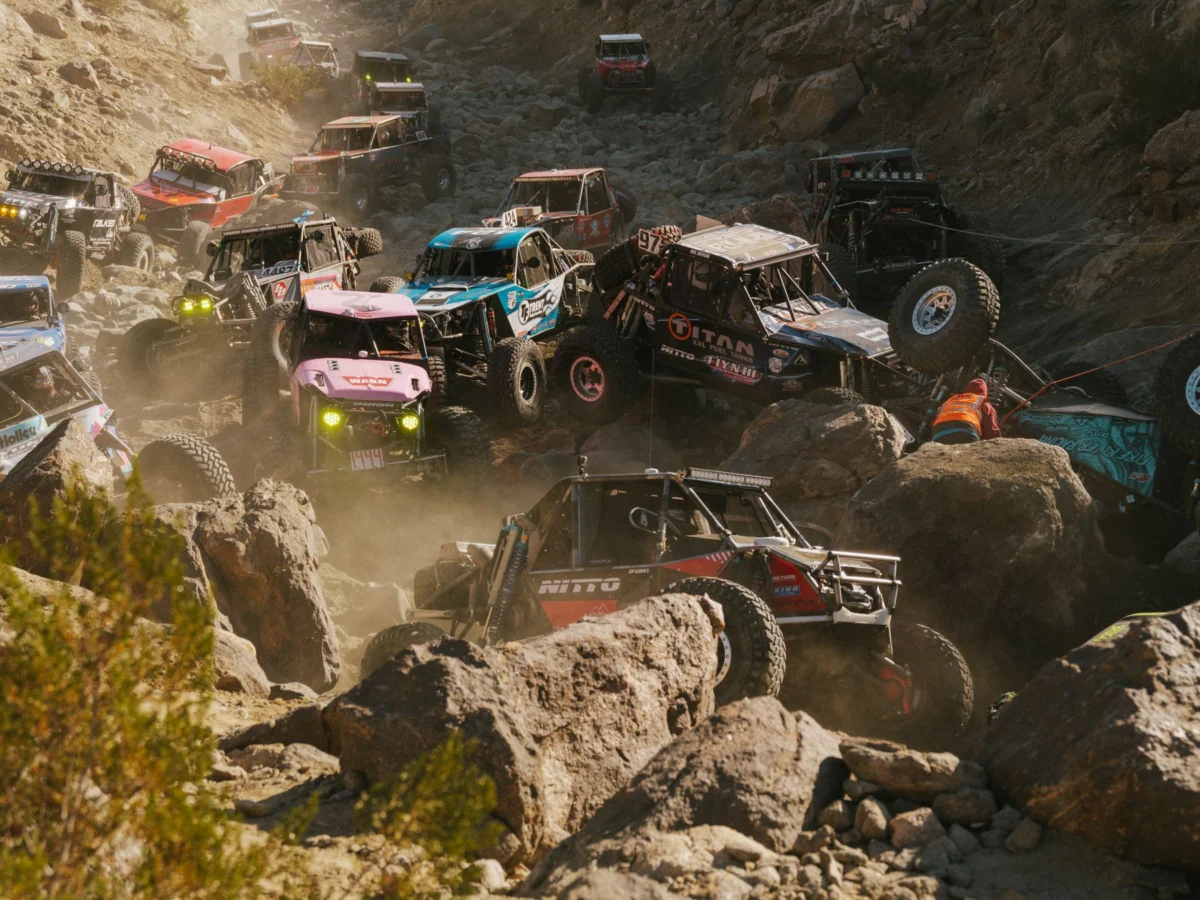
Deep within the arid expanse of the Johnson Valley in Southern California, a massive dust cloud marks the location of one of the most significant transformations in modern motorsports. Just beyond the rural community of Lucerne Valley, a vast plot of public land—managed by the Bureau of Land Management (BLM)—has evolved into a temporary metropolis known as Hammertown. This seasonal settlement serves as the epicenter for King of the Hammers (KOH), an off-road racing event that has grown from an informal gathering of enthusiasts into a global spectacle drawing nearly 100,000 people to the Mojave Desert. The landscape, typically characterized by its silence and scorched earth, is currently dominated by a diverse array of machinery: vintage Toyota pickups with custom-welded roll cages, modern Ford Broncos, high-performance UTVs, and specialized "Ultra4" rigs designed to navigate terrain that would be impassable for standard vehicles.
The Genesis and Chronological Growth of King of the Hammers
The origins of King of the Hammers date back to 2007, a year that saw a group of 13 friends—now referred to in off-road lore as the "OG13"—convene in the desert for a race with no prize money and no spectators. The premise was simple: to determine who could most effectively navigate the "Hammer" trails, a series of notoriously difficult rock-crawling paths in the Johnson Valley. What began as a local bet has, over two decades, transitioned into a 16-day festival of speed and mechanical endurance.
The timeline of the event’s expansion reflects the broader growth of the off-road industry. By 2010, the race had gained enough notoriety to attract professional sponsors and media coverage. By the mid-2010s, the introduction of different vehicle classes—including UTVs (Utility Terrain Vehicles), dirt bikes, and the "Everyman Challenge"—allowed for a wider range of participants. In 2024, the event celebrated its 20th year of organized competition, featuring a roster of approximately 750 racers representing a dozen countries. The evolution of the prize pool and the sophistication of the equipment have kept pace; what once featured "shit-box" trucks held together by stickers and welds now showcases million-dollar trophy trucks and purpose-built Ultra4 machines utilizing aerospace-grade materials.
Technical Complexity and the Race of Kings
At the heart of the event lies the "Race of Kings," widely regarded by industry experts as the most grueling single-day off-road race in the world. The race is unique because it combines two diametrically opposed disciplines of racing: high-speed desert crossing and technical rock crawling.
An Ultra4 vehicle must be capable of reaching speeds exceeding 100 mph on flat, sandy lakebeds while possessing the torque, suspension articulation, and tire grip to scale near-vertical rock faces. This year’s course spanned 245 miles, a distance that organizers intentionally designed to be the most difficult in the event’s history. The attrition rate is a testament to the severity of the terrain; out of the hundreds of starters, only two teams managed to cross the finish line within the mandated 14-hour time limit.
The technical challenge is compounded by the geography of Johnson Valley. The "Hammers" trails—with names like Sledgehammer, Jackhammer, and Chocolate Thunder—consist of massive boulders and narrow chutes that demand precision driving. A single mechanical failure or a poorly chosen line can result in a "DNF" (Did Not Finish), often leaving teams stranded in the remote desert until recovery crews can reach them.
Economic Impact and the $22 Billion Off-Road Market
The growth of King of the Hammers is not an isolated phenomenon but rather a reflection of a booming global market. According to data from Grand View Research, the global off-road vehicle market was valued at over $22 billion in recent years, with a projected compound annual growth rate (CAGR) that shows no signs of slowing. This economic surge is visible in the vendor village at Hammertown, which resembles a small county fair but is stocked with high-end automotive technology, from advanced GPS telemetry systems to specialized tire compounds.
Major automotive manufacturers have recognized the marketing potential of the event. Brands such as Ford, Toyota, and various tire manufacturers now use King of the Hammers as a proving ground for their consumer products. The "win on Sunday, sell on Monday" mentality has returned to the off-road sector, with vehicles like the Ford Bronco Raptor and the Jeep Wrangler Rubicon being marketed specifically to the demographic that frequents Johnson Valley.
The economic footprint extends beyond vehicle sales. For the 16 days of the event, the local economies of Lucerne Valley, Yucca Valley, and Victorville experience a significant surge in revenue. Hotels, gas stations, and grocery stores see peak demand as 80,000 attendees descend upon the region. Organizers have also leveraged digital growth; while the physical city of Hammertown houses tens of thousands, the event’s digital reach expanded to 1.2 million online viewers in the most recent cycle, providing a massive platform for sponsors like Monster Energy.
Sociopolitical Environment and the Culture of Autonomy
Beyond the mechanical and economic aspects, King of the Hammers serves as a cultural touchstone for a specific segment of the American public. The event is often described as "Burning Man meets Mad Max," a comparison that highlights both its temporary, self-sustaining nature and its rugged, survivalist aesthetic. The "Hammertown" infrastructure is a feat of logistical engineering, requiring the installation of temporary cellular towers, sanitation services, and emergency medical facilities in a location that has no permanent utilities.
A recurring theme among attendees and participants is a preoccupation with autonomy and self-reliance. This is reflected in the personalization of the vehicles. Many rigs double as platforms for political and social expression, featuring custom vinyl wraps and flags. While the American flag is the most prevalent, the presence of Gadsden flags, Second Amendment slogans, and references to "1776" or "We the People" underscores a community that values land-use rights and minimal government intervention.
This focus on autonomy is inextricably linked to the geography of the event. Johnson Valley is one of the largest open off-highway vehicle (OHV) areas in the United States. For many in the off-road community, the ability to access and utilize public lands is a primary political concern. The event represents a collective assertion of these rights, framed within a culture that celebrates the ability to "break things, fix them, and break them again."
Logistical Management and Environmental Stewardship
Managing an event of this magnitude on public land requires a complex partnership between race organizers (Hammerking Productions) and federal agencies. The Bureau of Land Management issues special recreation permits that mandate strict adherence to environmental protocols. Despite the appearance of chaotic desert racing, the event is highly regulated.
Environmental impact is a significant point of contention and focus. To maintain their permits, organizers must ensure that the 80,000 attendees remain within designated boundaries to protect the surrounding Mojave ecosystem, which includes habitats for the endangered desert tortoise. Post-event cleanup is a massive undertaking, as the temporary city must be dismantled entirely, returning the Johnson Valley to its natural state until the following winter.
Industry Analysis and Future Implications
The success of King of the Hammers has sparked a global expansion of the Ultra4 racing format. Similar events are now held in Europe, Australia, and South America, creating an international circuit for off-road racing. This expansion suggests that the appeal of high-stakes, technical off-roading is universal, transcending the specific cultural landscape of the American West.
However, the event faces future challenges. As the off-road vehicle market shifts toward electrification, King of the Hammers will likely need to adapt. The introduction of EV classes is already a topic of discussion among organizers, though the logistical challenge of charging high-performance vehicles in a remote desert environment remains a hurdle. Furthermore, ongoing debates regarding public land use and environmental conservation will continue to shape the parameters of the race.
In conclusion, King of the Hammers has evolved from a niche gathering into a cornerstone of the automotive industry and a significant cultural event. It represents the intersection of mechanical innovation, economic power, and a deeply ingrained American desire for rugged independence. As it enters its third decade, the "Race of Kings" stands as a testament to the endurance of both the machines and the community that builds them, proving that even in the most inhospitable environments, a temporary city can thrive on a foundation of dust, gasoline, and sheer determination.