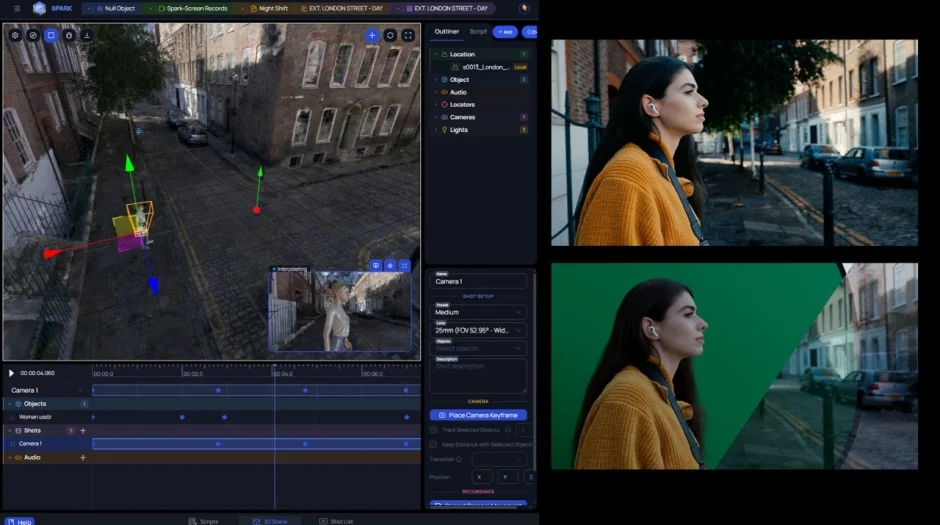
Lightcraft Technology has unveiled Spark Story, a groundbreaking real-time virtual shot system poised to transform the filmmaking process by enabling collaborative 3D visualization from the earliest stages of production. This innovative tool empowers creative teams to conceptualize, develop, and refine projects in an immersive 3D environment, ensuring that initial creative decisions maintain their integrity throughout the production pipeline, from script to final shot.
The core functionality of Spark Story lies in its ability to translate scripts and ideas into tangible, explorable 3D scenes almost instantaneously. Filmmakers can now build digital environments that reflect realistic spatial relationships, incorporate physically accurate motion, and simulate the behavior of real-world camera and lens systems. This early-stage visualization dramatically reduces the risk of costly creative misalignments that often surface later in production or post-production, a persistent challenge in the film industry. By allowing teams to "see their story" before stepping onto a physical set, Spark Story aims to democratize advanced previsualization techniques, making them accessible regardless of a project’s budget, scale, or the team’s prior experience.
"For the first time in history, every team can see their story before they step on set, regardless of budget, size or experience," stated Eliot Mack, CEO and founder of Lightcraft Technology. "The days of waiting until post to figure out if the story is working are over. With Spark Story, a team can go from 0 to 80% and be ready for pitching and planning almost immediately. Then they can pull people in, build momentum and radically accelerate the shooting process." This statement highlights the system’s ambition to streamline pre-production, a phase often characterized by lengthy iteration cycles and the need for specialized technical expertise.
Collaborative Workflow and Accessibility
Spark Story is designed with a global, distributed workforce in mind. Its integrated browser and mobile applications facilitate real-time collaboration among team members, irrespective of their geographical locations. This is achieved through the seamless integration of scripts, advanced rendering techniques like Gaussian splats, and industry-standard universal scene description (USD) assets. The system’s intuitive camera motion tools further enhance the interactive previs experience, allowing users to intuitively block out shots and explore different cinematic perspectives.
The ability to work with scripts directly within the 3D environment and to import existing assets signifies a significant leap in workflow efficiency. Traditionally, the translation from script to visual representation involved multiple steps, often handled by separate departments with distinct software tools. Spark Story aims to bridge these gaps, fostering a more unified and fluid creative process. The implications for independent filmmakers and smaller studios are particularly profound, as they often face resource constraints that limit access to sophisticated previsualization tools.

A Glimpse into the Future of the Spark Platform
Spark Story represents the foundational element of Lightcraft Technology’s broader Spark platform, a comprehensive ecosystem currently under development. While details regarding the full platform’s capabilities and release timeline remain under wraps, the company’s stated objective is to unify artificial intelligence (AI), 3D technologies, and traditional filmmaking methodologies into an end-to-end production system.
The development of the Spark platform is spearheaded by a team with significant industry pedigree. Lightcraft Technology was co-founded by Emmy-winning inventor Eliot Mack, a visionary in visual effects technology, and chairman Bill Warner, the renowned founder of Avid Technology, a company that revolutionized non-linear editing in the film and television industry. This blend of expertise in visual innovation and foundational production infrastructure suggests a robust and impactful future for the company’s offerings.
Accelerating Previs and Beyond
Interactive previs, the process of creating rough 3D simulations of shots, is a crucial but often time-consuming aspect of pre-production. Spark Story aims to dramatically accelerate this process, enabling teams to rapidly iterate on storyboarding, camera placement, and scene composition. This accelerated workflow has a direct impact on pitching and planning phases, allowing projects to gain momentum faster.
The "0 to 80%" preparedness mentioned by Mack suggests that Spark Story can quickly establish a strong visual foundation for a project, providing a compelling and concrete representation of the narrative that can be used for internal reviews, investor pitches, and discussions with key crew members. This level of early visual clarity can significantly de-risk a project and build confidence among stakeholders.
Background and Industry Context
The film industry has long sought to improve the efficiency and accuracy of pre-production. Traditional methods often involved storyboards, animatics, and physical mock-ups, which could be labor-intensive and prone to misinterpretation. The advent of digital technologies, including 3D modeling and virtual production, has offered significant advancements, but often at a high cost and with a steep learning curve.
Virtual production, in particular, has gained traction in recent years, leveraging LED walls and real-time rendering engines to create immersive environments for on-set visualization and shooting. However, these systems typically come into play much later in the production cycle. Spark Story’s innovation lies in bringing advanced 3D visualization and collaborative capabilities to the absolute earliest stages of a project, effectively bridging the gap between script conceptualization and the more intensive phases of virtual production.

The integration of AI into the broader Spark platform, as hinted by the company, could further unlock new possibilities. AI could potentially assist in generating initial 3D environments from scripts, optimizing camera movements based on narrative cues, or even predicting potential production challenges.
Data and Supporting Information
While specific data on user adoption and performance metrics for Spark Story are not yet publicly available, the underlying principles it addresses are well-documented. Industry reports consistently highlight pre-production as a critical factor in overall project success and budget adherence. Delays and miscommunications during this phase are often cited as primary drivers of budget overruns and schedule slippage.
For example, a 2022 study by the Motion Picture Association (MPA) indicated that the average budget for a major studio film can range from $70 million to over $200 million. Even a small percentage saved through more efficient pre-production can translate into millions of dollars. Furthermore, the increasing complexity of visual effects and the rise of global co-productions necessitate tools that can foster seamless collaboration across diverse teams and time zones. The accessibility of web-based and mobile platforms, which Spark Story leverages, is also a critical trend, with a growing reliance on cloud-based workflows in the creative industries.
Potential Implications and Future Outlook
The introduction of Spark Story has several potential implications for the film industry:
- Democratization of Advanced Previsualization: By offering a more accessible and collaborative platform, Spark Story could empower a wider range of filmmakers, including those in independent cinema and emerging markets, to leverage sophisticated previsualization techniques.
- Reduced Production Costs and Timelines: By identifying and resolving creative and logistical issues early on, the system has the potential to significantly reduce costly reshoots, delays, and rework in later stages of production.
- Enhanced Creative Collaboration: The real-time, multi-user functionality fosters a more integrated and communicative creative process, allowing directors, cinematographers, production designers, and other key personnel to work in concert from the outset.
- Foundation for Future Innovations: As the first component of the Spark platform, Spark Story sets the stage for a more comprehensive suite of tools that could redefine the entire filmmaking pipeline, potentially incorporating AI-driven workflows and advanced real-time rendering capabilities.
Lightcraft Technology’s announcement of a beta program for Spark Story invites industry professionals to experience its capabilities firsthand. Interested parties can sign up for notifications on the company’s official website, signaling an upcoming phase of testing and refinement before a wider release. The development of the full Spark platform, with its ambitious vision of an end-to-end production system, promises to be a significant area of focus for the company and a closely watched development within the filmmaking community.
The long-term success of Spark Story and the broader Spark platform will likely depend on its ability to seamlessly integrate with existing industry workflows, its performance in real-world production environments, and its capacity to continuously adapt to the evolving technological landscape of filmmaking. However, the initial offering presents a compelling vision for a more collaborative, efficient, and visually-driven future for storytelling on screen.