

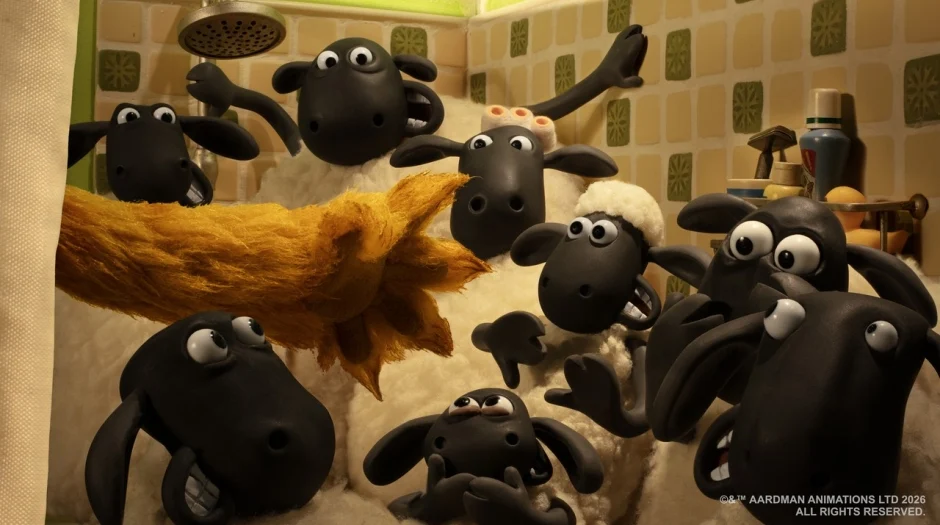
The legendary stop-motion animation studio Aardman Animations has long established a reputation for populating its cinematic universes with eccentric, highly memorable characters. From the cheese-loving exploits of Wallace and Gromit to the prehistoric antics of Early Man, the Bristol-based studio has consistently pushed the boundaries of physical puppet craftsmanship. With the upcoming release of Shaun the Sheep: The Beast of Mossy Bottom, scheduled to hit theaters on September 18, Aardman is once again raising the technical bar. This latest feature introduces one of the studio’s largest and most visually complex creations to date: the towering, shaggy Mossy Bottom beast.

As Aardman prepares for the global rollout of this family adventure, the production highlights a meticulous blend of traditional hand-crafted artistry and innovative visual effects. Co-directed by longtime studio collaborators Steve Cox and Matthew Walker, the film promises to deliver the trademark slapstick humor, intricate world-building, and profound visual detail that fans of the franchise have come to expect over nearly three decades of television and film production.
Plot Dynamics and Production Chronology
The narrative of The Beast of Mossy Bottom unfolds at the iconic Mossy Bottom Farm as the animal residents eagerly prepare for Halloween festivities. However, comedic chaos ensues when the perpetually clumsy Farmer inadvertently destroys the flock’s cherished pumpkin patch. In an effort to rectify the situation, Shaun adopts the persona of a mad scientist, setting off a chain reaction that quickly spirals out of control. With the Farmer mysteriously missing and a massive, wild creature stalking the dense woods surrounding the nearby town of Mossingham, the stage is set for a high-stakes, monster-themed escapade.

The origins of this feature trace back through Aardman’s extensive development pipeline. The film features characters originally conceived by acclaimed filmmaker Nick Park, whose indelible imprint on British animation continues to guide the studio’s creative direction. The screenplay is penned by Mark Burton—whose notable credits include the Academy Award-winning Wallace and Gromit: The Curse of the Were-Rabbit and the Academy Award-nominated Shaun the Sheep Movie—alongside Giles Pilbrow, a veteran writer for the Shaun the Sheep television series and holiday specials.
The production is overseen by producer Richard Beek, with Park, Peter Lord, Carla Shelley, and Sarah Cox attached as executive producers. Distribution duties are shared among major international players, with GKIDS managing the theatrical release in the United States, STUDIOCANAL handling worldwide sales and international theatrical distribution, and Sky U.K. securing the rights for the United Kingdom.

Scaling Up: Engineering the Ultimate Stop-Motion Monster
Bringing the Mossy Bottom beast to life required unprecedented coordination between Aardman’s puppet-making department and the animation floor. According to co-director Steve Cox, the sheer physical scale of the character eclipses almost everything the studio has produced previously.
"Our bull character in the film weighs a ton because he’s solid clay and the were-rabbit from Wallace and Gromit was a similar size, but not quite as hairy or big as the beast in this film," Cox explains. "This is definitely the biggest Shaun character we’ve made and it’s definitely one of Aardman’s tallest characters."

Managing a puppet with extensive, unruly fur presents a monumental challenge within the medium of stop-motion animation, where frame-by-frame adjustments are susceptible to unwanted hair drift. To combat this, the puppet team engineered a sophisticated internal framework. The creature’s abundant orange hair was treated with polyvinyl acetate (PVA) glue to stabilize its form, while concealed internal armature wires allowed animators to precisely manipulate individual tufts. Additionally, the puppet featured discreet access ports, enabling animators to use specialized tools to adjust features without physically altering the main body of the figure.
The technical foundation for this character design was informed by prior studio projects, specifically Nick Park’s 2018 feature Early Man. Directors Cox and Walker noted that the wavy, sweeping hair utilized on the character Dug served as a crucial reference point, proving that large-scale hair manipulation was viable within Aardman’s production ecosystem.

Blending Practical Craftsmanship with Modern VFX
While stop-motion remains the beating heart of Aardman’s operations, The Beast of Mossy Bottom demonstrates an aggressive expansion into enhanced atmospheric effects and digital compositing. Art director Andy Brown and director of photography Charles Copping intentionally sought to push past the conventional aesthetic boundaries typically associated with half-hour television specials, utilizing expanded budgets and advanced rendering techniques to enrich the cinematic scope.
For sequences requiring complex environmental elements—such as dense forest fog, rain-soaked dockyards, and an expansive cargo ship sequence—the art department integrated modern technological solutions alongside classic filmmaking tricks. Notably, the team utilized Gaussian splats, an advanced 3D rendering technique, to build out expansive environments like the town’s historic windmill and surrounding woodlands without having to compromise on visual complexity.

In crafting the mad scientist lightning storms, co-director Walker drew inspiration from 1980s cinematic techniques. Eschewing purely digital solutions in favor of a handcrafted aesthetic, the effects team constructed physical cloud tanks—vessels filled with salt water and fresh water injected with white paint—to capture authentic fluid dynamics. These practical elements were subsequently combined with hand-drawn 2D lightning bolts generated within the windmill sequences.
Furthermore, Shaun’s glowing pink laboratory serum was brought to life through a combination of practical chemistry and digital enhancement. Cinematographer Charles Copping notes that the team extracted UV ink from everyday pens, blended it with hair gel, and filmed specific animation passes entirely under ultraviolet light. Visual effects artists then layered these elements, granting the studio precise control over color rotation and fluid luminescence during post-production.

Performances, Practical Trickery, and the Voice Cast
Behind the silent, expressive antics of the farm animals lies a familiar lineup of vocal talent. Justin Fletcher returns to voice the titular Shaun and the rest of the flock, accompanied by John Sparkes and Kate Harbour. Their vocal performances provide the emotional anchor for physical comedy gags that rely heavily on precise timing and visual subtext.
The creative team emphasized that the production culture thrives on collaborative improvisation. Throughout the scripting and animation phases, crew members regularly contributed spontaneous gags, refining simple visual concepts into memorable character beats. A prime example highlighted by Walker involves the meticulous sheepdog, Bitzer, who—even while fleeing in absolute terror from the monster—pauses to adjust his truck’s mirrors and seat position to adhere strictly to protocol.

Practical ingenuity remains a cornerstone of the studio’s philosophy. From hiding clotheslines behind puppets to simulate objects being pulled directly from a character’s mouth, to shooting eyebrow hair-growth sequences in reverse by trimming physical clay models frame-by-frame, the production relied heavily on tangible problem-solving. This pragmatic flexibility ensures that the humor remains grounded in physical reality, maintaining the distinctive charm that has sustained the franchise for generations.
Broader Implications for the Animation Industry
The release of Shaun the Sheep: The Beast of Mossy Bottom arrives at a critical juncture for the stop-motion animation sector. As fully computer-generated imagery continues to dominate commercial box office returns, handcrafted studios face persistent economic pressures regarding production timelines and labor costs. By successfully integrating emerging digital tools—such as advanced 3D rendering and hybrid practical effects—with traditional claymation, Aardman demonstrates a viable blueprint for modernizing legacy animation formats without sacrificing their tactile identity.

Industry analysts observe that international distribution partnerships, such as GKIDS handling the North American footprint and STUDIOCANAL overseeing global territories, reflect strong institutional confidence in the commercial viability of British stop-motion cinema. As family audiences increasingly seek diverse aesthetic experiences outside of mainstream studio pipelines, The Beast of Mossy Bottom positions itself as a testament to the enduring appeal of physical craftsmanship enhanced by modern cinematic technology.