

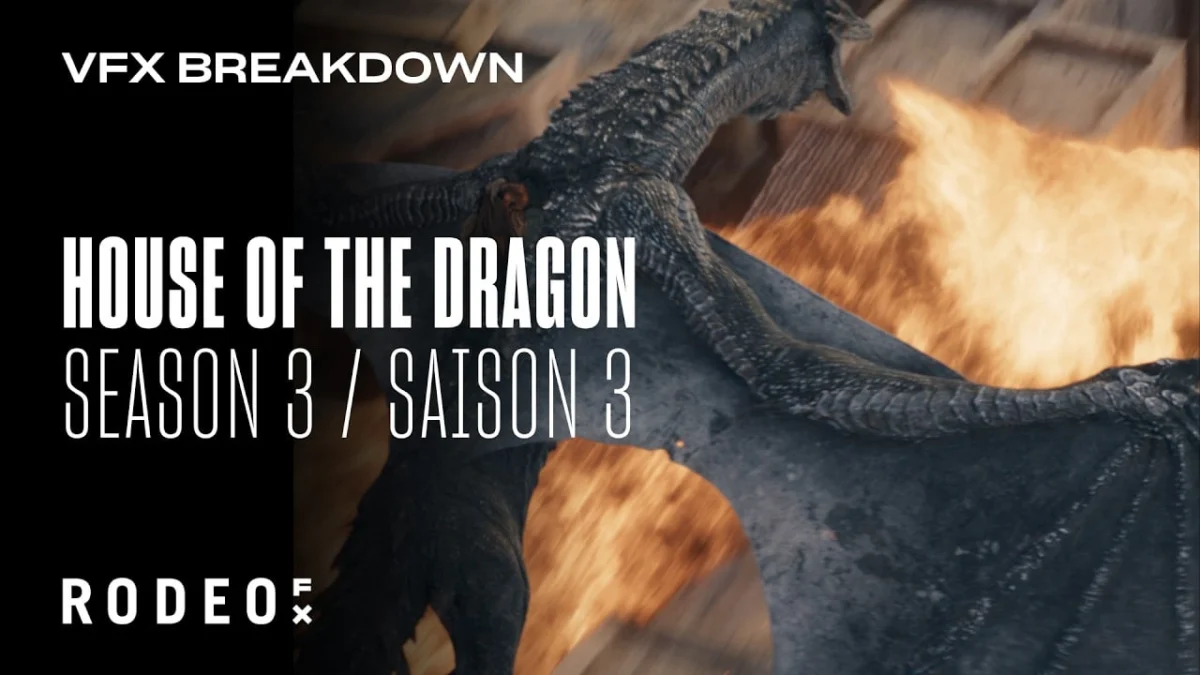
Visual effects powerhouse Rodeo FX has officially released its highly anticipated visual effects breakdown reel for the third season of HBO’s critically acclaimed fantasy drama House of the Dragon. Building upon their extensive contributions to the network’s flagship Game of Thrones prequel series, the Montreal-based studio expanded its operational footprint significantly for the latest season. Under the expert leadership of VFX Supervisor Sébastien Francoeur, a dedicated team of 133 artists and technicians handled an impressive inventory of 394 visual effects shots distributed across 66 distinct sequences. This massive undertaking encompassed the intricate animation of six iconic dragons, seamless digital extensions for the sprawling capital of King’s Landing, the complete virtual construction of a major historical stronghold, and a complex, action-packed season finale battle featuring extensive crowd replication and massive pyrotechnic destruction.
The release of the breakdown reel offers industry professionals and fantasy enthusiasts alike a rare, behind-the-scenes glimpse into the sophisticated pipeline required to bring George R.R. Martin’s fantastical world to life on television. As high-end television production increasingly mirrors the budgetary and technical scale of blockbuster feature films, Rodeo FX’s latest contribution underscores the growing importance of specialized visual effects houses in sustaining the immersive quality of contemporary prestige television.
Background Context and Evolution of the Production Pipeline
House of the Dragon, developed by showrunner Ryan Condal, has established a reputation for pushing the boundaries of television visual effects since its debut. Set centuries before the events of Game of Thrones, the series chronicles the bitter civil war of the Targaryen dynasty, known historically as the "Dance of the Dragons." Because mythical beasts and sprawling medieval environments sit at the very heart of the narrative, the visual effects department operates as a critical pillar of the storytelling apparatus, working in tandem with the writers, directors, and production designers from pre-production through final post-production delivery.
Rodeo FX’s involvement with the franchise represents a natural evolution of their long-standing relationship with HBO. Having previously delivered stellar visual effects work for the second season of House of the Dragon, the studio was entrusted with a substantially larger and more complex mandate for Season 3. The expansion from their previous workload to nearly 400 shots reflects not only the network’s trust in Francoeur’s leadership but also the escalating scale of the television series’ military conflicts and narrative scope.
The logistical challenges of mounting such an ambitious production are immense. Coordinating 133 artists across diverse specializations—ranging from rigorous creature simulation to complex matte painting and compositing—requires a highly structured pipeline capable of maintaining stylistic and technical consistency. Working closely with overall VFX Supervisor Dadi Einarsson and overall VFX Producer Tom Horton, the Rodeo FX team successfully integrated their digital assets into the overarching visual language established for the broader universe of Westeros.
Mastering the Menagerie: Bringing Six Unique Dragons to Life
Among the most technically demanding aspects of Rodeo FX’s contribution to Season 3 was the animation and simulation of six distinct dragons: Tessarion, Silverwing, Moondancer, Caraxes, Vermithor, and Seasmoke. Each creature in the George R.R. Martin universe possesses a distinct personality, scale, coloration, and combat style, necessitating bespoke approaches to modeling, rigging, and animation overseen by Animation Supervisor Shahar Levavi.

Tessarion, often referred in the lore as the Blue Queen, demanded the most extensive creative and technical resources from the team. The creature’s behavioral performance required a delicate balance, frequently shifting between an endearing, puppy-like curiosity during quieter character moments and unbridled, raw combat instinct during sequences of engagement. Capturing this duality meant meticulous attention to facial musculature, wing membrane flexibility, and micro-expressions that could convey emotion without sacrificing the naturalistic weight of a massive reptilian predator.
Meanwhile, Vermithor—the Bronze Fury—presented a different set of obstacles, particularly during a prominent landing sequence. To sell the sheer mass and grounding of the ancient dragon, the studio relied heavily on advanced creature FX simulations. Every impact of the dragon’s claws against the terrain required dynamic interaction with soil, stone, and debris, ensuring that the physical presence of the creature registered authentically within the live-action plate photography.
Silverwing, a dragon whose introduction to audiences occurred during Rodeo FX’s work on Season 2 in a memorable sequence alongside the character Ulf beneath King’s Landing, returned in full glory for the third season. The studio’s artists rendered Silverwing in breathtaking full flight, executing dynamic aerial maneuvers and unleashing devastating torrents of dragon fire upon the opposing armies of the Seven Kingdoms. The integration of complex fluid dynamics for the fire simulations, coupled with volumetric lighting adjustments, ensured that the radiant heat and destructive capacity of the dragon attacks looked entirely grounded in physical reality.
Environmental Artistry: Invisible Extensions and Digital Architecture
Beyond creature work, Rodeo FX managed a dual-track environmental strategy that balanced invisible digital integration with large-scale procedural world-building under the direction of Environment Supervisor Olivier Goulet.
In sequences set within the bustling, congested streets of King’s Landing, the primary artistic objective was complete invisibility. The visual effects team constructed elaborate digital street extensions designed to blend seamlessly into the physical set plates captured on location and on soundstages. These additions required painstaking attention to period-accurate architectural details, atmospheric haze, street-level activity, and lighting continuity so that viewers remain entirely immersed in the illusion of a living, breathing medieval metropolis without ever suspecting digital intervention.
In stark contrast to the invisible augmentation required for King’s Landing, the production necessitated the creation of an entirely new stronghold: Tumbleton. Unlike existing sets, Tumbleton was built by Rodeo FX entirely from the ground up as a fully digital environment. To streamline the production pipeline and maximize creative efficiency, the studio implemented a sophisticated, tighter layer structure. This organizational methodology allowed the environment team to complete the stronghold with significantly less post-matte-painting cleanup than typically required for legacy locations like King’s Landing.
Sébastien Francoeur praised the efficacy of this streamlined setup, noting the collaborative success between departments. "Tumbleton was genuinely well built," Francoeur stated. "We had the layers we needed to finish it straight in comp, so the environment team really nailed that setup." This architectural precision not only expedited delivery schedules but also provided compositing supervisors Marie-Pier Couture-Alain and Geoffrey Wigmore with the flexible multi-pass data necessary to fine-tune atmospheric conditions and integration during the final digital assembly.
The Climax: Orchestrating the Season Finale Battle

The crowning achievement of Rodeo FX’s tenure on House of the Dragon Season 3 was the management of the season’s grand finale battle. Spanning hundreds of shots, this monumental sequence represented the studio’s single largest logistical and creative lift of the production cycle.
The battle sequence required a harmonious synthesis of all primary visual effects disciplines. Approximately 100 shots were dedicated exclusively to intricate crowd replication and simulation, populating the digital landscape with thousands of combatants engaged in large-scale warfare outside the walls of Tumbleton. These digital background elements had to interact convincingly with physical stunt performers, practical pyrotechnics, and dynamic environmental destruction.
Layered directly over the massive troop movements were continuous displays of destructive dragon fire, collapsing architecture, and rolling smoke plumes. Coordinating the interplay between digital fire simulations and live-action combat elements demanded rigorous data management and precise cross-departmental communication. CG Supervisor Loïc Beguel and Executive VFX Supervisor Joseph Kasparian oversaw the technical architecture required to render these heavy scenes without compromising visual fidelity or hitting rendering bottlenecks.
Industry Implications and the Future of High-End Television VFX
The successful delivery of nearly 400 complex visual effects shots for a premier streaming and cable property like House of the Dragon highlights the maturing capabilities of modern visual effects studios based outside traditional Hollywood hubs. Rodeo FX, anchored primarily in Montreal with additional international reach, exemplifies how regional creative centers have built robust infrastructures capable of matching the exacting demands of major media conglomerates like Warner Bros. Discovery and HBO.
As audiences continue to demand cinematic production values from episodic television, the workflow innovations pioneered during productions like House of the Dragon—such as Rodeo FX’s streamlined layering for digital environments and sophisticated creature simulation pipelines—are likely to become industry standards. By reducing friction between environment design, creature animation, and final compositing, studios can manage escalating shot counts while maintaining the meticulous artistic detail required for projects of this magnitude.
The third season of House of the Dragon premiered on HBO this past June, drawing immense viewership and critical acclaim, largely propelled by the high-caliber craftsmanship of its behind-the-scenes artisans. With the release of the official VFX breakdown reel, industry observers and aspiring artists have been given a comprehensive masterclass in how modern digital magic is forged, balancing raw technological innovation with classical artistic storytelling principles.