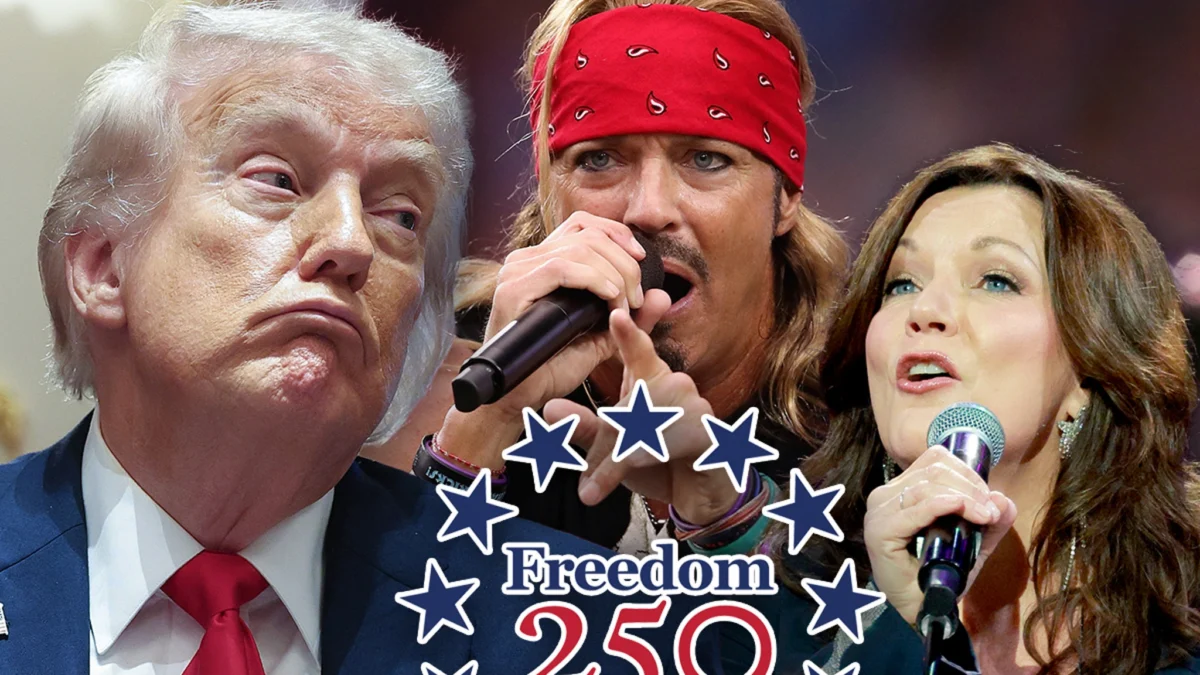
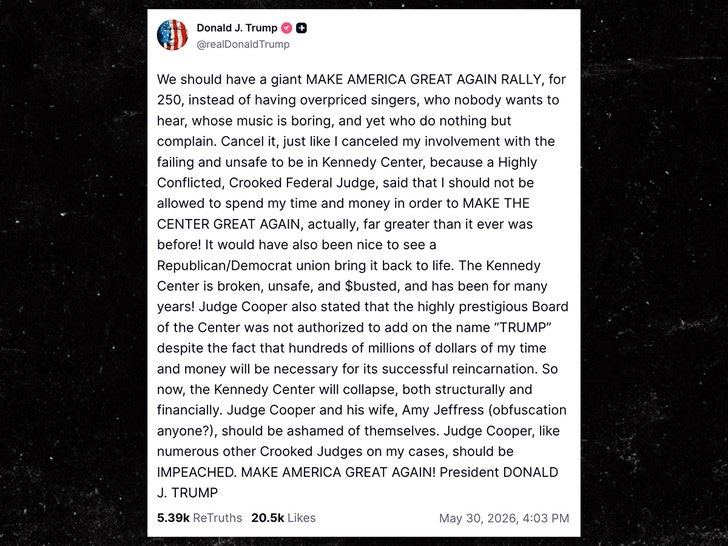
Washington D.C. – President Donald Trump has dramatically intervened in the planning for the Freedom 250 Great American State Fair, a cornerstone event designed to commemorate America’s 250th birthday, demanding its immediate cancellation. The President’s directive, issued via an explosive message on Truth Social, came in response to a growing list of prominent musical artists withdrawing from the scheduled performances, whom Trump disparaged as "overpriced singers, who nobody wants to hear, whose music is boring, and yet who do nothing but complain." The unprecedented presidential demand casts a pall over what was intended to be a unifying national celebration on the National Mall.
The announcement, made on Saturday, May 31, 2026, at 5:40 AM PDT, signaled a significant escalation in tensions surrounding the highly anticipated event. The Freedom 250 initiative, launched by President Trump last year, aimed to orchestrate a grand spectacle on June 24, 2026, on the iconic National Mall in Washington D.C., marking the United States’ quarter-millennium anniversary. The Great American State Fair was envisioned as the grand opening ceremony, featuring a diverse lineup of performers and a presidential address.
The President’s Stance and Rationale
In his characteristically direct Truth Social post, President Trump expressed profound displeasure with the artists who had recently pulled out of the Freedom 250 lineup. His remarks went beyond mere criticism, characterizing the performers as financially exorbitant and creatively stagnant. "I am pissed at the performers who dropped out of Freedom 250’s Great American State Fair – and now he wants to pull the plug on the whole damn event!" the post began, setting an aggressive tone. He further elaborated, "overpriced singers, who nobody wants to hear, whose music is boring, and yet who do nothing but complain."
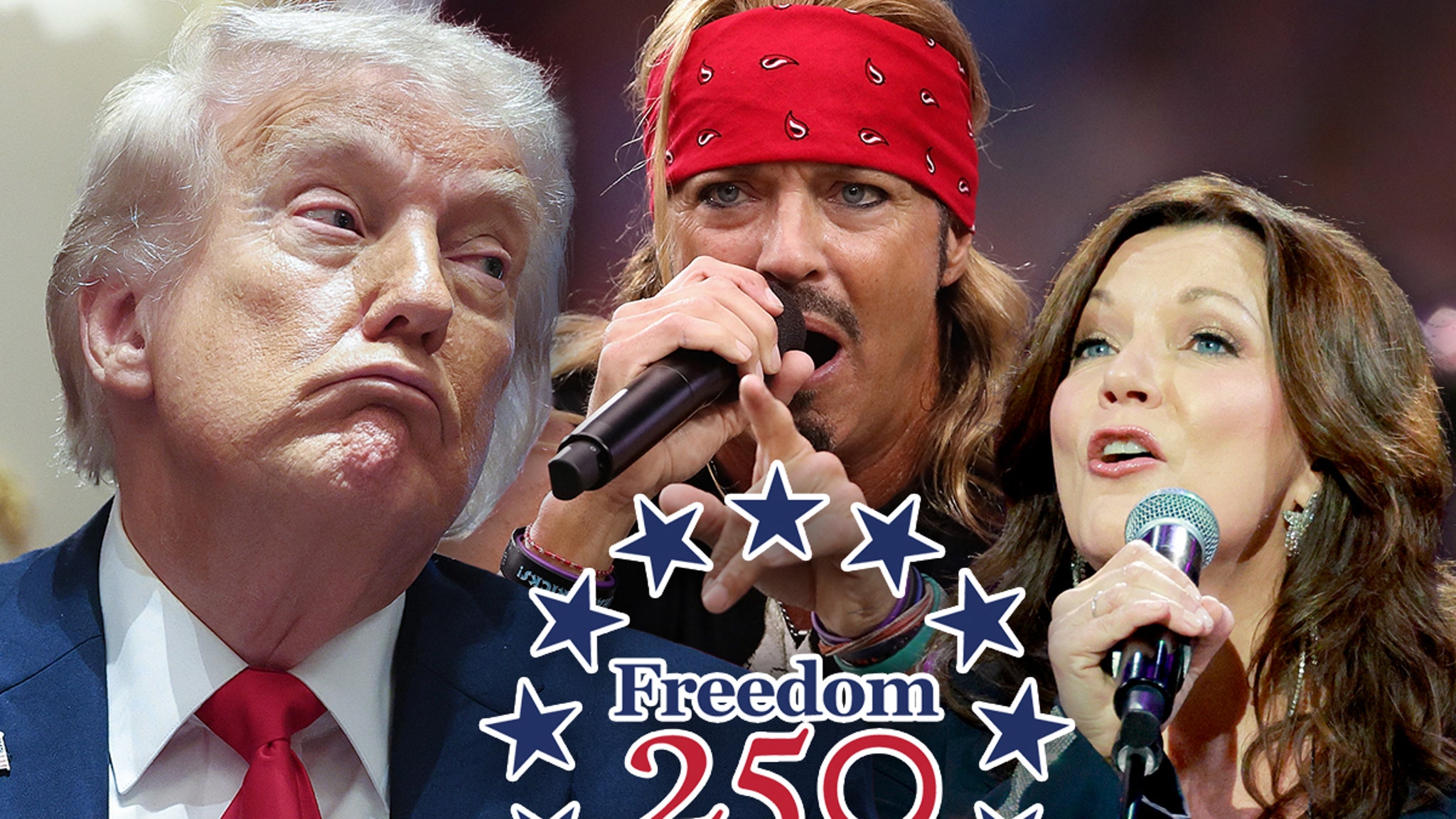
This strong condemnation culminated in a direct call for the event’s cancellation, with the President drawing a controversial parallel to another cultural institution. Trump demanded the cancellation of the Freedom 250 ceremony, comparing it to "the failing and unsafe to be in Kennedy Center." This comparison linked the perceived failings of the birthday celebration to his ongoing dispute regarding the John F. Kennedy Center for the Performing Arts, a separate but seemingly related grievance that appears to have fueled his frustration.
The Freedom 250 Initiative: A Background
The Freedom 250 initiative was conceived as a monumental undertaking to galvanize national pride and unity in anticipation of the nation’s 250th anniversary. Headed by Keith Krach, a former Trump State Department appointee, the organization aimed to create a series of events culminating in the Great American State Fair. The National Mall, a historic venue for national gatherings and celebrations, was chosen to host the inaugural ceremony, underscoring the event’s intended significance. Organizers had initially touted the celebration as a nonpartisan tribute to American history and culture, designed to appeal to a broad spectrum of citizens.
The concept of a national celebration on such a grand scale typically involves extensive planning, coordination with federal and local authorities, and significant financial investment, often drawing both public and private sector support. The 250th anniversary, following the bicentennial celebrations of 1976, was expected to be a landmark moment, potentially attracting millions of visitors to the nation’s capital and generating considerable economic activity for local businesses, hotels, and service providers.
A Chronology of Withdrawals and Perceived Politicization
The presidential directive to cancel the Freedom 250 concert did not emerge in a vacuum but followed a contentious period marked by a steady exodus of scheduled musical acts. Initially, the lineup boasted an eclectic mix of artists from various genres, aiming for broad appeal. However, in the days leading up to President Trump’s cancellation demand, several prominent performers publicly announced their withdrawal.
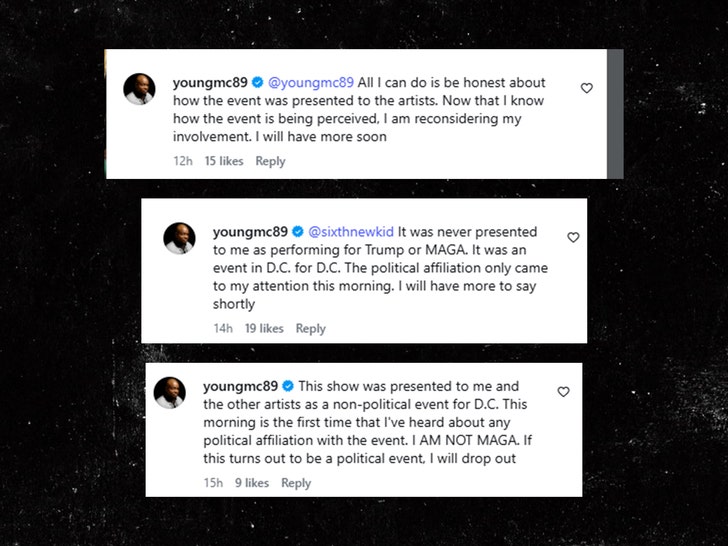
Among those who pulled out were legendary funk and soul group The Commodores, country music star Martina McBride, Morris Day and The Time, Poison frontman Bret Michaels, and rapper Young MC. Their reasons for withdrawal, as widely reported, centered on concerns that the event, initially presented as nonpartisan, had become increasingly politicized. Artists stated they felt "misled" regarding the show’s purported nonpartisan theme, suggesting that the event’s association with a specific political figure or administration overshadowed its intended nationalistic spirit. This sentiment highlighted the delicate balance required to host national commemorations in an era of deep political polarization, where even seemingly neutral events can be perceived through a partisan lens.
The withdrawals created a ripple effect, sparking public debate about the nature of national celebrations and the role of artists in politically charged environments. For many artists, maintaining an apolitical stance, particularly when performing at events with governmental ties, is crucial for their public image and fan base. The perception of being used as a political prop, even unintentionally, can have significant career implications.
Artists Who Remained Committed Amid Uncertainty
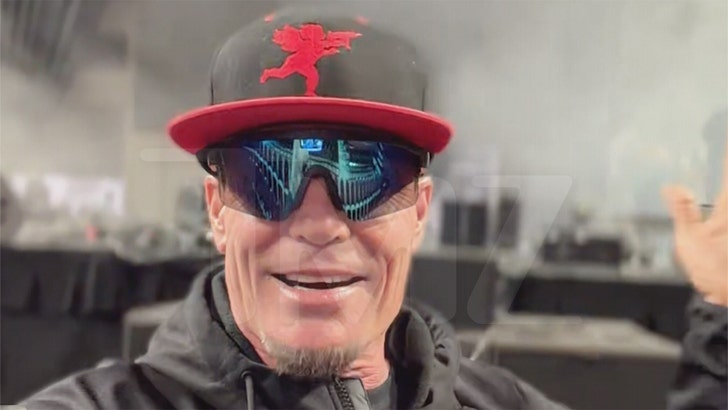
Despite the growing list of defections and the President’s call for cancellation, a handful of artists had publicly reaffirmed their commitment to perform, should the event proceed. These included hip-hop artists Flo Rida, Vanilla Ice, and Freedom Williams. Their continued willingness to participate suggested either a different interpretation of the event’s political leanings, existing contractual obligations that were harder to break, or a personal belief in the overarching message of celebrating America’s milestone.
Their steadfastness, however, now faces the direct challenge of a presidential order to terminate the event. The fate of their performances, and indeed the entire Great American State Fair, hinges on whether President Trump’s demand translates into an official cancellation by the organizers or if alternative arrangements can be made under duress. The legal and logistical complexities of unraveling an event of this magnitude, especially one with numerous artists, vendors, and sponsors, are considerable.
The Kennedy Center Controversy: A Parallel Grievance
President Trump’s decision to invoke the Kennedy Center in his Truth Social post provided crucial insight into his mindset and the broader context of his frustration. The President’s reference to the Kennedy Center as "failing and unsafe to be in" stemmed from a recent federal court ruling. A federal judge had recently blocked Trump’s proposed renovations at the historic performing arts venue and, significantly, ordered the removal of his name from the center.
This judicial decision evidently struck a nerve with the President. In his Truth Social post, Trump characterized the judge as "an anti-Trump Hater," underscoring his perception of the ruling as politically motivated. This ongoing legal and public dispute with a prominent cultural institution likely contributed to his strong reaction regarding the Freedom 250 concert, suggesting a broader discontent with what he perceives as a biased cultural establishment. The confluence of these two distinct but related grievances—performer withdrawals from Freedom 250 and the Kennedy Center ruling—appears to have solidified his resolve to demand the cancellation of the anniversary celebration.
Organizers’ Response and Public Reaction
The immediate aftermath of President Trump’s Truth Social post has been marked by uncertainty and a scramble for clarity among Freedom 250 organizers. As of this reporting, Keith Krach and the Freedom 250 team have not issued a formal public statement directly responding to the President’s demand. However, behind-the-scenes discussions are undoubtedly underway to assess the implications of a presidential order for an event they have been meticulously planning for months. Organizers face a difficult choice: comply with the President’s demand, attempt to salvage parts of the event, or push back against the directive, potentially risking further presidential ire.
Public reaction to the President’s announcement has been swift and polarized. Supporters of President Trump have largely applauded his stance, viewing it as a decisive move against what they perceive as ungrateful or politically motivated artists. Conversely, critics have decried the move as an overreach of presidential power, an attempt to silence dissenting artistic voices, and a politicization of a national anniversary that should ideally transcend partisan divides. Social media platforms are alight with debates, reflecting the deep divisions within the country regarding cultural events and political leadership. Commentators and cultural critics are weighing in on the implications for artistic freedom and the delicate balance between national commemoration and political expression.
Broader Implications for National Celebrations and the Arts
The potential cancellation of the Freedom 250 Great American State Fair carries significant broader implications beyond the immediate event. It raises fundamental questions about the future of national commemorative events and the willingness of artists to participate in them. The perception that such events can be easily politicized, or even summarily canceled by presidential decree over perceived slights, may deter future artists from committing to government-sponsored celebrations. This could lead to a chilling effect on cultural engagement with national milestones, making it harder to attract diverse and high-profile talent.
Moreover, the incident highlights the increasing challenge of fostering genuine national unity through cultural events in an intensely polarized political landscape. When the head of state publicly attacks performers and demands the cancellation of a national celebration due to artistic withdrawals, it underscores the difficulty in separating culture from politics. This situation could further entrench the divide, pushing artists and audiences further into their respective political camps.
Economic and Cultural Ramifications
The cancellation of an event planned for the National Mall of this scale would also have considerable economic ramifications. Vendors, production crews, security personnel, and local businesses that had invested resources and made plans based on the event’s occurrence would face significant losses. The ripple effect on tourism, hospitality, and ancillary services in Washington D.C. could be substantial, particularly as the city anticipates a boost from the 250th anniversary celebrations.
Culturally, the event’s demise would represent a missed opportunity to bring together Americans from all walks of life to celebrate a shared heritage. While the specific artists may be a point of contention, the underlying goal of a national birthday celebration is to foster a sense of collective identity and pride. The current situation, however, risks leaving a legacy of division rather than unity for America’s quarter-millennium milestone.
As the nation approaches its 250th anniversary, the dramatic turn of events surrounding the Freedom 250 Great American State Fair serves as a stark reminder of the intricate interplay between politics, culture, and national identity in contemporary America. The ultimate fate of the concert, and indeed the broader implications for how America chooses to celebrate its future milestones, remains to be seen.