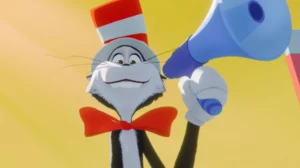
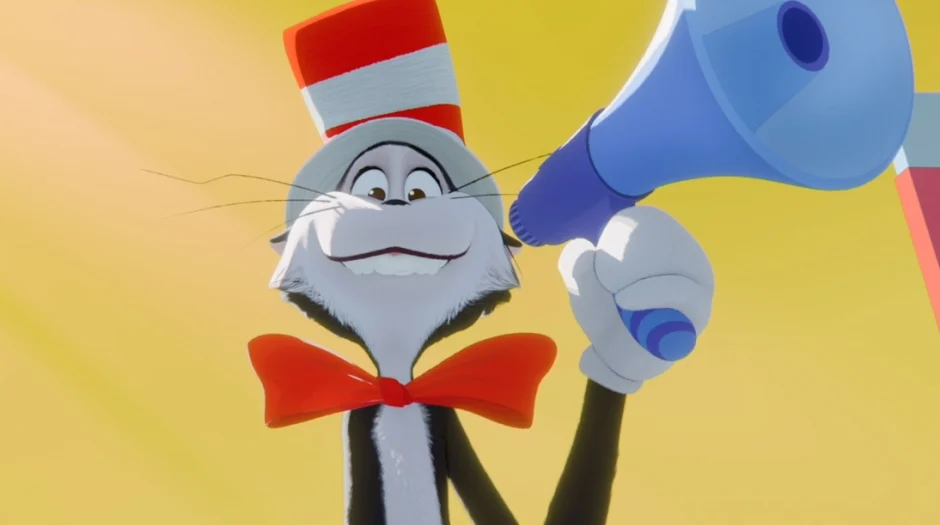
The landscape of family-oriented cinematic animation is poised for a significant expansion as Warner Bros. Pictures Animation formally releases the official theatrical trailer for its upcoming feature adaptation, The Cat in the Hat. Scheduled to hit international markets on November 4, followed by a wide North American release on November 6, the project represents a milestone for the studio as its first-ever full-length animated theatrical feature film. The newly unveiled promotional preview highlights the voice talents of comedian and actor Bill Hader, who steps into the iconic role of Dr. Seuss’s mischievous feline, alongside an original musical contribution titled "CATastrophe" by recording artist and actress Hilary Duff.
The film adapts the beloved 1957 children’s book by Theodor Seuss Geisel, universally known as Dr. Seuss, which has remained a cornerstone of early childhood literature for nearly seven decades. Directed by Erica Rivinoja and Alessandro Carloni from their own screenplay—based on a screen story by Caroline Williams—the production aims to bridge generational audiences by introducing traditional Seussian whimsy to modern animation techniques executed by DNEG Animation.
Main Facts of the Production
The cinematic undertaking is helmed by a prominent creative and executive team. Alongside Rivinoja and Carloni, the feature is produced by Daniela Mazzucato and Jared Stern. Executive producers include Bill Hader, Susan Brandt, Bill Damaschke, Kelly Marcel, Steve Zissis, Tim Story, and Alex Timbers. The technical and artistic execution relies on the craftsmanship of editor Dan Molina and composer Lorne Balfe, whose score accompanies the visual landscape crafted by the animation artists at DNEG Animation.
At the core of the narrative is the Cat, who is assigned his most formidable professional challenge yet by the Institute for the Institution of Imagination and Inspiration, LLC (I.I.I.I.). His objective is to cheer up Gabby and Sebastian, two young siblings who are experiencing the profound emotional displacement associated with relocating to a new town. Known historically for pushing boundaries and escalating chaos, the Cat faces a critical ultimatum: successfully raise the spirits of the children or face the permanent revocation of his magical hat.
The plot thickens when the Cat misplaces his essential "go backer" device, forcing the trio to embark on a high-stakes expedition into the fantastical land of memories to recover the item before structural and magical consequences ensue.
The voice cast supporting Hader features a notable ensemble of comedic and dramatic talent, including Matt Berry, Quinta Brunson, Xochitl Gomez, Giancarlo Esposito, America Ferrera, Tituss Burgess, Bowen Yang, Paula Pell, and Tiago Martinez. This diverse roster reflects a strategic casting choice designed to appeal to both contemporary demographic segments and traditional fans of family cinema.
Background Context and Intellectual Property History
The greenlighting and eventual release of The Cat in the Hat represent a calculated strategic pivot for Warner Bros. Discovery and its dedicated animation division. For decades, Dr. Seuss enterprises have maintained a protective stance over their intellectual properties, particularly following previous cinematic adaptations. The most notable live-action predecessor, Universal Pictures and Imagine Entertainment’s 2003 adaptation starring Mike Myers, grossed approximately $134 million worldwide against a production budget estimated at $109 million. While commercially viable, the live-action version received mixed critical reviews and established a high cautionary benchmark for future filmmakers handling the source material.

Subsequent adaptations shifted toward CGI animation, most notably with Illumination’s The Lorax (2012) and Universal’s The Grinch (2018), both of which demonstrated the immense box office potential of faithful, stylized animated adaptations of Dr. Seuss works. The Lorax opened to a robust $70 million domestically on its way to a worldwide gross of over $348 million, while The Grinch surpassed $512 million globally.
Capitalizing on this proven theatrical appetite, Warner Bros. Pictures Animation secured rights to establish an entire cinematic universe centered around the author’s legendary catalog. The Cat in the Hat is designated as the inaugural building block of this multi-film slate, carrying the weight of establishing the visual language, comedic tone, and market viability of subsequent Dr. Seuss adaptations under the Warner Bros. banner.
Chronology of Development and Production Milestones
The journey toward the November 2026 release date spans several years of strategic reorganization and creative development within Warner Bros. Animation.
In June 2018, Warner Animation Group (subsequently rebranded as Warner Bros. Pictures Animation) announced a creative partnership with Dr. Seuss Enterprises to develop multiple feature films based on the author’s literary universe. Among the initial titles prioritized was The Cat in the Hat, signaling a long-term commitment to theatrical family fare.
By March 2024, studio leadership under Bill Damaschke, who joined as head of Warner Bros. Pictures Animation in 2023, refined the release calendar and confirmed major creative personnel. Erica Rivinoja and Alessandro Carloni were locked in to write and direct, bringing extensive animation experience from projects such as South Park: Post Covid, Cloudy with a Chance of Meatballs 2, and Kung Fu Panda.
In June 2024, Warner Bros. formally unveiled the star-studded voice cast led by Bill Hader during an industry presentation at the Annecy International Animation Film Festival, generating substantial trade press and early fan engagement.
Throughout 2025, production advanced steadily with DNEG Animation serving as the primary visual effects and animation house. DNEG, renowned for its work on complex technical features across the industry, utilized advanced rendering techniques to translate the iconic 2D Seussian aesthetics—characterized by impossible architecture, non-Euclidean geometry, and vibrant color palettes—into a three-dimensional space without losing the hand-drawn essence of the original illustrations.
The autumn of 2026 marked the final marketing push, culminating in the public release of the official theatrical trailer and Hilary Duff’s original promotional single, "CATastrophe," designed to drive multi-platform awareness across digital streaming services and traditional broadcast media.
Supporting Data and Demographic Analysis

Family animation remains one of the most reliable and resilient sectors of the global theatrical box office. According to industry tracking data from major exhibition networks, animated features aimed at family audiences accounted for approximately 25% of total domestic box office revenues in the post-pandemic recovery era, outperforming several traditional live-action genres in repeat-viewing metrics.
The inclusion of Hilary Duff’s original single serves a dual demographic purpose. Duff, who maintains a robust multi-generational following stemming from her early television career through her contemporary musical output, bridges millennial parents and their Gen Alpha children. This cross-demographic targeting is mirrored in the voice cast: performers like Quinta Brunson (creator and star of Abbott Elementary) and Bowen Yang (Saturday Night Live) command substantial loyalty among young adult viewers who frequently drive opening-weekend social media traction.
Furthermore, international rollout strategies reflect the global appeal of Dr. Seuss properties. By premiering the film internationally on November 4—two days ahead of the domestic North American rollout on November 6—Warner Bros. Pictures Animation aims to capture early word-of-mouth momentum in key European and Asian markets, mitigating domestic competition and establishing a strong global footprint ahead of the competitive year-end holiday release window.
Official Statements and Industry Implications
While studio executives have maintained disciplined messaging regarding box office projections, internal memos and public statements from Warner Bros. Pictures Animation leadership underscore the immense strategic importance of the project.
"Adapting a literary treasure like The Cat in the Hat requires a delicate balance of reverence for the source material and bold, contemporary cinematic ambition," noted studio representatives during the initial project unveiling. "In Erica and Alessandro, we have storytellers who understand the chaotic, joyous heart of Dr. Seuss, and in Bill Hader, we have an artist whose comedic timing is uniquely suited to bring this iconic character to a new generation."
Industry analysts point out that the success or failure of The Cat in the Hat will have immediate ramifications for Warner Bros. Discovery’s broader intellectual property strategy. With traditional Hollywood studios increasingly relying on established pre-sold brands to mitigate financial risk, the establishment of a reliable, high-quality Dr. Seuss cinematic universe offers a lucrative counterweight to superhero-dominated franchises.
If DNEG Animation and the directorial duo successfully capture the anarchic spirit of the original text while delivering emotional resonance through the narrative arc of Gabby and Sebastian, Warner Bros. Pictures Animation will have secured a valuable, evergreen franchise. Conversely, any missteps in translating the minimalist, high-concept literary style into a feature-length narrative could prompt a reevaluation of subsequent planned Seuss adaptations.
As the countdown to the November theatrical debut continues, exhibitors and industry observers alike will monitor pre-ticket sales, social media sentiment, and early critical reception to gauge whether the Cat’s latest excursion into mischief, magic, and mayhem will secure its place in the modern animation canon.