
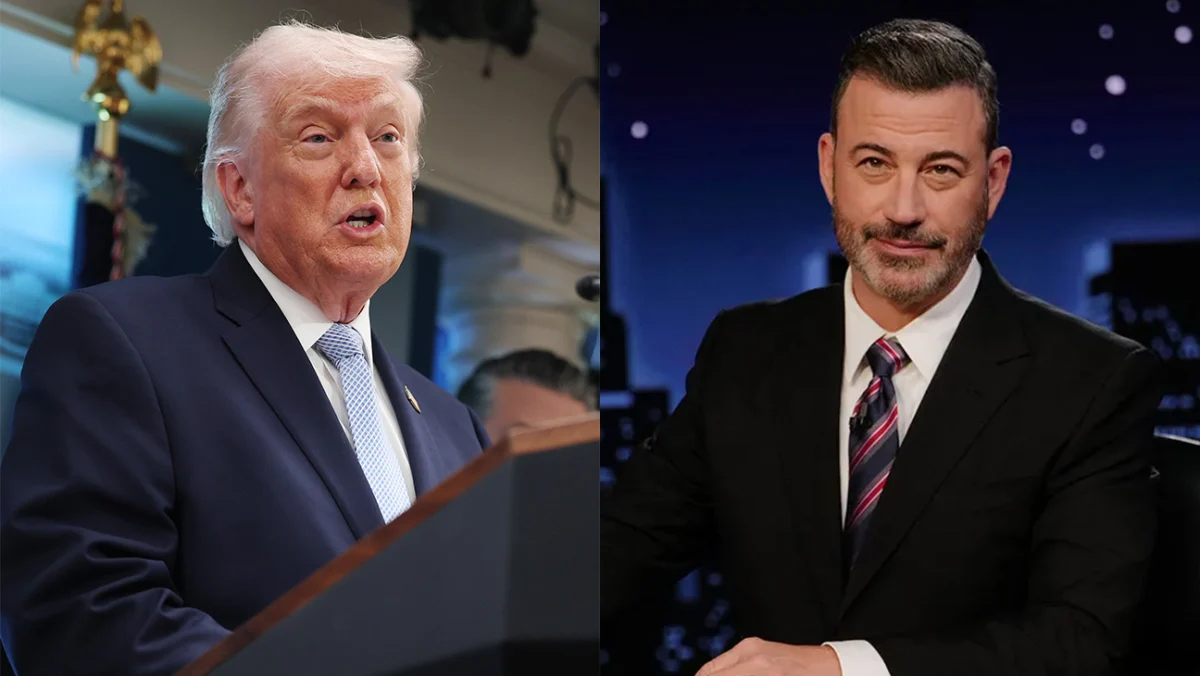
The long-running and often acrimonious public feud between late-night host Jimmy Kimmel and former President Donald Trump reached a new peak recently, following Trump’s public demand for ABC to terminate Kimmel’s employment. In a Truth Social post, Trump lambasted Kimmel as "seriously unfunny" and accused him of "incompetently presid[ing] over one of the Lowest Rated shows on Television," urging ABC to fire him "soon." Kimmel, a seasoned veteran of late-night television, wasted no time in delivering a sharp rebuttal during his monologue on Jimmy Kimmel Live!, turning the former president’s criticisms back on him and suggesting a broader political motivation behind the attacks. This exchange marks the latest escalation in a series of confrontations that have drawn attention to the intersection of political satire, media independence, and the weaponization of cultural criticism in contemporary American discourse.
The Genesis of the Latest Confrontation: A "Light Roast" and its Aftermath
The immediate catalyst for this latest round of hostilities stemmed from comments Kimmel made during a faux White House Correspondents’ Dinner segment on his show. Ahead of the actual White House Correspondents’ Dinner (WHCD), an annual event that typically features a comedian roasting the president and other political figures, Kimmel hosted his own version, delivering a series of satirical jokes. Among these was a remark directed at former First Lady Melania Trump, whom Kimmel addressed by noting, "Look at Melania, so beautiful. Mrs. Trump, you have a glow like an expectant widow." The joke, delivered on a Thursday preceding the WHCD, quickly garnered significant attention, particularly from conservative media outlets and figures loyal to the former president.
The reaction from the Trump camp was swift and severe. Following the WHCD event, both Donald and Melania Trump publicly called for Kimmel’s termination from Jimmy Kimmel Live!. Melania Trump’s office issued a statement, widely circulated across social media and conservative news platforms, expressing outrage over the joke and deeming it inappropriate for broadcast television. Donald Trump echoed these sentiments, using his platform to amplify calls for Kimmel’s firing, framing the joke as disrespectful and indicative of a broader bias against him and his family within mainstream media.
Kimmel, however, remained unrepentant. During the Monday episode of his show following the initial backlash, he addressed the controversy head-on, characterizing his remark as a "light roast" and pushing back firmly against the demands for his dismissal. "You know how sometimes you wake up in the morning and the first lady puts out a statement demanding you be fired from your job?" Kimmel quipped, adding, "We’ve all been there, right?" His refusal to apologize further fueled the criticism from his detractors, who viewed it as arrogance and a lack of accountability.
Regulatory Scrutiny and Corporate Response
The controversy took a more serious turn when the Federal Communications Commission (FCC) launched an "early review" of Disney’s broadcast TV licenses. Disney, as the parent company of ABC, holds numerous broadcast licenses, and any FCC review, even preliminary, signals potential regulatory scrutiny. The FCC’s mandate includes ensuring that broadcasters operate in the public interest, and complaints regarding content can trigger such reviews. While the FCC did not immediately issue a definitive statement on the scope or specific nature of its inquiry, the move was widely interpreted as a direct response to the public outcry and calls for action against Kimmel and ABC.
In response to the FCC’s action, a Disney spokesperson affirmed the company’s commitment to its broadcast responsibilities. "We are confident that [our] record demonstrates our continued qualifications as licensees under the Communications Act and the First Amendment and are prepared to show that through the appropriate legal channels," the spokesperson told The Hollywood Reporter. "Our focus remains, as always, on serving viewers in the local communities where our stations operate." This statement underscored Disney’s intent to defend its First Amendment rights and its programming decisions, signaling a firm stance against political pressure influencing its editorial or talent choices.
Trump’s Renewed Offensive and Kimmel’s Counter-Monologue
Despite Disney’s position and Kimmel’s earlier defense, Donald Trump escalated his campaign against the late-night host. On Thursday, he utilized his Truth Social platform to directly pressure ABC, writing, "When is ABC Fake News Network firing seriously unfunny Jimmy Kimmel, who incompetently presides over one of the Lowest Rated shows on Television? People are angry. It better be soon!!!" Trump’s post reiterated his long-standing criticism of Kimmel’s comedic style and the ratings performance of his show, while also attempting to leverage public sentiment by claiming, "People are angry."
Later that same day, Trump further amplified his demands during an appearance on Newsmax, a conservative news channel. He reportedly called Kimmel a "low life" and once again insisted on his firing. This consistent and multi-platform attack highlighted Trump’s ongoing strategy of directly engaging with and attempting to delegitimize media figures he perceives as critical or hostile.
Kimmel’s response during his Thursday night monologue was both defiant and strategically calculated. A screenshot of Trump’s Truth Social post was prominently displayed as Kimmel began his segment. Addressing Trump’s claim about "lowest rated shows," Kimmel retorted with a pointed comparison: "If incompetently presiding over not just one of, but the lowest rating in history is the reason I should be fired, we should both be out of a job." As he delivered this line, a photo of a headline indicating a slip in Trump’s approval ratings appeared on screen, reinforcing his counter-argument, and he concluded, "Because you’re not doing too good either."
The "Distraction" Theory and Hypocrisy Allegations
Beyond simply defending his show’s performance, Kimmel pivoted to a broader critique of Trump’s motives. He argued that the former president’s outrage was a deliberate tactic to divert public attention from more substantive political issues. "And of course, all of this is meant to distract us from the prices he didn’t lower on day one, and from the Trump-Epstein files that his attorney general refuses to release, and to distract us from the illegal war he started and can’t figure out how to get out of," Kimmel stated.
This "distraction" theory is a common analytical framework applied to high-profile political figures engaging in cultural wars. By mentioning specific, politically charged topics—such as unfulfilled promises (like lowering prices), the ongoing legal and public interest surrounding the "Trump-Epstein files" (likely referring to documents related to Jeffrey Epstein’s associates that have been subject to public release and scrutiny), and a vague "illegal war" (possibly alluding to past foreign policy decisions or rhetoric under his administration that faced criticism)—Kimmel sought to frame Trump’s attacks as a calculated maneuver rather than genuine outrage over a joke. He further underscored this point by remarking on the perceived triviality of the feud compared to global events: "Isn’t there a war dragging on? Imagine if FDR had taken to the airwaves during the Battle of the Bulge to complain about a Little Orphan Annie comic strip he didn’t like? Trump has three wars going on right now; Iranians, Ukrainians and comedians."
Kimmel also deftly deployed a charge of hypocrisy against Trump. He recalled that during his campaign for president, Trump had presented himself as a champion against "censorship, blacklisting and cancel culture." A clip of Trump articulating this stance was then shown during the monologue. Following the clip, Kimmel delivered a punchline that resonated with many critics of the former president: "I hate to say this, and I hope it doesn’t get me in trouble, I’m starting to think Donald Trump might be a hypocrite." This direct challenge to Trump’s stated principles on free speech and media censorship served to highlight what Kimmel perceived as a double standard.
Historical Context and Broader Implications
The ongoing feud between Kimmel and Trump is not an isolated incident but rather fits into a broader pattern of interactions between political figures and late-night comedians. Throughout American history, late-night hosts have often served as informal satirists of those in power, pushing boundaries and challenging authority through humor. From Johnny Carson’s gentle jabs to David Letterman’s more acerbic wit, and later, the overtly political commentary of Jon Stewart, Stephen Colbert, and Jimmy Kimmel, late-night television has consistently reflected and influenced public discourse.
Donald Trump’s approach, however, represents a significant departure from historical norms. While presidents have certainly been the target of comedic criticism, and some have expressed annoyance, the consistent, direct, and public calls for the firing of media personalities by a former president—and presidential candidate—are largely unprecedented. This strategy can be seen as an extension of Trump’s broader adversarial relationship with the mainstream media, which he frequently labels "fake news" and an "enemy of the people." By demanding the termination of a prominent host, Trump implicitly seeks to exert control over media content and personnel, a move that raises serious concerns about media freedom and the chilling effect such pressure could have on satirical expression.
Supporting Data and Analysis: Ratings and Political Approval
Trump’s claim that Jimmy Kimmel Live! is "one of the Lowest Rated shows on Television" requires factual context. While late-night television viewership, like traditional linear television across many genres, has generally seen declines in the era of streaming and fragmented media consumption, Jimmy Kimmel Live! remains a competitive player within its specific niche. It typically vies for viewership with other network late-night staples such as The Late Show with Stephen Colbert on CBS and The Tonight Show Starring Jimmy Fallon on NBC. While ratings fluctuate nightly and by demographic, Kimmel’s show consistently draws millions of viewers and is a significant property for ABC. To label it "lowest rated" without specific, comprehensive comparative data is often a rhetorical tactic rather than a factual statement. For instance, in recent seasons, The Late Show with Stephen Colbert has often led in total viewership, but Jimmy Kimmel Live! frequently performs strongly in key demographics and is a major platform for celebrity interviews and cultural commentary.
Conversely, Kimmel’s counter-argument referencing Trump’s approval ratings also holds weight. Public opinion polls consistently tracked Trump’s approval ratings throughout his presidency, often showing them to be historically low compared to other modern presidents, frequently hovering in the low to mid-40s. Post-presidency, while still retaining strong support among his base, his overall favorability ratings among the general population have continued to reflect a polarized electorate. This juxtaposition by Kimmel was a direct and effective retort, using Trump’s own metric of public favor against him.
The "Death Joke" Precedent
Adding another layer to the complex dynamic, Kimmel himself had previously slammed Trump for a joke the former president made regarding his own marriage. On Tuesday’s episode of Jimmy Kimmel Live!, Kimmel highlighted a speech Trump delivered at an event tied to England’s King Charles’ state visit. In his address, Trump recalled his parents being married for 63 years, then told his wife, "That’s a record we won’t be able to match, darling. It’s just not gonna work out that way." Kimmel seized on this, joking during his monologue, "Wait a minute. Did he just make a joke about his death? My God, you should be fired for that." This earlier exchange demonstrated Kimmel’s consistent strategy of turning Trump’s criticisms and rhetoric back on him, underscoring what Kimmel perceives as a double standard in how jokes are received and judged depending on their target.
Conclusion: An Enduring Battleground
The escalating feud between Jimmy Kimmel and Donald Trump is more than just a celebrity spat; it is a microcosm of broader cultural and political conflicts in the United States. It underscores the ongoing tension between political power and the role of satire in a democratic society, the pressures faced by media organizations caught between partisan divides, and the ever-present debate over freedom of speech versus perceived offense.
As long as prominent figures like Trump continue to engage directly with and critique media personalities, and as long as late-night hosts like Kimmel continue to use their platforms for political commentary and satire, these confrontations are likely to persist. They serve to energize political bases, provide fodder for news cycles, and continually test the boundaries of acceptable discourse in an increasingly polarized public sphere. The saga of Kimmel and Trump, therefore, remains an important barometer of the evolving relationship between entertainment, media, and the political landscape of the nation.