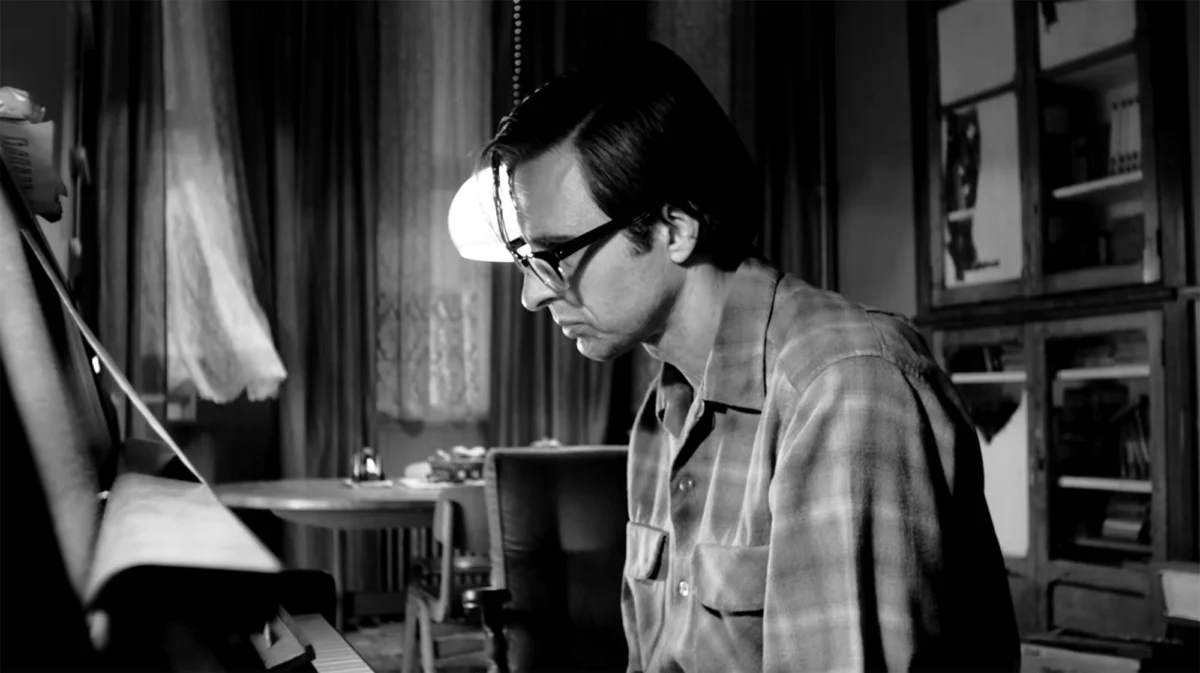
Modern Films UK has officially unveiled the inaugural trailer for Everybody Digs Bill Evans, a highly anticipated independent drama chronicling the life and profound struggles of American jazz maestro Bill Evans. The film, which first garnered critical attention at the 2026 Berlin Film Festival earlier this year, has since made stops at the Dublin and Karlovy Vary Film Festivals, setting the stage for its UK theatrical release on September 11th, 2026. At its core, the biopic, directed by acclaimed English filmmaker Grant Gee and starring Norwegian actor Anders Danielsen Lie as the legendary pianist, transcends the typical musician’s tale, delving instead into the devastating impact of grief on artistic genius.
The trailer, released on July 19, 2026, provides a stark, black-and-white glimpse into Evans’s world, underscored by the poignant declaration, "Sometimes an intermission is part of the music." This quote, resonating deeply with the film’s narrative, hints at the central conflict: Evans’s battle to overcome personal tragedy and reclaim his musical voice following the untimely death of his brilliant young bassist, Scott LaFaro, in 1961. The visual aesthetic of the trailer — a deliberate choice by Gee — emphasizes the emotional rawness and introspective nature of the story, drawing viewers into the troubled inner life of one of the 20th century’s most influential jazz figures.
A Musical Prodigy’s Journey and the Formation of an Iconic Trio
Bill Evans, born William John Evans in Plainfield, New Jersey, in 1929, was a piano virtuoso whose early classical training profoundly shaped his distinctive jazz approach. From a young age, Evans displayed exceptional musical talent, mastering classical repertoire before transitioning to jazz, where he quickly developed a unique harmonic sensibility and lyrical improvisation style. His innovative use of "block chords," introspective melodic lines, and a profound sensitivity to dynamics set him apart from his contemporaries. Evans’s sound was often described as impressionistic, drawing parallels to composers like Debussy and Ravel, yet infused with an undeniable jazz swing and blues inflection. He revolutionized jazz piano, moving away from the more percussive, bebop-influenced styles towards a more fluid, conversational, and deeply emotive expression.
His career trajectory saw him collaborate with titans of the genre, most notably contributing to Miles Davis’s seminal 1959 album, Kind of Blue, an album widely regarded as one of the greatest and most influential jazz records of all time. However, it was the formation of his own trio in the late 1950s that truly cemented his legacy. With bassist Scott LaFaro and drummer Paul Motian, Evans forged what many consider the quintessential piano trio. This ensemble was revolutionary for its interactive, non-hierarchical approach, where each instrument contributed melodically and rhythmically in a collective improvisation that transcended the traditional soloist-accompanist dynamic. LaFaro, in particular, was a groundbreaking figure on the bass, pushing the instrument beyond its rhythmic and harmonic support role to become an equal melodic voice, engaging in intricate counterpoint with Evans’s piano.

The zenith of this trio’s collaboration came in June 1961, during a residency at New York’s legendary Village Vanguard. Over a single day, the trio recorded two live albums: Sunday at the Village Vanguard and Waltz for Debby. These recordings captured the trio at the peak of their telepathic interplay, showcasing their innovative approach to standards and original compositions. They are lauded as masterpieces, exemplifying the pinnacle of jazz improvisation and group cohesion. The album Everybody Digs Bill Evans, from which the film draws its title, was released earlier, in 1958, featuring Evans with bassist Sam Jones and drummer Philly Joe Jones, and was instrumental in establishing his burgeoning reputation as a leader.
The Tragic Interruption: Grief and Addiction
Just eleven days after those iconic Village Vanguard recordings, the jazz world was plunged into mourning. On July 6, 1961, Scott LaFaro, at the tragically young age of 25, died in a car accident. His death was a devastating blow to Evans, who considered LaFaro his musical soulmate and a profound personal friend. The loss plunged Evans into a deep depression, causing him to withdraw from performing and recording for several months – a period he later described as "numb with grief." This traumatic event marked a turning point in Evans’s life, exacerbating his struggles with addiction, which would plague him for the remainder of his career. The Berlinale synopsis explicitly highlights this struggle, noting the film "cutting between Evans’ present and future, his sobriety and intoxication, and his relationships with his family and on/off girlfriend, who shares his taste in music and hard drugs."
The film Everybody Digs Bill Evans is poised to explore this agonizing period, tracing Evans’s arduous journey to overcome his profound sorrow and find his way back to music. It seeks to portray not merely the external events of his life but the intense internal landscape of a troubled genius grappling with loss, addiction, and the relentless demands of his art. The quote, "Sometimes an intermission is part of the music," becomes a central metaphor for this period of forced hiatus and self-reflection, a necessary pause before the next movement of his life could begin.
Grant Gee’s Vision: A Director Tuned to the Artist’s Soul
At the helm of this ambitious project is English filmmaker Grant Gee, a director celebrated for his distinctive approach to documenting the lives of artists and musicians. Gee’s filmography includes critically acclaimed works such as Meeting People Is Easy (1998), a documentary about Radiohead, and Joy Division (2007), a comprehensive look at the iconic post-punk band. His previous films often delve into the creative process and the psychological complexities of his subjects, eschewing conventional narrative structures for a more impressionistic and emotionally resonant style. This background makes him particularly suited to explore the nuanced inner world of Bill Evans, an artist whose music was deeply personal and introspective.

Gee’s decision to film Everybody Digs Bill Evans in black and white is a deliberate artistic choice that serves multiple thematic purposes. It evokes the era in which Evans rose to prominence, lending an authentic, timeless quality to the visuals. More importantly, it strips away distractions, focusing the viewer’s attention on the emotional depth of the characters and the stark realities of Evans’s struggles. The absence of color can enhance the feeling of melancholy, isolation, and the raw intensity of grief, aligning perfectly with the film’s central theme. It underscores the film’s commitment to being "really not about jazz," but rather a profound character study of how "grief can torture a great artist."
The screenplay, penned by Mark O’Halloran, is based on Owen Martell’s novel Intermission. Martell’s book, known for its lyrical prose and deep dive into the psychological aftermath of LaFaro’s death on Evans, provides a rich literary foundation for O’Halloran’s adaptation. This collaboration between an acclaimed director, a skilled screenwriter, and a poignant source text suggests a film that is both meticulously researched and artfully conceived. Producers Alan Maher and Janine Marmot, known for their work on independent features with strong artistic sensibilities, further bolster the film’s pedigree.
Anders Danielsen Lie: Embodying a Jazz Icon
The casting of Norwegian actor Anders Danielsen Lie as Bill Evans has generated considerable anticipation. Lie is renowned for his nuanced portrayals of complex, often melancholic characters in critically acclaimed films such as Joachim Trier’s Oslo, August 31st (2011) and The Worst Person in the World (2021). His ability to convey profound internal struggles with subtlety and intensity makes him an ideal choice to embody Bill Evans, an artist whose public persona often masked deep emotional turmoil. The challenge of portraying a real-life musical genius, particularly one whose piano playing was so distinctive, is immense. Lie’s track record suggests a performance that will prioritize emotional authenticity and psychological depth over mere mimicry.
The supporting cast features a formidable lineup of established talents. Bill Pullman and Laurie Metcalf, both highly respected actors with extensive careers in film, television, and theatre, are set to bring their considerable experience to the project. While their specific roles have not been detailed in the initial announcements, their involvement indicates the film’s commitment to high-caliber performances across the board. Barry Ward and Valene Kane also feature, rounding out an ensemble that promises to deliver a compelling and emotionally charged narrative.
Festival Acclaim and Future Prospects

Everybody Digs Bill Evans made its world premiere at the prestigious 2026 Berlin Film Festival, a significant platform for international cinema. Selection for Berlinale is a testament to a film’s artistic merit and its potential to engage a global audience. The film’s subsequent appearances at the Dublin and Karlovy Vary Film Festivals further underscore its strong reception within the festival circuit, suggesting positive early critical buzz. These festivals are known for showcasing independent and art-house cinema, aligning perfectly with the film’s contemplative and character-driven nature. While specific critical reactions from these early screenings are yet to be widely published, the consistent festival presence indicates that the film is resonating with programmers and early audiences.
Modern Films UK’s role as the distributor for the United Kingdom points to a strategic release plan aimed at a discerning audience. The September 11th, 2026 release date positions the film for potential awards consideration later in the year, particularly given its strong festival pedigree and profound thematic content. As of now, a US release date remains unannounced, leaving American jazz enthusiasts and cinephiles eagerly awaiting news of its distribution across the Atlantic. The success of other recent music biopics, such as those exploring the lives of Freddie Mercury, Elton John, and Elvis Presley, highlights a robust market for stories about musical legends, although Everybody Digs Bill Evans appears to adopt a more introspective and art-house approach compared to some of its more mainstream counterparts.
The film’s exploration of grief, addiction, and the redemptive power of art positions it as more than just a biopic; it is a profound meditation on the human condition. Bill Evans’s music, born from a unique blend of intellectual rigor and raw emotion, found its most profound expression in the wake of immense personal sorrow. Everybody Digs Bill Evans promises to illuminate this complex interplay, offering audiences a rare glimpse into the soul of a jazz giant who, through his "intermissions," ultimately deepened his music and solidified his enduring legacy. The cinematic journey into Evans’s world, marked by both brilliance and tragedy, is set to be a powerful and unforgettable experience.