Legendary production designer Dean Tavoularis, whose visionary work shaped the iconic landscapes of cinematic masterpieces such as The Godfather trilogy, Apocalypse Now, and Bonnie and Clyde, passed away on Thursday at the age of 93. Tavoularis was celebrated for his meticulous attention to detail, his pioneering embrace of cinematic realism, and his profound influence on the visual aesthetics of the New Hollywood era. His death marks the loss of a true artist whose indelible contributions elevated the craft of production design to an art form, leaving an unparalleled legacy in film history.
A Life Dedicated to Craft and Artistry
Born the son of Greek immigrants during the Great Depression, Dean Tavoularis’s journey into the world of film was a testament to perseverance and an evolving artistic vision. His early life was marked by the economic hardships of the era and the transformative experience of World War II. Following his military service, Tavoularis channeled his artistic inclinations into animation, beginning his career at Walt Disney Studios in the 1950s. During this period, he served as a budding animator and later an assistant art director, sometimes working directly under the formidable Walt Disney himself. This foundational experience in the classical studio system, however, also exposed him to the conventional, often artificial, methods of set design that he would later passionately challenge and redefine.
Tavoularis often recounted his early frustrations with the prevailing Hollywood mentality. He observed that many elements on movie sets were exaggerated and "beefed up"—for instance, moldings designed to appear larger than life, under the mistaken belief that the camera wouldn’t capture them otherwise. He dismissed this as "100% bullshit," a small detail that nonetheless encapsulated a broader studio-era approach he found creatively limiting. This critical perspective would become a driving force in his career, pushing him towards a more authentic and immersive form of visual storytelling.
Pioneering Realism in New Hollywood

The true apex of Tavoularis’s career began a decade or so after his Disney years, coinciding with the seismic shift known as the New Hollywood movement. This era, characterized by a departure from the traditional studio system and an embrace of more auteur-driven, gritty, and realistic filmmaking, provided the perfect canvas for Tavoularis’s revolutionary approach. His first major credit as production designer (though still officially termed "art director" at the time) came with Arthur Penn’s 1967 crime drama Bonnie and Clyde, a film widely regarded as a watershed moment in American cinema.
For Bonnie and Clyde, Tavoularis, collaborating with star and producer Warren Beatty, insisted on shooting on location in the actual Texas towns that Bonnie Parker and Clyde Barrow had frequented in the 1930s. This was a radical departure from the common practice of shooting on studio backlots and ran contrary to the preferences of studio heads like Jack Warner. Tavoularis personally scouted and photographed these locations, ensuring an unprecedented level of authenticity. For interior scenes, he meticulously designed sets to reflect the grim realities of the characters’ lives, deliberately making ceilings low to evoke a sense of claustrophobia and entrapment within their "crummy hotels." This commitment to verisimilitude not only visually grounded the film but also deepened its psychological impact on both characters and audience, marking a significant break from the illusionistic tendencies of old Hollywood.
The Architect of Worlds: Tavoularis’s Philosophy
Tavoularis’s design philosophy was pragmatic yet deeply artistic. He famously articulated that "the job is roughly 20% creativity and 80% logistics." This mantra underscored his belief that a brilliant idea was only as good as its meticulous execution. He understood that the practical challenges of bringing a cinematic vision to life—from sourcing specific props to rewiring an entire set—were paramount. His creative genius lay not just in conceiving striking visuals but in painstakingly orchestrating every minute detail to achieve them, no matter the logistical hurdles.
This dedication was famously exemplified in his work on Roman Polanski’s 2011 film Carnage, which unfolded entirely within a Brooklyn condo. Tavoularis recreated this setting on a soundstage outside Paris, going to extraordinary lengths to ensure its authenticity. Every furnishing, from doorknobs to light fixtures and electrical outlets, was shipped from the United States. Even the appliances, also imported, required the entire set to be rewired to accommodate American-compatible circuits. This extreme measure was taken for a single, fleeting moment where the Jodie Foster character might or might not use a hairdryer. For Tavoularis, such unseen details were crucial, contributing to an overall sense of reality that permeated the set, even if subliminally perceived by the audience or primarily serving to immerse the actors.
Unseen Details, Profound Impact

Perhaps one of the most remarkable aspects of Tavoularis’s artistry was his conviction that the production designer’s role extended to elements that might never even be explicitly seen on screen. These "unseeable" details, he believed, were vital for creating a fully immersive environment for the actors and, by extension, the audience.
For Francis Ford Coppola’s paranoid thriller The Conversation (1974), Tavoularis aimed to deepen Gene Hackman’s portrayal of surveillance expert Harry Caul. Months before filming began, Tavoularis subscribed Harry Caul to dozens of periodicals, ensuring that when Hackman arrived on set, he would discover spy magazines with his character’s name on the mailing labels tucked into desk drawers. While the camera never captured these details in close-up, Tavoularis theorized, "maybe it did something to him as an actor." This intuitive understanding of an actor’s process, and how a fully realized environment could inform a performance, speaks volumes about his holistic approach to filmmaking.
Similarly, for William Friedkin’s The Brink’s Job (1978), an underrated working-class crime flick, Tavoularis had his art department crush garlic and oregano onto the floor of the Italian grocery store set. His rationale was simple: the place needed to smell less like a freshly painted movie set and more like an actual grocery store, enhancing the sensory experience for everyone involved, whether or not the aroma registered consciously with viewers.
His meticulousness also extended to costume design. Having served as both production and costume designer on Apocalypse Now, he challenged conventional wardrobe practices. He questioned why actors were given jackets with empty pockets, suggesting instead to "put a roll of Tums in there" for a nervous character, or "give him five or six heavy keys to carry around" to convey weight or anxiety. These subtle additions, he believed, could significantly impact an actor’s physicality and internal state, enriching their performance in ways that transcended visible props.
Iconic Scenes and Radical Experimentation
Tavoularis’s career was defined by a series of collaborations with visionary directors, most notably Francis Ford Coppola, with whom he worked on 13 features. Coppola himself acknowledged Tavoularis’s pivotal role, stating, "Everything that people see in a movie, as opposed to hear, comes from a collaboration with the production designer." He lauded Tavoularis for his "brilliant visual ideas of illusion," recognizing how he not only translated directorial visions into reality but imbued each project with his unique artistic stamp.

Among his most mesmerizing experiments was the climactic sequence of Michelangelo Antonioni’s 1970 film Zabriskie Point. In this radical, slow-motion explosion sequence, Tavoularis sought to symbolize the countercultural yearning and anti-consumerist sentiment of the era. He oversaw the construction and detonation of a life-size model house in the Arizona desert, but he didn’t stop there. He also orchestrated the destruction of countless consumer items—from televisions to raw chickens and tomatoes—all filmed in exquisite slow motion. This extensive sequence, largely managed by Tavoularis on the MGM backlot, involved burying huge sewer pipes with explosives, compressed air, and gas jets. He personally purchased food products from supermarkets daily to stuff into the pipes, spending a week blowing things up to achieve the desired effect. This sequence remains a powerful and unforgettable testament to his willingness to experiment and push cinematic boundaries.
His visual monuments from the 1970s are etched into cinematic history: the opulent yet intimidating office of Don Corleone in The Godfather, which perfectly encapsulated the patriarch’s power and isolation; the haunting, surreal temple of Colonel Kurtz in Apocalypse Now, a visceral representation of madness and primal fear; and the claustrophobic apartment of Harry Caul in The Conversation, mirroring his protagonist’s psychological unraveling. Each set was not merely a backdrop but an active participant in the narrative, reflecting character, mood, and thematic depth.
A Lasting Influence on Production Design
Dean Tavoularis, alongside figures like Richard Sylbert (Chinatown), was instrumental in defining the look and feel of New Hollywood. He spearheaded a shift in American cinema from the perceived artificiality of studio-bound productions to the grittier, more authentic realism of on-location shooting and meticulously crafted environments. His work demonstrated that production design could be a profound conceptual art, where visual creations, whether grand or subtly unseeable, could profoundly impact a film’s narrative and emotional resonance.
His commitment to research, impeccable sense of detail, and willingness to innovate set a new standard for the profession. He taught that the environment in which a story unfolds is as crucial as the script or performances, acting as a silent narrator that informs every aspect of the cinematic experience. Tavoularis’s influence continues to resonate in contemporary filmmaking, where production designers strive for similar levels of authenticity, psychological depth, and visual storytelling.
A Final Act of Creativity and Friendship

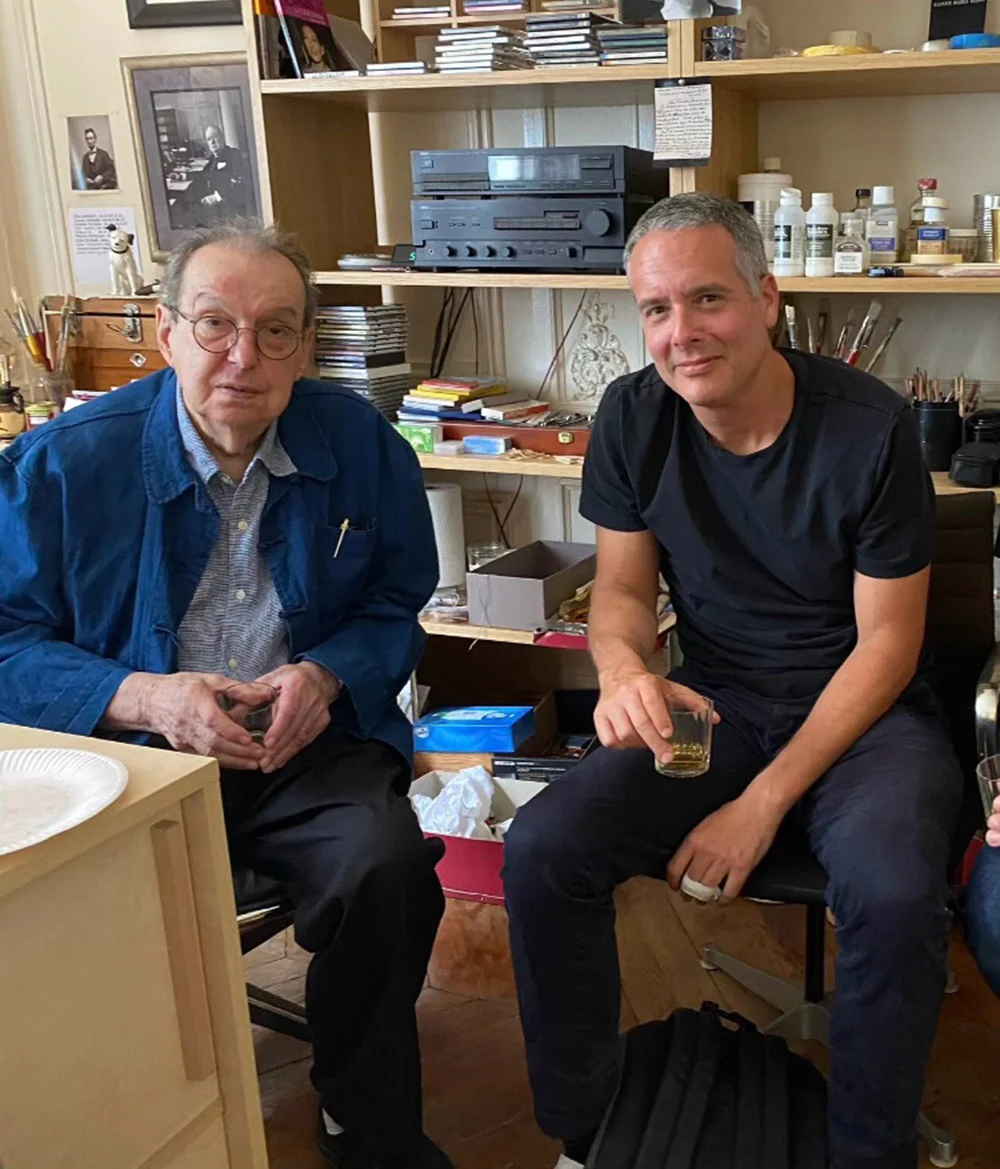
In his later years, after completing his final film, Carnage, Dean Tavoularis moved permanently to Paris with his wife, actress Aurore Clément, whom he had met on the set of Apocalypse Now. There, he converted a ground-floor apartment in the tranquil 17th arrondissement into an artist’s studio. It was in this studio, surrounded by paints, canvases, and the tools of a lifelong creator, that he spent his days painting, fulfilling a dream he had harbored since his youth.
It was in this Parisian sanctuary that Jordan Mintzer, a critic for The Hollywood Reporter, had the unique opportunity to engage in extensive conversations with Tavoularis, initially for a short magazine interview that quickly blossomed into a book project, Conversations with Dean Tavoularis. These discussions, spanning months and continuing even after the book’s publication, offered unparalleled insight into Tavoularis’s remarkable life and career. Mintzer describes Tavoularis as sharp, funny, wise, and generous, often sharing stories over a glass of scotch and a bag of Fritos (a comfort food imported from the U.S. by visiting friends), a ritual that continued until just weeks before his passing.
The rare opportunity to learn firsthand from such a master, to witness his enduring passion for art and storytelling, and to develop a personal friendship with him, underscores the profound impact Tavoularis had on those around him. His passing marks the end of an era, but his genius, immortalized in the frames of some of cinema’s greatest achievements, will continue to inspire filmmakers and audiences for generations to come. Dean Tavoularis was not merely an artisan; he was an artist whose vision helped define what we see, and profoundly feel, in the magic of movies.