


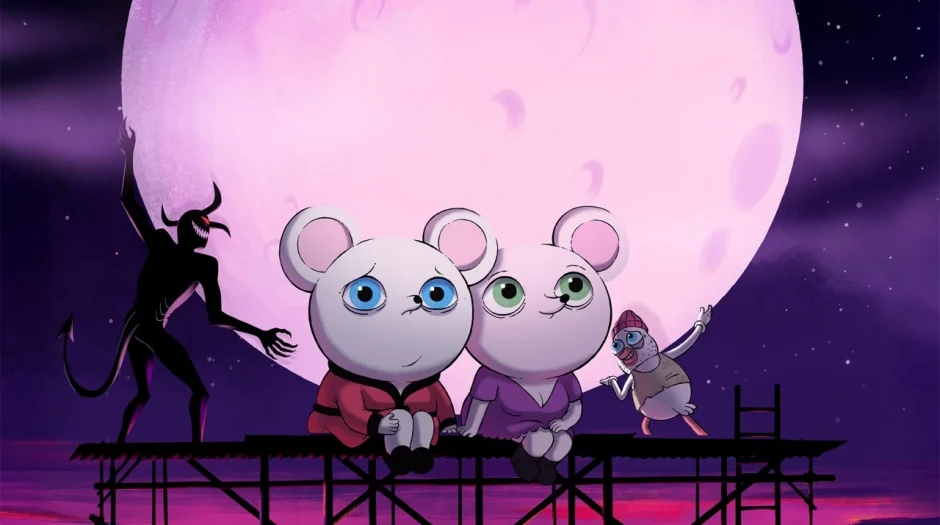
Three years after Spanish comic book artist and filmmaker Alberto Vázquez captivated and disturbed audiences with the graphic brutality of his animated war film Unicorn Wars, he returns with Decorado, a new feature that delves into the psychological underpinnings of contemporary society through a similarly disarming yet deeply unsettling lens. Opening in North American theaters on May 15th, the film, distributed by GKIDS, presents a world where the adorable and the tormented coexist, mirroring the often-jarring realities of mental health struggles, addiction, economic hardship, and marital discord.
Vázquez, known for his distinctive visual style that juxtaposes cute, anthropomorphic characters with mature and often grim themes, explained in a recent interview that Decorado is the culmination of a long creative journey, spanning approximately 13 years. The genesis of the project lies in a comic series he created, which later evolved into an acclaimed short film. A subsequent attempt at an adult animated series did not materialize, but the narrative’s potent themes and unique characters paved the way for this feature-length adaptation.
The film centers on Arnold, a middle-aged, unemployed mouse who begins to suspect that his entire existence is a fabrication – a meticulously constructed set with a scripted narrative. His paranoia escalates when his close friend, Ramiro, dies under suspicious circumstances. Arnold’s investigation into Ramiro’s demise leads him to uncover a vast, monolithic corporation that exerts an insidious influence over every facet of daily life in the city of Anywhere. This unsettling realization fuels Arnold’s descent into a profound existential crisis, challenging the very nature of his reality.
A Tapestry of Influences: From Dystopian Literature to Classic Animation
The thematic and stylistic underpinnings of Decorado are a rich amalgamation of diverse inspirations. Vázquez credits classic Disney films for their aesthetic influence, a nod to the foundational elements of animated storytelling. However, the film’s core anxieties are deeply rooted in dystopian literature, drawing parallels to George Orwell’s Nineteen Eighty-Four and Aldous Huxley’s Brave New World, both of which explore societies under oppressive social control. The existential dread and sense of surveillance also echo the unsettling atmosphere of the classic television series The Prisoner, and, as noted by critics, the pervasive unease present in The Truman Show.

Beyond these literary and cinematic touchstones, Vázquez also cites the surreal and often darkly humorous work of Spanish director Luis Buñuel and comic artist Jim Woodring as significant influences. This blend of the absurd, the satirical, and the deeply psychological allows Vázquez to filter these disparate elements through his unique perspective, creating a narrative that feels both universally relevant and intensely personal.
"I took all of that and filtered it through my own perspective—through how I understand the world, these social issues, and the conflicts we’re living through today," Vázquez stated, emphasizing his commitment to grounding even fantastical narratives in contemporary human experience.
Subverting Expectations: The Power of Adorable Melancholy
Vázquez’s previous work, Unicorn Wars, gained notoriety for its stark contrast between endearing characters and graphic violence. While Decorado is less overtly violent, it maintains a similar intent to provoke audiences by subverting expectations. The film’s "slow descent into madness," as described by interviewer Victoria Davis, replaces the overt warfare of Unicorn Wars with a more insidious psychological terror.
"This film is less violent than Unicorn Wars, but it is also a bit more realistic, even within its fantastical world," Vázquez explained. "It deals with real themes and the crises we go through: medical, financial, existential, and work crises; mega-corporations that control us; and superficial relationships that all point to a society that is unwell, that is sick."
The choice to employ universally appealing animal characters as conduits for these profound and often painful themes is a deliberate artistic strategy. Vázquez believes that animals offer a unique metaphorical advantage in animation.

"Animals work because they are so universal," he elaborated. "They do not necessarily belong to any specific time, place, or culture. They can be understood everywhere. And animals lead us toward fantasy. I am not using fantasy as a way to get away from reality, but rather to make things feel more real. There are poetic ways to talk about difficult subjects with animation and animals. You can use metaphors in a way that is not as possible with live action or with human characters."
This approach creates a powerful contrast between the characters’ innocent appearances and the complex, often devastating, struggles they endure. This juxtaposition can lead audiences, who might initially anticipate a family-friendly animated film, to discover a profound drama that grapples with the darker aspects of the human condition.
Visualizing the Unraveling: Animation as a Mirror to the Psyche
The visual design of Decorado, overseen by animation director Pamela Poltronieri and art director Jose Luis Ágreda, plays a crucial role in depicting Arnold’s deteriorating mental state. While the interview did not delve into specific visual techniques, Vázquez alluded to Arnold serving as the audience’s surrogate, experiencing the world through his isolated and controlled perspective. The film emphasizes the importance of real relationships as a grounding force amidst this existential turmoil.
"Arnold is definitely a character who is suffering and, in a way, serves as the eyes of the viewer," Vázquez stated. "He is our way of seeing this world. He feels like he is being controlled and feels very isolated, but he is still able to count on the support of his friends and his wife. Even though he and his wife are going through a rough patch in their marriage, you can tell that their relationship is still very real. Ultimately, those real relationships are what are going to save us, too."
Interconnected Crises: A Thematic Web of Modern Anxiety
The narrative of Decorado intricately weaves together various societal ills, demonstrating their interconnectedness. Vázquez intentionally linked mental health issues with marital strain, economic hardship, and the pervasive influence of social control, all of which contribute to a broader identity crisis. This approach ensures that the film’s exploration of human existence feels comprehensive and deeply relevant to contemporary audiences.

"The problems we talk about are all connected and have a cause-and-effect relationship in the story," Vázquez explained. "Mental health problems are related to marital crises. The troubles in the marriage are connected to the economic crisis. Then you have social control, which leads to an identity crisis. All of these topics are closely related, and they are all very current and relevant today."
Emotional Resonance and Production Challenges
The creation of Decorado was not without its emotional and technical hurdles. Vázquez shared that certain scenes, particularly a flashback depicting Arnold and Maria’s past and Arnold’s experience caring for his father, were emotionally resonant. He consistently draws upon personal experiences and those of his close circle to imbue his work with authenticity.
"I always try to depict things that I have been through, or that friends have been through, and filter everything through my own emotions and experience, because that is what really brings a layer of truth and honesty to the film," he said.
From a technical standpoint, the final scene of the film presented significant challenges due to the multitude of characters involved. For an independent production, managing such complexity while remaining economical requires careful resource allocation. Vázquez acknowledged the delicate balance between artistic ambition and budgetary constraints.
"I mean, it might have been the hardest one technically, but there are lots of characters, and that is something you have to be careful about because it can also add a lot to a film’s budget," he noted. "At the end of the day, we are a small independent production, so we needed to make sure we were spreading our efforts in an economical way. You have to strike that balance. You have to cut some things. But there are scenes that are absolutely worth the effort. The last scene had a lot of characters, and that is how we wanted to do it."

A Universe of Small Stories: Building Empathy Through Ensemble Characters
Despite the film’s focus on Arnold’s personal crisis, Vázquez successfully cultivates empathy for a wide range of characters, even those with limited screen time. He described Decorado as an ensemble piece, where every character, from the protagonists Arnold and Maria to supporting figures like the spying frog, grapples with their own distinct set of problems.
"It is an ensemble piece. You have your key characters, of course, Arnold and Maria, but all of the characters have their own problems," Vázquez stated. "You have the friends, certainly, but you also have characters who are spying on them, like the frog, who has its own problems to deal with as well. So, everyone is going through something. And I really do like having a lot of small stories within the larger one." This approach enriches the narrative tapestry, demonstrating that even within a seemingly controlled or absurd world, individual struggles and internal lives are profoundly real.
The Future of Vázquez’s Unique Aesthetic
Having spent years developing a distinct visual language characterized by adorable yet troubled animal characters, the question of whether Vázquez will continue to explore similar themes and designs in future projects arises. He expressed a strong affinity for the universality of animal characters, which has been a consistent element in his work since his comic book days. However, he also indicated a need for rest and reflection before committing to his next creative endeavor.
"I have been working in this style since my comics days. I do like that these animals are so universal, and that is why I have kept using them," Vázquez concluded. "But I do not know whether I will make another movie with them. I have to think about what I want to do next, and I cannot say whether it is going to be in the same style. I need to rest and think about it."
Decorado promises to be a thought-provoking and visually striking cinematic experience, inviting audiences to confront the anxieties of modern life through a unique and unforgettable animated narrative. Its release on May 15th marks another significant contribution to the landscape of mature animated storytelling.