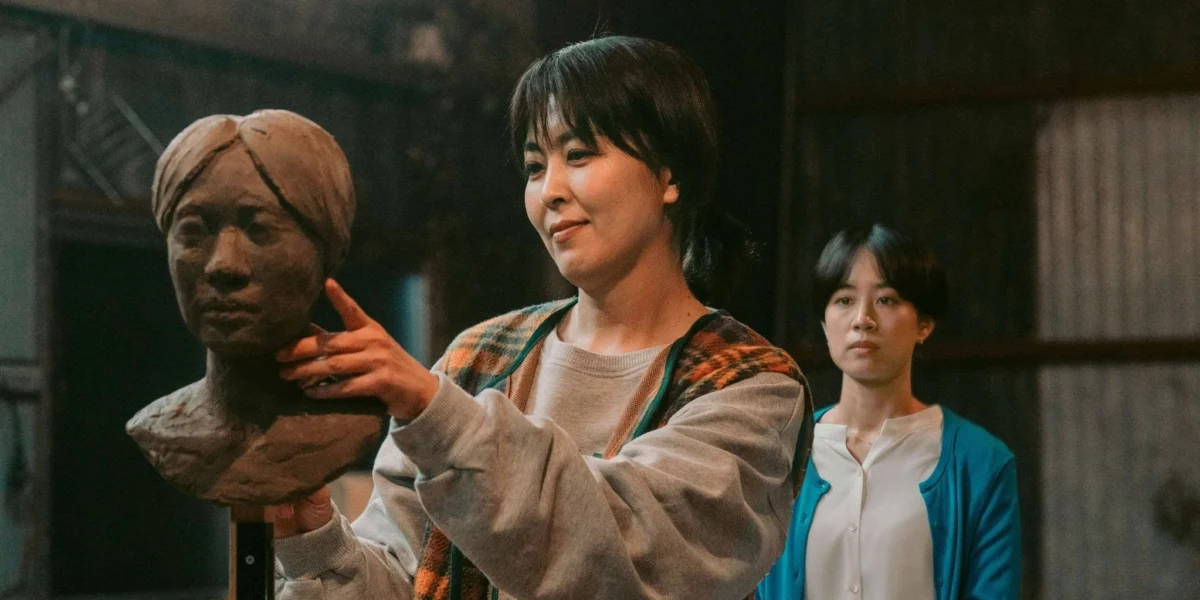
Koji Fukada’s latest cinematic offering, “Nagi Notes,” a contemplative drama adapted from Oriza Hirata’s acclaimed play “Tokyo Notes,” delicately navigates the intricate tapestry of human connection, loneliness, and the quiet resilience of the human spirit. The film, running at a deliberate 110 minutes, centers on the reunion of sculptor Yoriko and her former sister-in-law, Yuri, in the serene, almost insular, Japanese village of Nagi. What begins as a seemingly straightforward visit to model for Yoriko’s art soon unfolds into a nuanced exploration of unspoken emotions, evolving relationships, and the profound realization that true contentment often lies not in external validation but in self-acceptance. The ensemble cast, featuring the nuanced performances of Takako Matsu as Yoriko and Kenichi Matsuyama as Yuri, alongside Shizuka Ishibashi, Kawaguchi Waku, and Kiyora Fujiwara, contributes to the film’s understated yet deeply resonant emotional core.
The narrative unfolds with a deliberate pace, mirroring the unhurried rhythm of life in Nagi. The village itself, with its picturesque landscapes and intimate community where even local radio bulletins announce deaths, becomes a character in its own right, fostering an atmosphere conducive to introspection. Fukada masterfully employs this setting to underscore the film’s central themes, allowing the quietude of the environment to amplify the internal worlds of his characters. The film’s understated approach is a deliberate artistic choice, eschewing dramatic fireworks for subtle gestures and hushed conversations that, in their very restraint, carry significant emotional weight. This is a film that rewards patient observation, where a character’s off-hand remark about feeling “newly energized” can feel like a seismic shift.
H2: Thematic Core: Bonds, Loneliness, and Artistic Expression
At its heart, “Nagi Notes” delves into the multifaceted nature of human bonds, examining how they form, evolve, and sometimes persist even after formal ties are severed. Yoriko, a sculptor living a solitary life on a farm where she tends to her cows and carves intricate wooden figures, represents a form of contentment found in self-imposed isolation and artistic dedication. Her existence, though physically alone, is demonstrably not one of loneliness, a distinction the film carefully elucidates. Loneliness, as explored here, implies a dissatisfaction with one’s state, a yearning for something absent. Yoriko, conversely, finds profound satisfaction in her solitude, viewing it as a necessary space for her creative process and a sanctuary for her peace of mind.
Yuri, an architect by profession, arrives in Nagi seeking not only to serve as a muse for Yoriko’s latest sculpture but also, implicitly, to reconnect with a sense of belonging. Having divorced Yoriko’s brother, the formal familial connection has dissolved, yet a deep and enduring bond between the two women remains. Their interactions quickly reveal a familiarity and an intellectual rapport that transcends casual acquaintance. They effortlessly fall back into conversations that are far from superficial, probing the depths of their individual relationships and the broader spectrum of human interaction. This shared history and profound understanding allow them to navigate complex emotional territories with a candor that is both refreshing and revealing.
H3: A Question of Connection: Queering Subtext and Generational Dialogue
The film boldly addresses the potential for romantic or deeply intimate connections between individuals of the same sex, allowing what might typically be relegated to subtext to surface as a palpable possibility. Early in the narrative, another character directly questions the nature of Yoriko and Yuri’s relationship, prompting a frank acknowledgment that while they are not romantically involved, the depth of their bond invites such contemplation. Fukada’s direction here is significant; by bringing this question to the forefront, he normalizes the exploration of diverse forms of love and connection, moving beyond conventional heteronormative frameworks.
Complementing this central dynamic is the story of two young men, Keita and Haruki. Their burgeoning relationship, though initially appearing tentative, mirrors the exploration of connection occurring between Yoriko and Yuri. The film subtly portrays their journey as they navigate their own evolving bond, bringing discussions of queer relationships into sharper focus. The juxtaposition of these two pairings—the mature women and the younger men—creates a compelling generational dialogue. This allows Fukada to examine how interpersonal dynamics and the understanding of human connection can shift and evolve across different age groups, offering a nuanced perspective on the enduring human need for belonging and affection.
H2: The Art of Being: Contrasting Lifestyles and Existential Reflections
The film’s deliberate pacing and muted aesthetic are not merely stylistic choices but integral components of its thematic exploration. Nagi’s serene environment, bathed in soft light and characterized by its tranquil pace, provides a stark contrast to the bustling, perhaps more demanding, life Yuri leads in the city. Yuri, as an architect, is engaged in the creation of monumental structures designed for widespread use and public visibility. Her work is about building, about permanence, and about leaving a tangible mark on the world. This ambition and outward focus often mask an underlying uncertainty about her own existential state.
Yoriko, on the other hand, finds solace and purpose in a more introspective and ephemeral form of creation. Her wooden sculptures, housed in her barn, are not intended for public display or enduring legacy. She expresses a profound peace with the idea that her creations will eventually decay and return to the earth. This acceptance of impermanence, rather than being a source of despair, is a testament to her contentment. Her art is an expression of her inner world, a private communion that sustains her. This fundamental difference in their approaches to creation and their views on the ephemeral nature of existence highlights their contrasting perspectives on life and happiness.
H3: Loneliness vs. Solitude: A Matter of Perspective
Fukada is adept at dissecting the fine line between loneliness and solitude. Yuri, accustomed to the constant hum of urban life and the interconnectedness of a metropolitan environment, initially perceives Yoriko’s quiet existence as a form of pitiable isolation. However, Yoriko’s lived experience refutes this assumption. Her solitude is a chosen state, a fertile ground for her art and her internal peace. It is not a void to be filled but a space to be inhabited. This distinction is crucial to understanding Yoriko’s character and her serene outlook on life.
Yuri, in contrast, appears to be actively seeking a connection that her urban life may not fully provide. Her extended stay in Nagi, far beyond her initial departure date, suggests a deep-seated yearning for something more, a desire to re-establish a meaningful bond and perhaps to find a sense of grounding. The film suggests that her time in Nagi, and her rekindled connection with Yoriko, serves as an unexpected form of therapy, prompting her to confront her own internal state and re-evaluate her existential path.
H2: The Quiet Power of Self-Acceptance and Evolving Bonds
The film’s narrative arc, while subtle, leads to a conclusion that is both simple in its execution and powerful in its emotional impact. The enduring presence of Yuri in Nagi, the deepening of her bond with Yoriko, and the parallel development of Keita and Haruki’s relationship all underscore the film’s central message: the importance of accepting one’s reality while actively pursuing what one desires. Fukada’s “Nagi Notes” offers unobtrusive yet profoundly valuable lessons on the nature of human connection, the serenity found in self-acceptance, and the ever-evolving landscape of our interpersonal lives. The film’s quiet strength lies in its ability to resonate with viewers on a deeply personal level, prompting reflection on their own relationships, their own moments of solitude, and their own paths toward fulfillment. The delicate portrayal of these nuanced emotional journeys solidifies “Nagi Notes” as a significant work that lingers in the mind long after the credits roll.