


The digital entertainment ecosystem, characterized by an ever-growing array of streaming services, has become an indelible part of contemporary media consumption. However, this convenience often comes at an escalating and frequently overlooked cost, a challenge that a newly highlighted web application, the "Subscription Cost Visualizer," and its companion app, Vexly, aim to address. Announced on April 26, 2026, these tools provide consumers with a critical mechanism to monitor and manage their recurring digital expenditures, offering a much-needed antidote to the phenomenon of "subscription creep."
The Evolution of the Streaming Era: From Novelty to Necessity
The journey into the "streaming era" began decades ago, evolving from rudimentary online video platforms to sophisticated, on-demand content libraries. Initially, services like Netflix pioneered the concept of subscription-based entertainment, offering a revolutionary alternative to traditional cable television. The early 2010s saw the acceleration of this trend, with Netflix’s aggressive expansion into original content production and the emergence of early competitors such as Hulu and Amazon Prime Video. These platforms promised a liberation from expensive cable bundles, ushering in an era of perceived savings and personalized viewing experiences.
By the mid-2010s, the streaming landscape had diversified significantly. Major media conglomerates, recognizing the shift in consumer behavior, began reclaiming their content from third-party platforms and launching their own direct-to-consumer services. This strategic pivot led to the proliferation of platforms like Disney+, Apple TV+, HBO Max (now simply Max), Peacock, and Paramount+, each vying for a share of subscriber wallets and screen time. Niche services, catering to specific interests, also found their footing, exemplified by platforms like the Criterion Channel for cinephiles or dedicated sports streaming packages. Even free, ad-supported streaming television (FAST) services such as Tubi carved out a segment, offering a no-cost alternative within a largely paid ecosystem. This rapid expansion, while providing an unprecedented breadth of content, also laid the groundwork for the financial complexities consumers now face. The initial promise of "cord-cutting" savings has gradually eroded, replaced by the challenge of managing a burgeoning portfolio of individual subscriptions.
The Escalating Cost of Digital Entertainment: A Growing Financial Burden
What began as a cost-effective alternative to cable TV has morphed into a significant household expense, often surpassing the very cable bills consumers sought to avoid. Market research conducted in late 2025 indicated that the average household in developed nations subscribed to an average of 5-7 streaming services, with a growing segment reporting 10 or more. A recent report by financial analytics firm "Digital Spend Insights" revealed that cumulative monthly spending on streaming subscriptions in North America increased by approximately 18% year-over-year from 2023 to 2025, reaching an average of $65 per household. For those with a broader array of services, including premium tiers, sports packages, and niche platforms, this figure can easily exceed $100-$150 per month.
This upward trajectory is fueled by several factors. Firstly, individual service providers have consistently raised their prices. Netflix, for instance, has implemented multiple price hikes across its tiers over the past five years, reflecting increased content production costs and a drive for higher profitability. Similarly, Disney+ and Hulu have adjusted their pricing structures, often introducing ad-supported tiers as a lower-cost option while increasing the price of ad-free plans. Secondly, the sheer number of desirable services means that consumers often feel compelled to subscribe to multiple platforms to access specific shows, movies, or sports events, creating a fragmented content landscape. The days of a single, comprehensive streaming solution are long past.
The phenomenon of "subscription creep" exacerbates this financial burden. Many consumers sign up for free trials or promotional periods and then forget to cancel, leading to recurring charges for services they no longer actively use or even remember subscribing to. These "zombie subscriptions" silently drain bank accounts, contributing to a sense of financial leakage. A survey conducted by "Consumer Finance Watch" in early 2026 found that nearly 40% of respondents admitted to paying for at least one subscription service they rarely or never used, with 15% acknowledging three or more such dormant accounts. This collective oversight represents billions of dollars annually in wasted consumer spending. The challenge is not merely the cost of individual services but the cumulative, often opaque, total.

Introducing the Subscription Cost Visualizer and Vexly: Tools for Financial Clarity
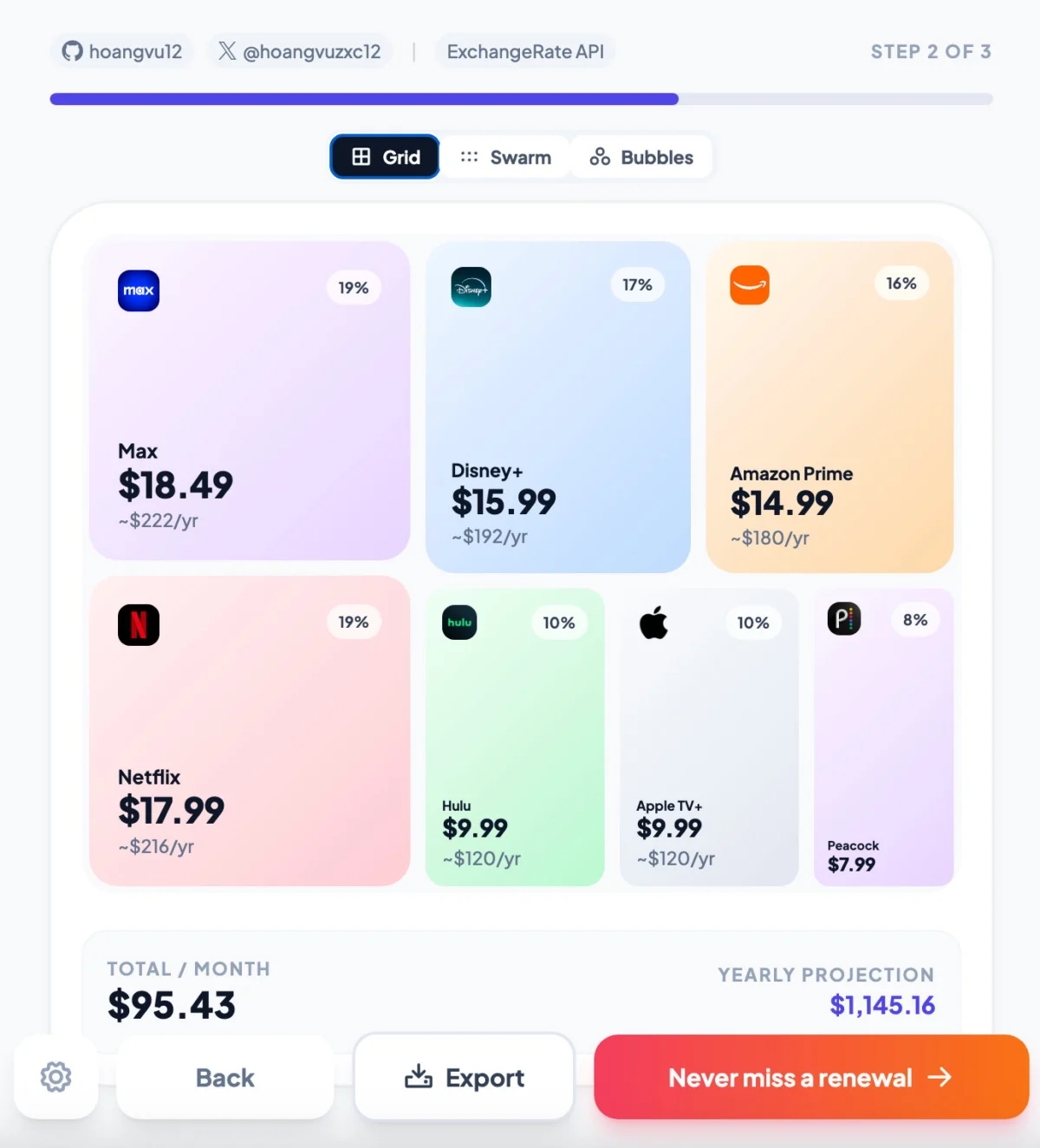
In response to this growing consumer need for transparency and control, the "Subscription Cost Visualizer" web app, developed by Nguyen Vu, offers an immediate and accessible solution. Launched with a focus on simplicity and utility, the online tool allows users to manually input their various streaming subscriptions, including services like Netflix, Prime Video, Apple TV+, Max, Hulu, and even more specialized platforms like the Criterion Channel. Upon data entry, the visualizer generates a clear, concise chart or a clean list detailing the monthly and annual cumulative costs. This immediate visualization serves as a powerful awakening for many, making the often-hidden financial outlay starkly apparent. The tool is designed to accommodate both US and European subscription costs and services, ensuring broad applicability.
The web app, available at visualize.nguyenvu.dev, functions as a standalone utility, providing instant insight without requiring extensive setup. However, it also serves as an entry point to its more comprehensive companion application, Vexly. Vexly is positioned as a sophisticated personal finance management app specifically tailored to address the complexities of recurring subscriptions.
Vexly’s feature set extends beyond mere visualization:
- Secure Tracking Without Bank Connection: A critical differentiator, Vexly allows users to track their subscriptions without requiring direct access to their bank accounts. This addresses significant privacy and security concerns often associated with financial management apps, building user trust.
- Renewal Alerts: The app provides timely notifications before subscriptions are due for renewal, empowering users to make informed decisions about continuation or cancellation, thereby preventing inadvertent charges.
- Detailed Spend Analysis: Vexly offers deeper insights into where money is allocated across various services, helping users identify underutilized subscriptions or areas for potential savings.
The creator, Nguyen Vu, articulated his motivation for developing Vexly on a developer forum, stating, "I built Vexly after discovering I was wasting $200/month on forgotten subscriptions. It was a personal pain point that I realized was shared by countless others." This personal experience underscores the widespread nature of subscription management challenges. Early beta testers of Vexly reported significant savings, averaging $540 in the first year alone. This figure is substantial, demonstrating the app’s tangible impact on household budgets. "Most people find 3-5 forgotten subscriptions in their first minute using Vexly," Vu added, highlighting the immediate value proposition.
Developer’s Philosophy and Broader Market Impact
Nguyen Vu’s approach to Vexly is rooted in empowering the consumer through clarity and control. His design philosophy prioritizes user privacy and autonomy, evidenced by the decision to forgo direct bank account integration. This choice positions Vexly as a user-centric solution, contrasting with many financial aggregation apps that require extensive data access. The app’s interface is intuitive, designed for ease of input and quick comprehension of financial data.
The introduction of Vexly and similar tools represents a significant development in the broader market for personal finance technology. While general budgeting apps exist, Vexly’s specialized focus on subscriptions addresses a distinct and growing pain point. Analysts from "Tech Innovations Review" suggest that such targeted solutions are likely to gain traction as consumers become increasingly overwhelmed by digital commitments. "The market is ripe for applications that simplify complex digital lives," stated Dr. Lena Hansen, a senior analyst at Tech Innovations Review. "Vexly’s emphasis on security and immediate savings resonates strongly with current consumer anxieties regarding data privacy and rising living costs."
The widespread adoption of tools like Vexly could also subtly influence the strategies of streaming providers themselves. As consumers gain greater awareness and control over their subscription spending, they may become more discerning. This could potentially lead to increased churn for services that fail to deliver perceived value or to a greater demand for flexible, short-term subscription options. It might also encourage streaming companies to offer more transparent pricing and more compelling bundles that genuinely offer savings, rather than just convenience.

Implications for Financial Literacy and Consumer Empowerment
The emergence of the Subscription Cost Visualizer and Vexly extends beyond mere financial tracking; it represents a stride towards enhanced financial literacy and consumer empowerment in the digital age. By making invisible expenses visible, these tools enable individuals to take active control of their discretionary spending. The psychological impact of seeing a cumulative sum, rather than individual small charges, can be profound, prompting users to critically evaluate the necessity and value of each service.
In an economy increasingly reliant on recurring revenue models, from software-as-a-service to fitness apps and cloud storage, the principles embodied by Vexly are broadly applicable. While initially focused on streaming, the underlying framework for tracking, alerting, and visualizing recurring payments holds immense potential for expansion into other areas of subscription-based consumption. This broader utility could establish Vexly as a foundational tool for modern financial management, helping users manage the entirety of their recurring digital footprint.
For specific demographics such as cinephiles, TV geeks, and movie lovers, who are often early adopters and heavy users of multiple streaming platforms (including niche ones like the Criterion Channel), Vexly offers a tailored solution to manage their passion without unknowingly overspending. It allows them to maintain access to diverse content libraries while ensuring financial prudence.
Future Outlook and Conclusion
As the streaming industry continues its dynamic evolution, marked by content wars, mergers, and shifting business models, the financial implications for consumers are unlikely to diminish. The convenience of on-demand entertainment remains highly valued, but the associated costs require diligent management. Tools like the Subscription Cost Visualizer and Vexly are therefore not merely helpful adjuncts but essential components of responsible digital consumption.
The ability to track subscriptions securely, receive timely renewal alerts, and visualize spending patterns empowers consumers to navigate the complex streaming landscape with greater confidence and control. In an era where digital services are integral to daily life, Vexly stands as a testament to the power of targeted technological solutions in addressing contemporary financial challenges, ensuring that the benefits of the streaming era do not come at an unforeseen and unmanageable cost. The ongoing battle for consumer attention and wallets will undoubtedly continue, but with tools like Vexly, consumers are better equipped to participate on their own terms.