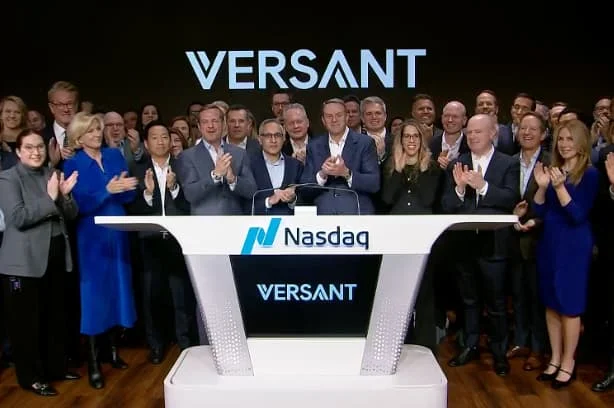
Versant Media Group is scheduled to release its first earnings report as a publicly traded entity this Tuesday, marking a pivotal moment for the media industry as Wall Street receives its first comprehensive look at the internal financials of the newly independent company. The report comes roughly four months after Versant’s high-profile debut on the Nasdaq on January 5, 2026, following its separation from Comcast Corporation. As a "pure-play" media entity comprised primarily of cable television networks, Versant’s performance is being viewed by analysts as a bellwether for the viability of traditional pay TV assets in an increasingly digital-centric marketplace.
The portfolio under scrutiny includes some of the most recognizable brands in American broadcasting: CNBC, MS Now, USA Network, Golf Channel, Syfy, E!, and Oxygen. Beyond linear television, the company also controls a suite of digital and transactional properties, including the movie ticketing platform Fandango, the review aggregator Rotten Tomatoes, and the sports-tech interfaces GolfNow and Sports Engine. This Tuesday’s disclosure will provide the first granular data on these assets since they were decoupled from Comcast’s NBCUniversal division, offering a test case for whether legacy cable brands can thrive as standalone businesses.
The Path to Independence: A Strategic Separation
The journey to Versant Media Group’s current standing began in late 2024, when Comcast Corporation announced its intention to spin off its cable networks into a separate, publicly traded company. The move was widely interpreted as a strategic effort by Comcast to shield its core connectivity and streaming businesses—Xfinity and Peacock—from the secular decline affecting the traditional television bundle. By January 2026, the transaction was finalized, and Versant began trading under the ticker symbol "VSNT."
This spinoff represented one of the most significant structural shifts in the media landscape in recent years. For decades, these cable networks served as the "cash cows" of the NBCUniversal umbrella, generating consistent cash flow that fueled investments in film production and theme parks. However, as "cord-cutting" accelerated—with millions of households opting for streaming services over traditional cable packages—the growth profile of these networks shifted. By creating Versant, Comcast provided these assets with their own capital structure and management team, led by veteran media executive Mark Lazarus as CEO and Anand Kini as COO and CFO.
Since its January debut, Versant’s stock has faced significant headwinds, declining approximately 25%. Market analysts attribute much of this volatility to technical selling pressure, a common occurrence following spinoffs as institutional investors who held Comcast shares rebalance their portfolios or divest from the new entity. With a current market capitalization of roughly $4.8 billion, the company now faces the challenge of proving its long-term value proposition to a skeptical investor base.
Analyzing the Financial Trajectory
Pre-IPO filings with the Securities and Exchange Commission (SEC) provided a sobering look at the revenue trends Versant is working to reverse. The assets currently comprising the group generated $7.1 billion in revenue in 2024, a notable decrease from $7.4 billion in 2023 and $7.8 billion in 2022. This downward trajectory reflects the broader industry struggle with declining affiliate fees and a softening linear advertising market.
Despite the revenue contraction, Versant’s leadership has emphasized the company’s profitability and relatively light debt load compared to its larger media peers. Unlike many media giants that are burdened by the massive capital expenditures required to build global streaming platforms, Versant is positioning itself as a lean, cash-flow-positive enterprise.
"At Versant, 62% of our audience comes from live programming across sports and news," CEO Mark Lazarus noted during an investor presentation in December. This focus on "appointment viewing"—content that viewers prefer to watch live rather than on-demand—is the cornerstone of the company’s survival strategy. By anchoring the portfolio with CNBC’s financial news and the Golf Channel’s niche sports coverage, Versant aims to remain an essential component of the television bundle for as long as it exists.
The Dual-Pillar Strategy: Live Content and Digital Platforms
The upcoming earnings report will likely highlight Versant’s "business model transition," a phrase used by CFO Anand Kini to describe the shift from a cable-dependent entity to a diversified media firm. The company’s long-term goal is to reach a 50/50 revenue split between traditional pay TV distribution and a combination of digital, transactional, and ad-supported platforms.
To achieve this, Versant has already begun aggressive maneuvers in the M&A space. The company recently completed the acquisition of Free TV Networks, a provider of over-the-air digital broadcast channels, and Indy Cinema Group, a cloud-based operating system for movie theaters. The latter was integrated into Fandango, bolstering the platform’s utility for exhibitors and filmgoers alike. These acquisitions suggest that Versant is looking for growth in areas that complement its existing strengths in entertainment and sports without overextending its balance sheet.
The digital properties—Fandango and Rotten Tomatoes—are particularly vital. They offer a transactional revenue stream that is independent of the cable bundle and provide valuable consumer data. Analysts from Raymond James have noted that while Versant lacks "Tier One" sports rights like the NFL or NBA, its "Tier Two" assets—including significant golf rights, WWE, and NASCAR—provide enough leverage to remain relevant to distributors.
Distribution Stability and Upcoming Negotiations
One of the most critical metrics for Versant is its relationship with distributors like Charter Communications, Comcast (its former parent), and Google’s YouTube TV. Before the spinoff, NBCUniversal secured multi-year carriage agreements that included the Versant networks. These contracts provide a "cushion," with more than half of the company’s pay TV subscribers governed by agreements that extend through 2028 and beyond.
However, the "stability" of these partnerships will face an immediate test. Sources familiar with the matter indicate that two significant distribution agreements are up for renewal this year. These negotiations are occurring at a time when "blackouts"—the temporary removal of channels during pricing disputes—have become a common tactic. While Versant’s news and sports focus gives it more leverage than a general entertainment network might have, the outcome of these talks will be a major indicator of the company’s standalone bargaining power.
The broader industry context offers some glimmers of hope. Charter Communications recently reported its first quarterly gain in cable customers since 2020, suggesting that the "death of the bundle" may be slowing in certain segments. If the traditional TV market stabilizes, Versant stands to benefit significantly as a specialized provider.
Industry Comparison and Market Sentiment
Versant is not alone in its attempt to navigate the post-streaming landscape. The company’s trajectory is being compared to Newsmax, which went public last year, and the massive consolidation seen in the Warner Bros. Discovery and Paramount Skydance merger. While Warner Bros. Discovery initially considered a similar split of its TV networks before opting for a full-company sale, Versant is committed to the independent path.
Wall Street’s reception remains cautious. Goldman Sachs analysts initiated coverage with a "Neutral" rating in January, citing the "secular challenges in the linear networks business" while expressing optimism regarding the company’s platform and digital initiatives. The sentiment reflects a "wait-and-see" approach: investors want to see if the cash flow from declining cable assets can successfully fund the transition to a digital future.
The Tuesday earnings report will be the first time Versant management must answer directly to shareholders as a standalone entity. Key areas of focus for analysts will include:
- Ad Revenue Performance: How the current economic climate is impacting advertising spend across CNBC and USA Network.
- Digital Growth Rates: Whether Fandango and Rotten Tomatoes are seeing increased transactional volume.
- Margin Protection: How the company is managing costs as revenue from affiliate fees faces pressure.
- Capital Allocation: Further details on future acquisitions or potential share buybacks to address the stock’s recent decline.
Looking Ahead: 2026 as a Transition Year
Management has designated 2026 as the inaugural year of its fundamental business transformation. The objective is to prove that a collection of "legacy" assets can be managed for profit and used as a foundation for a modern, multi-platform media company. By emphasizing live news and sports, Versant is betting that there remains a loyal, if shrinking, audience that values real-time information and competition.
As the media industry continues to consolidate and evolve, Versant Media Group serves as a high-stakes experiment. If the company can demonstrate stability in its first quarterly report, it may provide a roadmap for other media conglomerates looking to unlock value from their traditional assets. Conversely, if the numbers show a faster-than-expected decline, it could accelerate the push for further consolidation across the cable landscape.
The results released on Tuesday will offer the first definitive evidence of whether Versant’s strategy is gaining traction or if the headwinds of the digital age are proving too strong for even the most established cable brands to overcome. For now, the eyes of the media world are on the Nasdaq, waiting to see if Versant can turn its first chapter as a public company into a success story.