A landmark jury verdict in New York has determined that Live Nation Entertainment operates an unlawful monopoly that significantly impacts multiple facets of the live concert industry. While the jury has rendered its decision on liability after a month-long trial and four days of deliberations, the full ramifications for the global entertainment giant remain uncertain and will likely take considerable time to unfold. The verdict, delivered on Wednesday, April 15, found Live Nation guilty of monopolizing the market for primary concert ticketing and unlawfully coercing artists to utilize their promotional services as a condition for performing at Live Nation-owned amphitheaters. This decisive "yes" on all counts by the jury marks a pivotal moment in the ongoing scrutiny of the company’s market dominance.
The Legal Battle Unpacked: From Verdict to Remedy
The immediate next step in this high-stakes legal battle involves Live Nation’s right to petition U.S. District Judge Arun Subramanian to overturn the jury’s verdict and enter a judgment in their favor. Should the judge decline this motion, he will then assume the critical role of determining the practical consequences of the ruling. This determination will involve crafting a "remedy," which could include financial damages, mandates for operational changes, or a combination of both.
For years, critics of Live Nation, including a coalition of state attorneys general who spearheaded the litigation, have advocated for the forced divestiture of Ticketmaster, the company’s ticketing arm. Their core argument, which appears to have resonated with the jury, is that Live Nation’s dual control over ticketing and artist promotion creates an insurmountable anticompetitive advantage. This advantage, they contend, is leveraged by threatening to withhold concert bookings from venues that do not exclusively use Ticketmaster for their ticketing needs. The jury’s verdict could be interpreted as a validation of this central thesis.
Potential Remedial Pathways: Divestiture and Beyond
Judge Subramanian faces a complex decision regarding the appropriate remedy. One possibility is that he could allow Live Nation to retain Ticketmaster but compel the company to divest other significant assets, such as a portion of its extensive amphitheater portfolio. Lauren Spahn, an entertainment partner at Buchalter, suggests this approach could be a strategic maneuver by the judge to "weaken [Live Nation and Ticketmaster] without completely killing the combined companies." This would aim to restore a degree of competition without dismantling the entire enterprise.
While the legal precedent for breaking up large corporations exists, dating back to the dissolution of Standard Oil in 1911, such structural remedies have become increasingly rare in contemporary court proceedings. A notable example is the 2024 case where Google was found liable for monopolizing the online search market. In that instance, the federal judge opted against forcing the divestiture of Google’s Chrome browser or its Android operating system. Instead, the remedy focused on mandating changes to the tech giant’s contracting practices and requiring greater data accessibility for rivals.

Precedents and Possible Outcomes
It is plausible that Judge Subramanian will follow a similar path in the Live Nation case, ordering financial damages and implementing operational "guardrails" rather than a forced structural breakup. These guardrails could encompass a range of measures, such as restricting Live Nation’s ability to enforce exclusive ticketing contracts, capping certain fees, or mandating that its owned amphitheaters be made available to rival promoters.
Interestingly, Live Nation had already agreed to implement many such operational changes and establish a $280 million payment fund as part of a proposed settlement with the Department of Justice (DOJ) reached shortly after the antitrust trial commenced. The company reiterated this stance in a statement following the verdict, expressing confidence that "the ultimate outcome of the states’ case will not be materially different than what is envisioned by the DOJ settlement."
Navigating a Complex Legal Landscape
However, this scenario introduces a layer of complexity. The proposed DOJ settlement is still subject to Judge Subramanian’s approval. Furthermore, many of the state attorneys general who initially joined the DOJ in suing Live Nation had criticized the settlement as overly lenient. These states subsequently chose to proceed with the trial independently. This places Judge Subramanian in the unusual position of being asked by two distinct government entities, which were once litigation partners, to simultaneously approve a settlement and impose a more stringent structural remedy based on the same set of facts.
Kenneth Dintzer, an antitrust partner at Crowell & Moring with extensive experience at the DOJ, described the situation as "unprecedented." He noted to Billboard, "Nobody’s ever seen something quite like this. So exactly how these cards are going to be shuffled is anybody’s guess."
The Road Ahead: A Protracted Process
The resolution of this intricate legal puzzle is unlikely to be swift. It is anticipated that Judge Subramanian will require several months, potentially up to a year, to thoroughly review all arguments and evidence before rendering detailed decisions on both the DOJ settlement and the proposed remedy from the states’ trial. Adding another layer of potential delay, Live Nation has indicated its intent to "appeal any unfavorable rulings." Such appeals could prolong the proceedings for at least another year.
As Spahn summarized the outlook, "It’s going to take a while before anything trickles down to the consumer level." The immediate aftermath of the verdict, therefore, is marked by legal maneuvering and strategic positioning, with tangible changes for consumers and the broader industry remaining a distant prospect.

Background and Chronology of the Case
The antitrust lawsuit against Live Nation, a company formed through the controversial merger of Live Nation and Ticketmaster in 2010, has been brewing for years. The Department of Justice initiated its investigation, leading to a settlement proposal. Simultaneously, a coalition of state attorneys general pursued their own litigation, culminating in the recent jury trial. The trial itself focused on specific allegations of Live Nation leveraging its market power to stifle competition.
Key chronological markers:
- 2010: Live Nation merges with Ticketmaster, creating a dominant force in the live entertainment ecosystem.
- Ongoing: Numerous complaints and investigations surface regarding anticompetitive practices.
- Recent Years: Increased scrutiny from government bodies and consumer advocacy groups intensifies.
- Weeks Leading Up to Verdict: A month-long jury trial takes place in New York, presenting evidence and arguments from both sides.
- April 15, 2024 (Hypothetical Date): Jury delivers a verdict finding Live Nation liable for antitrust violations.
- Post-Verdict: Live Nation has the opportunity to challenge the verdict. Judge Subramanian will then determine the remedy.
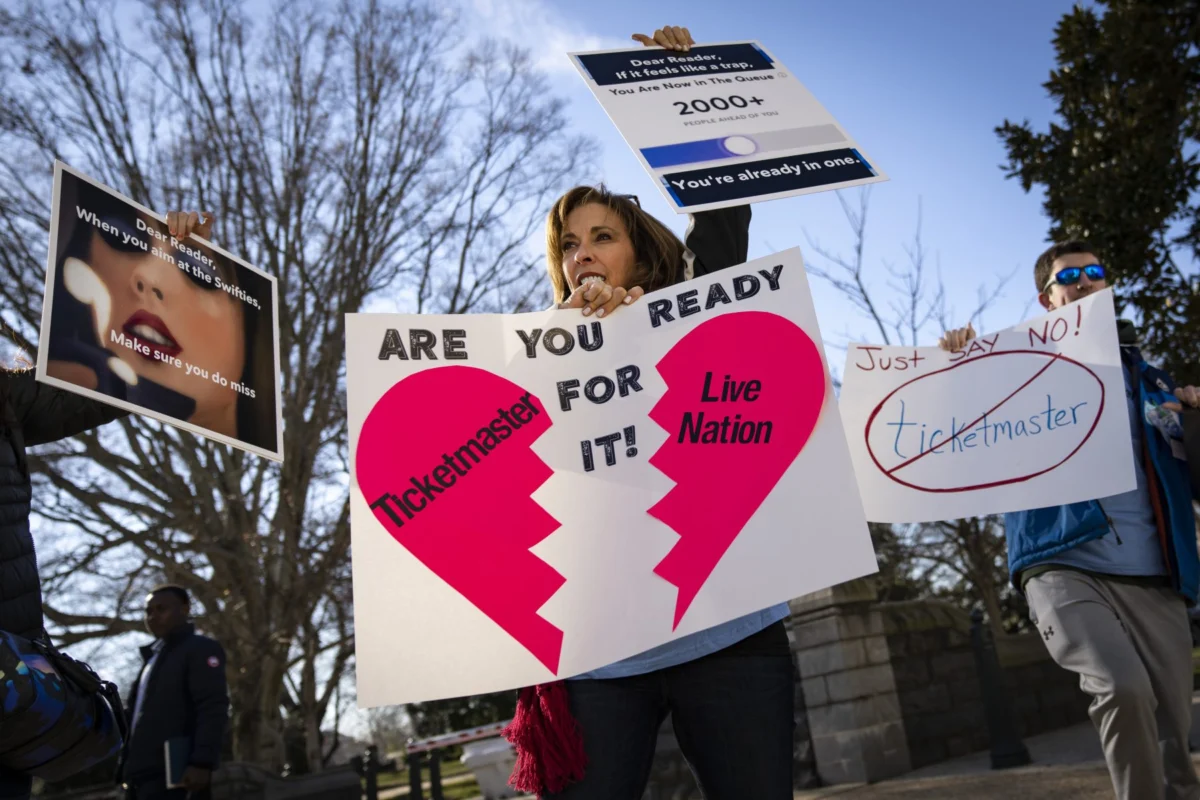
The imagery accompanying this development often features protests and rallies, such as the one captured outside the U.S. Capitol in Washington D.C. on January 24, 2023, where individuals like Penny Harrison and her son Parker Harrison voiced their concerns about the live entertainment ticket industry. These public demonstrations underscore the widespread public sentiment and the pressure faced by regulators and lawmakers to address perceived monopolistic practices. The Senate Judiciary Committee has also held hearings exploring whether the Live Nation-Ticketmaster merger has indeed stifled competition and harmed consumers.
Supporting Data and Industry Context
Live Nation Entertainment’s sheer scale in the live music industry is a critical factor in understanding the antitrust concerns. The company operates a vast network of venues, promotes thousands of concerts annually, and, through Ticketmaster, controls a significant portion of the primary ticket sales market in North America. Industry analyses have consistently pointed to a high market share for Live Nation in concert promotion and ticketing, raising red flags for antitrust regulators. For instance, reports have indicated that Live Nation promotes a substantial percentage of major concert tours and controls a majority of the primary ticketing market share for large venues. This concentration of power allows the company to wield considerable influence over artists, venues, and ultimately, consumers.
The financial implications of Live Nation’s market position are also substantial. Ticketmaster has faced criticism for its substantial service fees, which contribute significantly to the company’s revenue. When combined with Live Nation’s promotional activities and venue ownership, the potential for exploiting market dominance becomes a tangible concern. The jury’s finding of liability suggests that this concern was substantiated by the evidence presented during the trial.
Official Responses and Industry Reactions
While the legal proceedings have been underway, various stakeholders have expressed their views. The state attorneys general have been vocal in their pursuit of a structural remedy, emphasizing the need to break up the company to restore fair competition. Their statements have consistently highlighted the negative impact on artists, fans, and smaller promoters who struggle to compete with Live Nation’s integrated business model.

Live Nation, in its public statements, has consistently defended its business practices, arguing that its integration of services provides efficiencies and benefits to the industry. The company has also pointed to its efforts to improve the ticketing experience and address consumer concerns, often referencing its settlement with the DOJ as a testament to its willingness to adapt.
Reactions from artists and music industry professionals have been varied, though many have privately expressed frustration with the perceived lack of choice and the financial pressures exerted by Live Nation’s dominance. The verdict is likely to be met with cautious optimism by those advocating for greater competition, while Live Nation’s stakeholders will be closely watching the upcoming judicial decisions regarding the remedy.
Broader Impact and Implications
The outcome of this case has the potential to reshape the live entertainment landscape. If Judge Subramanian imposes significant structural changes, it could lead to a more fragmented and competitive market, potentially benefiting artists through increased negotiation power and consumers through more diverse ticketing options and potentially lower fees. Alternatively, if the remedy is more focused on operational changes and financial penalties, the fundamental market structure might remain largely intact, with the long-term impact on competition being less dramatic.
The case also serves as a significant development in antitrust enforcement, particularly concerning the digital age and the complexities of integrated business models. The legal and judicial approach taken by Judge Subramanian will be closely watched as a precedent for future antitrust challenges against large, dominant companies across various sectors. The ongoing legal process, with its potential for appeals, underscores the enduring power of established legal frameworks to address modern market challenges, albeit through a potentially protracted and intricate judicial journey.