




For parents navigating the modern digital landscape, handing a smartphone or tablet to a young child has become an exercise in quiet anxiety. Beyond the standard concerns of screen-time duration lies a more insidious threat: the proliferation of algorithmic "AI slop" on mainstream video-sharing platforms. Targeted specifically at children aged zero to six, these digital streams serve up bizarre, hyperstimulating, and frequently incoherent content packaged to mimic genuine educational programming. While legacy platforms like YouTube and YouTube Kids have implemented automated filters and parental controls to curb inappropriate material, experts warn that the digital ecosystem remains fundamentally warped by commercial incentives that prioritize watch time over child development.
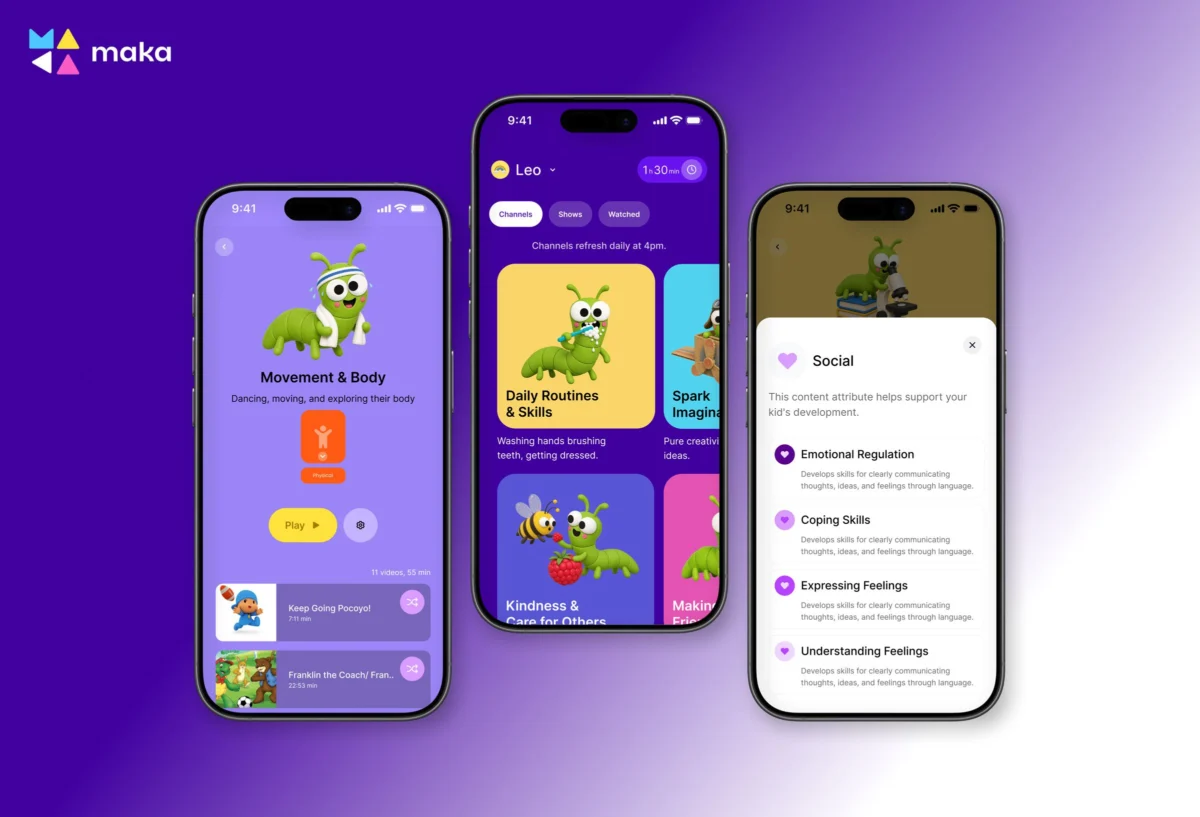
Enter Maka, a newly launched subscription-based streaming application designed explicitly as an antidote to the attention-economy model dominating children’s entertainment. Built from the ground up to reject the traditional mechanics of engagement-driven platforms, Maka arrives at a critical juncture when pediatricians, researchers, and child advocacy groups are pushing back against the unchecked expansion of low-quality digital media.
The Genesis of a Child-Centric Streaming Alternative
The conceptual foundation for Maka was laid during the COVID-19 pandemic, a period that saw an unprecedented reliance on digital screens for childcare and early childhood education. Isabel Sheinman and Tanyella Leta, cofounders of the platform, spent those months critically evaluating the state of children’s media. They concluded that existing streaming services—even those ostensibly marketed toward families—were fundamentally built to serve adults and corporate monetization models, leaving children as an afterthought.
Maka officially launched with a curated catalog of 25 shows, blending licensed content from major global studios with works from independent creators. Notable titles in the initial lineup include established educational mainstays such as Sesame Street, The Wiggles, Franklin, Pocoyo, and Vida the Vet. Unlike ad-supported competitors that rely on algorithms to maximize user retention, Maka operates on a subscription model, charging $15 per month or $107 annually. Crucially, the platform features zero advertisements, no autoplay functions, and no endless scrolling capabilities, deliberately abandoning the features that turn standard children’s media into compulsive engagement machines.
A Rigorous Vetting Framework Rooted in Science
To ensure that its programming meets high developmental standards, every episode streamed on Maka undergoes a rigorous evaluation process through Imprint, a specialized framework created in partnership with researchers at the Yale Child Study Center.
Rather than relying purely on automated content moderation or general age ratings, the Imprint framework evaluates media across seven core domains of child development. These include emotional regulation, the promotion of kindness, the modeling of healthy child-caregiver relationships, and the support of critical thinking and language development. Reviewers assess granular elements of a show, ranging from scene-cut pacing to the complexity of the narrative structure.
This scientific approach stands in stark contrast to the unregulated wild west of open-video platforms. According to Michael Robb, head of research at the media literacy nonprofit Common Sense Media, modern digital platforms fail to adequately distinguish between carefully designed educational content and low-effort algorithmic slop. While platforms have made strides in blocking overtly inappropriate material, Robb notes that avoiding harm represents a very low bar. There remains a profound gulf between content that is merely not harmful and media created intentionally with child development in mind.
The Algorithmic Threat: AI Slop and Eroding Attention Spans
The urgency behind platforms like Maka is underscored by mounting empirical evidence regarding children’s digital consumption. A landmark 2020 study by Common Sense Media revealed that 75 percent of YouTube videos watched by young children possessed weak or zero educational value, with many exposing viewers to advertisements and content intended for older audiences.
In recent years, the rise of generative artificial intelligence has drastically accelerated this crisis. Bad actors now leverage AI tools to generate thousands of low-effort cartoon videos featuring nonsensical plots, subtle misinformation, and occasionally disturbing imagery, including graphic violence and fetishized content masked as children’s entertainment. Because these videos are optimized to mimic the visual style of legitimate educational shows, they frequently bypass parental scrutiny when appearing side-by-side with trusted programming.
This saturation of low-quality content has provoked sharp pushback from the medical community. Earlier this year, the American Academy of Pediatrics (AAP) updated its guidance on digital media, urging families to actively avoid AI-generated content, AI chatbots, short-form video formats, and clickbait. Tiffany Munzer, a developmental-behavioral pediatrician at the University of Michigan and lead author of the AAP’s recent policy statement, emphasizes that the proliferation of low-quality media deprives children of essential, slower-paced learning opportunities that foster critical attention spans and creative thinking.
Similarly, in April, the child advocacy group Fairplay spearheaded a letter signed by more than 200 organizations and experts, demanding that YouTube take aggressive action against the spread of AI slop. The coalition argued that such content directly distorts children’s sense of reality, overwhelms cognitive processes, and hijacks developing attention spans.
Industry Response and Platform Defenses
In response to sustained criticism, major platforms maintain that they have established robust safeguards for young users. YouTube representatives emphasize that its dedicated YouTube Kids application—intended for children 12 and under—restricts AI-generated content to a small, pre-vetted set of high-quality channels. The platform also offers granular controls allowing parents to manually block specific channels and disable search features entirely.
However, Google’s own support documentation explicitly acknowledges the limitations of automated filtering systems, noting that parents should expect occasional instances where a child encounters unintended material. Furthermore, industry critics argue that relying on parental gatekeeping places an unfair burden on families while allowing tech giants to profit from engagement-driven architectures.
Yalda Uhls, a researcher at UCLA specializing in children’s social learning and a former film executive at Sony and MGM, highlights a systemic shift in how media is curated. Historically, children’s media passed through layers of accountable human gatekeepers. Today, however, algorithms, anonymous creators, and automated tools dictate what children watch, with total watch time serving as the primary metric of success. "Nobody in that chain is required to ask what a child is actually learning," Uhls observes.
Redesigning the Digital Off-Ramp
Beyond content curation, Maka has introduced distinct product features aimed at redefining the psychological dynamics of screen time. Recognizing that transitions away from devices are often flashpoints for familial conflict, the platform integrates a customizable timer set at the beginning of each viewing session.
As a viewing session concludes, an original animated character named Scoot appears on screen to guide the child through the process of detaching from the device. By transforming screen termination into a predictable, structured ritual rather than an abrupt shutdown, the platform seeks to ease the friction associated with media consumption.
Furthermore, Maka’s leadership hopes to alleviate the cultural stigma surrounding parental screen use. Tanyella Leta points out that modern parents frequently face intense judgment for utilizing digital devices as tactical tools in public spaces, such as restaurants or public transit. By offering a guilt-free, scientifically vetted environment, the company aims to support parents rather than penalize them for necessary technological reliance.
Implications and the Road Ahead
Whether Maka can achieve long-term commercial viability remains an open question in an industry dominated by massive, free-to-consumer tech ecosystems. Industry analysts point out that competing against entrenched giants like YouTube—which are ubiquitous, free, and pre-installed on virtually every household device—presents a monumental challenge.
The ultimate test for Maka, according to Common Sense Media’s Michael Robb, will be its ability to scale sustainably without capitulating to the aggressive engagement metrics that govern the broader media landscape. Yet, despite the hurdles, industry advocates remain cautiously optimistic about the potential for intentional design to reclaim children’s media.
Reflecting on the historical trajectory of educational television, Leta draws parallels to the creation of foundational programming like Sesame Street and the philosophy of Fred Rogers, who viewed the boundary between the child and the screen as a sacred space. "One of the dads in our beta told us that with other platforms, when his kid is watching, it feels like a race to the bottom of my kid’s brainstem," Leta notes. "It doesn’t have to be like that."