


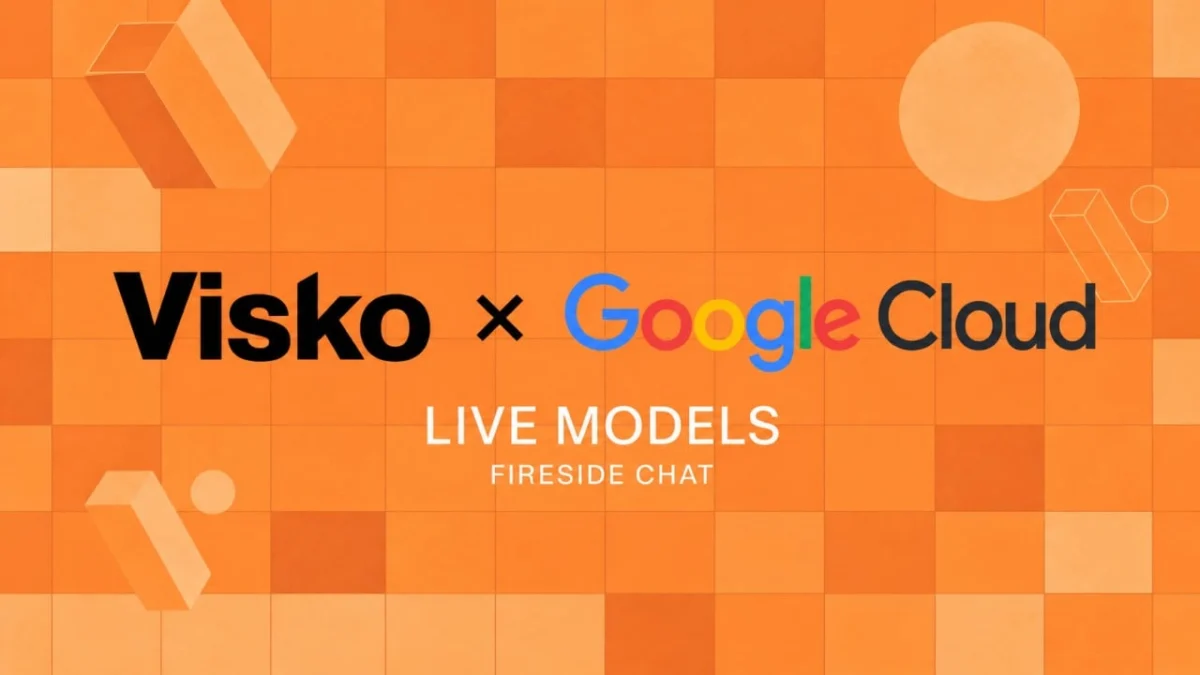
The intersection of artificial intelligence, interactive entertainment, and cloud computing infrastructure will take center stage on Wednesday, October 14, as AI research company Visko and tech giant Google Cloud host an exclusive evening event in Los Angeles. Titled the "Live Models Fireside Chat," the gathering is designed for professionals across animation, visual effects (VFX), and game development. Attendees will explore the emerging paradigm of AI-generated environments that respond dynamically to user input while maintaining strict spatial and narrative continuity.
As the entertainment industry increasingly looks toward real-time tools to streamline production pipelines, the event aims to demystify the technology powering these systems. Specifically, the discussion will focus on Visko’s foundational model, Orbis, and the specialized hardware architecture provided by Google Cloud necessary to sustain real-time, large-scale AI inference.
Main Facts and Event Overview
The "Live Models Fireside Chat" is scheduled to run from 6:30 p.m. to 9:00 p.m. Pacific Time on Wednesday, October 14, at a confidential location in Los Angeles. Due to capacity constraints and the technical nature of the audience, attendance is strictly regulated; registration is mandatory and subject to approval by the hosting parties, with venue addresses dispatched solely to verified guests.
The core subject of the evening is the operational mechanics and creative implications of "Live Models"—a term coined by Visko to describe real-time systems that combine persistent memory, user interactivity, and generation grounded in physical laws. Unlike traditional generative AI tools that produce static images or pre-rendered video clips, these systems generate and stream interactive environments continuously as users explore them.
The event features two primary presentations from industry leaders:
- Will Yin, Chief Executive Officer of Visko, who will outline the technical distinctions between conventional AI architectures and continuous Live Models, while introducing the Orbis foundation model.
- Dave Elliott, Head of Developer Advocacy for AI at Google Cloud, alongside members of Google’s startup team, who will detail the role of Tensor Processing Units (TPUs) in powering high-demand, real-time AI inference at scale.
Background Context and Industry Evolution
To understand the significance of the upcoming Visko and Google Cloud event, one must examine the rapid evolution of generative artificial intelligence within the media and entertainment sectors over the past half-decade.
Initial breakthroughs in generative AI primarily focused on static imagery, text-to-image synthesis, and isolated video generation clips. While these tools demonstrated remarkable aesthetic capabilities, they suffered from critical limitations: a lack of temporal consistency, absence of physics-based reactions, and an inability to accept real-time user inputs to alter the output dynamically. For filmmakers and game developers, these early iterations were useful for early-stage inspiration or mood boards, but impractical for production workflows requiring precise spatial continuity and interactive control.
By 2024, the focus of AI research shifted aggressively toward foundational models capable of understanding three-dimensional space, lighting persistence, and real-time streaming. Companies began seeking ways to bypass the exhaustive rendering times associated with traditional computer graphics pipelines. Visko emerged within this landscape as a specialized research entity dedicated to solving the problem of persistent, interactive, AI-generated worlds.

Concurrently, the computational load required to run such models escalated exponentially. Traditional graphics processing units (GPUs), while foundational to the initial AI boom, faced bottlenecks when tasked with the simultaneous training, fine-tuning, and continuous low-latency inference demanded by real-time generative worlds. This created a symbiotic dependency between specialized AI software developers like Visko and cloud infrastructure providers capable of delivering massive, scalable compute power.
Chronology of the Technology and Partnership
The trajectory leading up to the October 14 fireside chat reflects a coordinated push by infrastructure giants and AI innovators to bridge the gap between theoretical machine learning and practical studio application:
- Late 2023 to Early 2024: Accelerated development of spatial AI models capable of maintaining object permanence across multiple video frames or rendered blocks. Industry discussions shift from "text-to-video" to "interactive world simulation."
- Mid 2024: Visko conceptualizes and develops Orbis, a large, general-purpose foundation model engineered specifically to generate and stream interactive, physics-grounded environments on demand.
- Late 2024: Integration challenges prompt AI startups to seek out ultra-high-performance cloud architectures. Collaborations form between foundational model developers and cloud ecosystems offering proprietary hardware designed explicitly for tensor operations.
- October 14 (Upcoming): Visko and Google Cloud formalize their collaborative discourse through the "Live Models Fireside Chat" in Los Angeles, presenting their technical findings and infrastructure solutions directly to the creative community.
Supporting Data and Technical Architecture
The transition from pre-rendered computer-generated imagery (CGI) to real-time AI generation hinges on two critical technological pillars: the software foundation model (Orbis) and the hardware inference engine (Google TPUs).
Orbis and Persistent Memory
In traditional game engines like Unreal Engine or Unity, environments are constructed using pre-built assets, rigid physics engines, and scripted triggers. In contrast, foundation models like Visko’s Orbis generate environments dynamically. For a system to be viable in virtual production or gaming, it must solve the "continuity problem"—ensuring that if a user turns around and looks back at a previously generated object, that object has not randomly altered its form, texture, or location. Orbis integrates persistent memory protocols with physics-grounded generation algorithms to ensure that the virtual world retains spatial and temporal consistency as the user navigates through it.
Tensor Processing Units (TPUs)
Running a trained AI model to produce an output—a process known as inference—demands immense computational throughput, particularly when executed in real time at high frame rates and resolutions. During the Los Angeles event, Google Cloud representatives will address why standard computing setups fall short for these workloads.
Google’s custom-designed Tensor Processing Units (TPUs) are purpose-built ASIC (Application-Specific Integrated Circuit) chips optimized for matrix multiplication, the fundamental mathematical operation underlying neural networks. According to Google Cloud’s technical frameworks, TPUs provide superior performance-per-watt efficiency and scalability for large language models and generative foundation models compared to generalized hardware alternatives. For real-time live models that stream complex environments continuously to multiple users, TPU infrastructure offers the necessary low-latency inference capabilities to prevent lag, stuttering, or visual degradation.
Official Responses and Industry Stakeholder Perspectives
While the event itself serves as a direct platform for Visko and Google Cloud executives, representatives from both organizations have framed the initiative as a necessary bridge between high-end artificial intelligence research and practical creative execution.
Industry analysts observe that hardware providers like Google Cloud are increasingly eager to position their proprietary silicon as the default backbone for the next generation of entertainment technology. By supporting foundational model developers such as Visko, cloud providers can demonstrate real-world utility for TPUs outside of traditional enterprise data analytics and text-based generative AI applications.
Conversely, AI research firms benefit immensely from aligning with major cloud ecosystems. The sheer capital expenditure required to train and deploy foundational models that simulate physics-grounded environments makes independent hosting virtually impossible for mid-sized startups. Partnerships with entities like Google Cloud provide the elastic compute capacity needed to scale operations from experimental research prototypes to enterprise-grade production tools.

Broader Impact and Implications for Entertainment Sectors
The implications of real-time, AI-generated environments extend far beyond experimental research, touching three core pillars of modern media creation: previsualization (previs), virtual production, and video game development.
Previsualization (Previs)
In traditional filmmaking, previs is a labor-intensive, time-consuming phase where directors and cinematographers map out complex sequences using rough 3D models and animatics. If a director decides to alter a camera angle, lighting setup, or set design during a previs session, artists must manually adjust the assets and re-render the scene.
With Live Models, directors could theoretically manipulate environments in real time using natural language prompts or direct spatial inputs, observing the rendered outcome instantaneously. This drastically compresses the pre-production timeline and allows for more fluid, improvisational creative decision-making before physical or LED-volume shoots begin.
Virtual Production
Virtual production—exemplified by LED stages that display real-time background environments during principal photography—currently relies heavily on game engines running on powerful local hardware workstations. While effective, these setups require extensive manual asset creation by environment artists.
AI-generated live models could augment virtual production workflows by dynamically generating background extensions, changing weather conditions, or altering geographical layouts on the fly based on the narrative needs of the director on set. This reduces the dependency on pre-built asset libraries and opens new possibilities for adaptive storytelling.
Video Game Development
The video game industry faces mounting development costs and ballooning production cycles, often taking five to seven years to deliver AAA titles. A significant portion of this time is dedicated to manual environment design, level building, and optimization.
If foundation models like Orbis mature into reliable, real-time generation tools integrated into game engines, developers could offload procedural and dynamic world-building tasks to AI. This would enable games to feature infinitely expanding, responsive environments that adapt to player choices in real time, fundamentally altering game design philosophy and reducing asset production burdens.
Conclusion
As the entertainment technology sector converges on Los Angeles for the "Live Models Fireside Chat" on October 14, the dialogue between Visko and Google Cloud highlights a pivotal technological juncture. By addressing both the algorithmic challenges of persistent, physics-grounded AI worlds and the raw computing infrastructure required to sustain them, the event offers a clear glimpse into the future of digital creation. Whether these tools will seamlessly integrate into professional pipelines depends on the successful harmonization of software innovation and hardware scalability—a challenge that both companies are positioning themselves to lead.