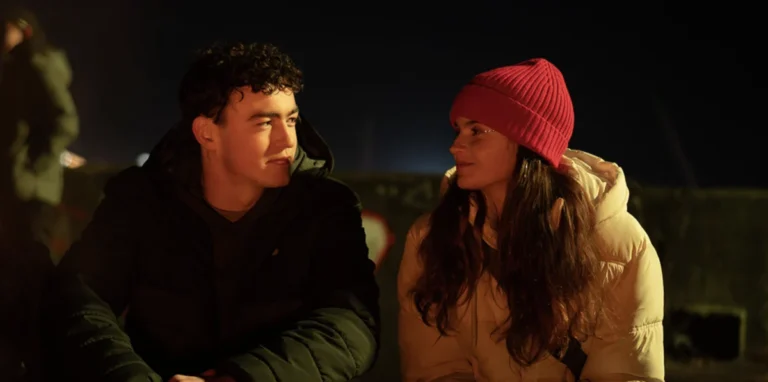




A Narrative of Cultural Navigation
The film is fundamentally a study of human movement across psychological and societal borders. Set against the backdrop of Marseille’s vibrant yet historically strained neighborhoods, the story follows the reconciliation of two estranged childhood friends during a summer break. Their attempt to recapture the simplicity of their past is abruptly halted by a tragic incident at a social gathering, an event that serves as the narrative catalyst for the remainder of the film.
Rather than relying on the typical tropes associated with interfaith conflict, El Yousfi focuses on the internal struggle to maintain personal autonomy while tethered to ancestral, religious, and linguistic legacies. The film adopts a chaotic, almost documentary-style aesthetic that mirrors the characters’ own lack of equilibrium, providing a visual representation of their struggle to reconcile the desire for liberation with the anxiety of losing their connection to their heritage.
The Marseille Context: A City of Transition
To understand the film’s gravity, one must acknowledge the role of Marseille as a primary setting. Historically, the port city has served as a gateway for North African and Mediterranean migration. Statistical data from the French National Institute of Statistics and Economic Studies (INSEE) underscores that Marseille maintains one of the highest concentrations of immigrant-background populations in France. This demographic reality creates a unique environment where the "new normal" of French secularism frequently clashes with traditional, often conservative, familial structures.
While cinematic history has often portrayed Marseille through the lens of grit and criminality—most famously in the 1971 film The French Connection—El Yousfi reclaims this space to highlight the domestic realities of the Moroccan ex-pat community. The film illustrates that for many, the most significant conflicts do not occur in the streets, but within the domestic sphere. The "insidious impact" mentioned in the film’s thematic core refers to the way family obligations can override individual aspirations, creating a pressure cooker effect that is particularly acute for young women expected to uphold cultural purity.
Chronology of the Narrative Arc
The film’s structure follows a clear, albeit emotionally volatile, progression:
- The Reconnection: The opening act establishes the reunion of Myriam and Eva, framing their friendship as a bridge across religious lines. Their interaction is depicted as a return to a shared history, temporarily insulated from the external pressures of their families.
- The Inciting Incident: A tragedy occurs at a party, shattering the illusion of their carefree holiday. This event forces the characters to stop observing their cultural constraints from a distance and instead engage with them directly.
- The Period of Estrangement and Pressure: Following the tragedy, both women are pulled back into the orbit of their respective families. The film shifts focus to the "insular obligations" that dictate their behavior, highlighting the disparity between their personal values and their communal responsibilities.
- The Resolution of Identity: The final act centers on the characters’ decisions to forge their own paths. It is not a story of total rupture from their past, but rather a tempered realization that their identity is a synthesis of their heritage and their personal agency.
Sociological Implications of Interfaith Friendships
The film serves as a mirror for broader social debates regarding the integration of religious minorities in Europe. According to various sociological studies on social cohesion in France, the "double-burden" faced by women from religious backgrounds—specifically the negotiation between traditional family values and the secular demands of the French Republic—is a recurring point of tension.
By centering on the relationship between a Jewish woman and a Muslim woman, the film highlights a shared historical and cultural legacy, often referred to in the title as "The Daughters of Abraham." This common lineage is presented not as a guarantee of peace, but as a source of shared struggle. The film suggests that the proximity of these two cultures in a city like Marseille makes their interactions both "compatible and combustible."
Critical Analysis of Production and Craft
The effectiveness of the film lies in its refusal to simplify the moral dilemmas of its protagonists. The cinematography by Fabien Faure utilizes both subtle, intimate framing and sweeping, grand captures of the Marseille landscape to juxtapose the characters’ internal confusion with their external environment.
Critics have noted that the performances by Guers and Baya are instrumental in anchoring the film. By avoiding melodrama, the actors allow the audience to observe the characters’ flaws without judgment. The film’s script, penned by El Yousfi and Brown, is noted for its "deft interweaving" of emotional and cultural threads. The dialogue captures the specific linguistic cadence of the region, adding a layer of authenticity that elevates the film from a standard drama to a piece of social commentary.
Official Responses and Industry Reception
While the film is still in the early stages of its distribution cycle, early festival screenings have generated significant discourse among sociologists and film critics alike. Industry analysts suggest that the film occupies a vital space in the "modernist context" of European cinema. By focusing on the personal as political, El Yousfi avoids the pitfalls of didactic storytelling.
Observers in the European film community have remarked that the film provides a necessary counter-narrative to the sensationalized media portrayals of Marseille. Rather than focusing on the sensational or the salacious, the creative team has focused on the "meandering paths" of human growth. This approach has been praised for its ability to reflect upon issues of global impact—such as migration, identity politics, and the generational divide—through the lens of a deeply intimate friendship.
Conclusion: The Path Forward
The Daughters of Abraham concludes not with a tidy resolution, but with a nuanced understanding of the future. The film posits that for Myriam and Eva, the "constraints of the past" are both a source of comfort (succor) and a suffocating force. This duality is the central paradox of the film.
As the characters navigate their way through the obstacles presented by their families and their own internal biases, the film suggests that maturity is the result of reconciling these tensions. The message is clear: true growth requires a balanced understanding of one’s origins, but it also necessitates the courage to define a path that is uniquely one’s own. By the end of the 94-minute runtime, the audience is left with the understanding that while the past is a permanent foundation, it need not be a prison. The film successfully positions itself as a significant contribution to contemporary French cinema, offering a thoughtful, balanced, and deeply humanistic look at the struggle for identity in a rapidly evolving world.