

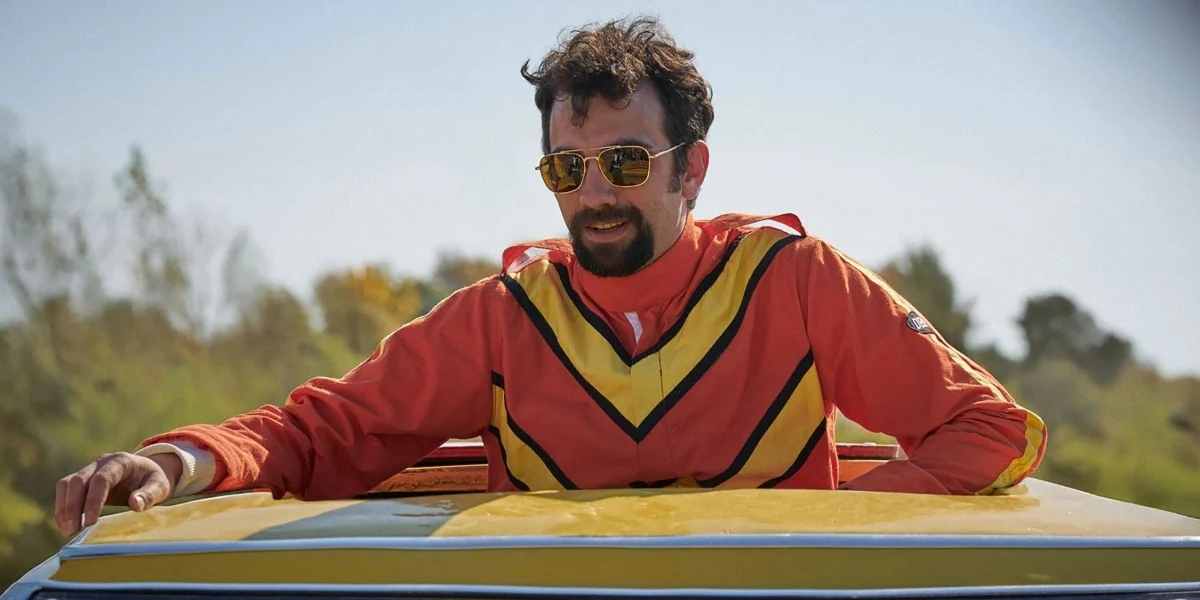
Directed by Michael Dowse and starring Jay Baruchel, the film serves as a hybrid narrative that blends historical documentary footage with dramatic reenactments. The project is rooted in the 1981 National Film Board of Canada documentary The Devil at Your Heels, which chronicled Carter’s obsessive, multi-year pursuit of a singular, gravity-defying stunt. With a runtime of 99 minutes, the film provides an examination of human obsession, the mechanics of mid-century stunt work, and the complex intersection of documentary filmmaking and biographical storytelling.
The Historical Genesis of the Rocket Jump
In the late 1970s, Ken Carter, a stuntman known for his extreme appetite for danger, conceived of a feat that defied the conventional limitations of automotive engineering. His goal was to bridge the St. Lawrence River—a span of approximately one mile—by launching a rocket-equipped Lincoln Continental from a massive ramp located on the Canadian side to a landing site in the United States.
The logistical undertaking required the fabrication of a custom rocket engine, a series of failed test runs, and the solicitation of significant corporate and private investment. Carter’s quest was not merely an athletic endeavor; it became a complex, years-long saga involving financial ruin, technical failures, and a relentless public relations campaign. The stunt was finally attempted in 1979, but not in the manner Carter had envisioned. The project was plagued by equipment malfunctions and the unpredictable nature of the St. Lawrence, leading to a series of delays that transformed the event into a study of endurance and psychological strain.
Production Methodology: A Nested Narrative
Michael Dowse’s The Stunt Driver employs a sophisticated visual structure to distinguish between historical reality and cinematic reconstruction. By utilizing original footage from Robert Fortier’s 1981 documentary, the film creates a "film-within-a-film" aesthetic. Dowse integrates widescreen 35mm cinematography with the raw, grainy texture of 16mm archival footage, effectively blurring the lines between the past and the present.
The narrative arc is anchored by Jay Baruchel’s portrayal of Carter, which captures the dichotomy between the man’s public persona—the "Mad Canadian" stunt performer—and his private, often more calculated management style. The supporting cast, including Ed Helms as the pragmatic engineer Dick Keller, Laurence Leboeuf as Gloria, and Ben Foster in a brief but poignant appearance as a skeptical peer, provides the necessary tension to balance the spectacle of the stunts with the internal pressures facing the production team.
Chronology of the Carter Quest
- 1974–1976: Initial conception of the "St. Lawrence River Jump." Carter begins seeking investors and engineering support for the rocket-powered Lincoln.
- 1977: The project gains traction as a media event. The National Film Board of Canada begins filming The Devil at Your Heels.
- 1978: Multiple test runs end in failure. Technical limitations regarding the rocket’s thrust and the ramp’s structural integrity lead to mounting debt.
- 1979: The final, tragic attempt occurs. The stunt results in the loss of the vehicle and effectively ends Carter’s career, leaving him with significant physical and financial consequences.
- 1981: The documentary The Devil at Your Heels is released, solidifying Carter’s legacy as a tragic, heroic figure of the era.
- 2026: The Stunt Driver premieres, recontextualizing the footage and the man for a modern audience.
Technical and Engineering Challenges
The engineering behind Carter’s rocket car was rudimentary by modern standards. The vehicle, a heavy sedan, was outfitted with rockets designed to provide the necessary thrust to clear a mile-wide expanse. However, the variables involved—wind speed, fuel mixture, landing angle, and the physical stress on the vehicle’s frame—posed insurmountable risks.
Engineers associated with the project, including the fictionalized portrayal of Dick Keller, faced constant pressure to accelerate the timeline for media exposure. According to archival reports from the era, the financial burden of the stunt led to corners being cut in safety protocols, a theme that The Stunt Driver explores with somber detail. The failure of the final jump was not a result of a lack of courage, but a failure of the mechanical systems that were pushed beyond their intended capabilities.
Broader Implications and Cultural Legacy
The cultural significance of Ken Carter’s quest extends beyond the realm of extreme sports. In the political climate of the late 1970s, as Canada navigated internal tensions regarding its relationship with the United States and internal regional disputes, Carter’s desire to physically bridge the two countries served as a metaphorical, if chaotic, act of national expression.
The film suggests that Carter’s madness was, in some ways, a response to the anxieties of his time. By attempting to overcome a physical border through sheer force and speed, he embodied the spirit of a generation attempting to define itself through spectacle. Critics and historians have noted that while the stunt itself was a failure, the documentation of the event provides a valuable look at the desperation and determination inherent in the "daredevil" culture of the 1970s.
Analysis of the Film’s Impact
The decision to include the filmmaker, Robert Fortier (played by Joe Cobden), as a central character in The Stunt Driver provides a meta-commentary on the ethics of documentary filmmaking. The relationship between the observer and the subject is fraught with complications; as the documentary crew followed Carter, they became financiers and catalysts for his increasingly dangerous behavior. This narrative choice highlights the moral ambiguity often present when journalists become participants in the events they are covering.
Furthermore, the film serves as an examination of the "Quixotic" nature of the stunt. Much like the literary figure who tilts at windmills, Carter’s quest was doomed by its own impossibility. However, the film avoids ridiculing this ambition. Instead, it positions Carter as a tragic hero who sought a form of immortality through an act that was as much about the process of trying as it was about the success of the finish.
Conclusion: A Legacy Re-examined
In the contemporary landscape, where risks are calculated by algorithms and safety is a primary concern in all public events, the story of Ken Carter feels like a relic of a more dangerous, visceral era. The Stunt Driver succeeds in humanizing a man who was often treated as a caricature of insanity by the media of his time. By highlighting the logistical, emotional, and social costs of the stunt, the film elevates a story of a "giant ramp" into a profound reflection on human ambition.
As the production reaches audiences in 2026, the film serves as a reminder of the thin line between bravery and folly. It does not shy away from the tragedy of the event, nor does it diminish the spectacle. Rather, it offers a balanced, objective look at a period in Canadian history where one man’s obsession with a rocket-powered leap across a river became the ultimate symbol of a life lived at the edge of human capacity. Through its meticulous recreation and respectful use of historical archives, The Stunt Driver ensures that the legacy of Ken Carter remains, for better or worse, a permanent part of the cultural tapestry.