

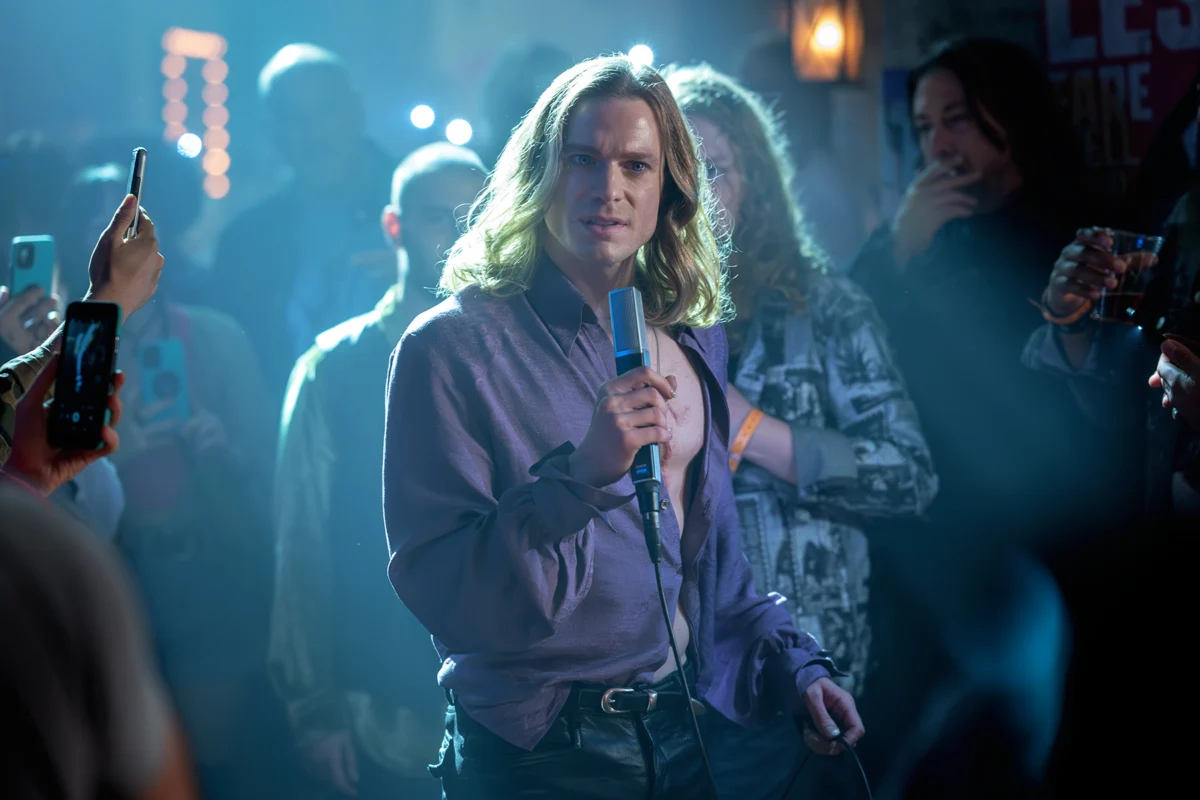
The season finale of AMC’s The Vampire Lestat delivered a poignant and introspective conclusion for its titular immortal, Lestat de Lioncourt, as portrayed by Sam Reid. In a narrative arc that deliberately diverts from Anne Rice’s established lore, the series plunges Lestat into a profound reckoning with his perceived failures, most notably his inability to conquer the fictional Billboard Hot 100 with his groundbreaking music. This departure from the source material, which depicts Lestat as a global musical phenomenon, allowed the creative team—led by showrunner Rolin Jones and music writer Daniel Hart—to explore a more vulnerable and relatable facet of the ancient vampire, even if it meant his debut album became a critical and commercial disappointment, overshadowed by contemporary artists like Drake.
The undertaking to translate Rice’s iconic rock star vampire to the small screen was, by all accounts, a significant creative challenge. While the series aimed to capture Lestat’s inherent charisma and larger-than-life persona, it also sought to imbue him with a sense of authenticity and struggle. Actor Sam Reid, speaking to Billboard from his native Australia, where he is currently starring in a Sydney production of Doubt, detailed his approach to embodying this reimagined Lestat. "I looked at a lot of glam rock," Reid revealed, "but I was a little bit concerned about him feeling too nostalgic, so I didn’t try and lean too much into that."
Reid’s preparation for the immortal theater kid’s latest musical adventure involved an unexpected detour down a YouTube rabbit hole, focusing on the primal energy of big cats. "Lestat’s got big cat energy," he explained with a laugh. "That’s how I always operate with him. It was like that, just on steroids." This metaphor highlights the intended portrayal of Lestat onstage: a creature of immense power, predatory grace, and a captivating, almost feline, swagger that embraces genre-typical androgyny. However, the season finale strips away this carefully constructed façade, exposing the raw vulnerability beneath the surface.
Facing the Music: Critical Backlash and Chart Failure
The season’s climax sees Lestat grappling not only with physical peril—the double beheadings of himself and his companion Louis (Jacob Anderson) are debilitating but not fatal—but also with a profound internal crisis. The episode plunges him into a maelstrom of self-doubt, amplified by the harsh critical reception of his posthumous LP. Reviews from esteemed publications like Pitchfork and Stereogum delivered "brutal pans," dissecting the album’s artistic merits and Lestat’s musical aspirations.
"He’s not succeeding in anything that he tries to do, even in telling his story," Reid stated, underscoring the thematic weight of the finale. The fictional chart failure, where Drake’s prolific output—a prescient nod to the artist’s real-world chart dominance—bested Lestat’s efforts, serves as a potent symbol of his contemporary artistic irrelevance. This deviation from the books, where Lestat is an undisputed musical icon who can incite riots and command global adoration, positions the series as a fresh interpretation rather than a direct adaptation.
Crafting the Rock Star: Influences and Interpretations
Reid’s preparation for portraying Lestat as a rock star was a nuanced process, prioritizing authenticity over imitation. "You know, it’s weird to say, but I didn’t really think about it too much," he admitted. "Lestat’s always been a performer. He’s always naturally taken on this role of a larger-than-life character. So when I was thinking about the rock performances, I just leaned into the work that we had already done. Trying to overly craft it was a bit of a concern to me because I wanted it to feel natural. I didn’t want it to feel overly choreographed or anything like that."
His research involved delving into the performances of musical titans. "I did look a lot at some bootleg David Bowie recordings of one of his concerts in Los Angeles," Reid shared. "But I was never really trying to emulate David Bowie. It was just always trying to maintain that alien quality. Even though he’s trying to be very raw and express himself in an honest way, he does feel very alien and otherworldly." This approach allowed him to explore Lestat’s inherent otherness, a quality that could be dialed back when the character shed his performative shell.
The influence of Kurt Cobain, suggested by music writer Daniel Hart, also played a role. Reid’s viewing of Montage of Heck, the documentary about Cobain, provided a crucial insight. "I did find that a little bit jarring," he confessed. "I couldn’t quite work out what he meant. I had seen [the documentary] before, but looking at it from the perspective of Lestat was a bit of an eye-opener because the character is so misunderstood. His music was so far-reaching, but there was still this very vulnerable soul that was at the center of it." This comparison highlights the potential for even the most outwardly defiant artists to harbor deep-seated insecurities and a yearning for genuine connection.
Further inspirations for Reid included insights from Anne Rice herself. "I always start with Anne Rice interviews," he said. "There are a lot of Jim Morrison references in the book, so I did look at Jim Morrison, trying to work out what she meant." He also noted Rice’s reference to Jon Bon Jovi, though he humorously admitted, "I didn’t find that reference so helpful." Creative consultations with Rolin Jones also proved fruitful. "Rolin, very early, had also said that Lestat is a Fiona Apple-esque kind of id-first musician, so it was fun to go back and examine her music. Saint Vincent was always an inspiration for me for Lestat, as well." This eclectic mix of influences—from glam rock pioneers to introspective singer-songwriters and raw punk icons—contributed to the multifaceted portrayal of Lestat’s musical identity.
Beyond the Androgyny: Exploring Gender and Identity
The series also touches upon Lestat’s complex relationship with gender. When asked about Lestat’s line expressing a desire to be a woman, Reid was careful to clarify the creative intent. "I don’t know whether that’s him trying to say anything beyond that," he stated. "I think Lestat isn’t in a gender crisis at all, and it would be wrong to say that’s how we’re portraying him."
Instead, Reid suggested, the sentiment might be a reflection of Lestat’s self-awareness regarding internal conflicts. "But I feel like it does give a nod to—potentially—where he might be going in terms of acknowledging that there is a toxicity that exists within him that might be connected to his maleness, more than anything else." This nuanced interpretation suggests that Lestat’s comment isn’t a declaration of gender identity but rather an exploration of the societal constructs and inherent pressures associated with his perceived masculinity, particularly in the context of his vampiric existence and his often destructive relationships.
The Role of Criticism and the Artist’s Resilience
The inclusion of harsh music criticism, including a fictionalized Billboard review, served as a crucial narrative device. "It was a great framing device to not make Lestat this global megastar, the way that he is in the books," Reid explained. "I think there’s been a big misdirect in the way that this season has intentionally presented itself. Lestat is very powerful, but his whole modus operandi is to try to feel genuine love and appreciation. He might say that he doesn’t need validation, that he’s above the validation. But, actually, deep down, he really does."
This vulnerability is central to the season’s arc. Despite facing repeated setbacks and profound failures, Lestat exhibits a remarkable resilience. "Lestat can just be completely burnt down or hit a brick wall time and time again. But he gets up and brushes himself off again," Reid observed. The finale reinforces this theme, even as Lestat lies dying, struggling to articulate coherent thoughts. His inability to form a simple, beautiful sentence due to grammatical stumbles is a poignant metaphor for his artistic and personal frustrations. Yet, even in this state, he acknowledges the value of his attempt. "Even if he didn’t succeed, even if he has failed, even if everybody who he loves thinks he is a failure, at least he tried something."
Reid drew an important lesson from this narrative choice: "There’s an important lesson in criticism in that too, because even if everybody says, ‘Not good enough’ or ‘I don’t appreciate your work,’ it’s up to you as the artist to turn around and say, ‘Do I take that as a full stop? Or do I take that as a semicolon?’" This perspective emphasizes the artist’s agency in interpreting feedback and continuing their creative journey, regardless of external validation.
The Oracle of Rolin Jones and the Echoes of Reality
The episode’s narrative included a surprisingly prescient detail: Lestat’s album being bested by Drake’s release of an overwhelming number of songs, a scenario that mirrored Drake’s real-world chart strategies. "That was trippy," Reid remarked. "Props to Rolin, because I was like, ‘I don’t think this is very realistic. Why is it Drake that releases all of these songs?’ And he was adamant that it had to be that. Even me saying that line, I sort of, like, imbued it with so much confusion. Then it turns out Drake does drop all of those songs at once. So props to the oracle Rolin Jones. That just blew my mind. I only just found out that happened." This confluence of fictional narrative and real-world music industry trends added an unexpected layer of meta-commentary to the season’s conclusion.
Reid also mused on another contemporary chart-topper, Taylor Swift. When informed that Lestat’s fictional release date would have placed him behind Swift on the charts, he laughed, "See, that would have been more realistic for me at the time." This lighthearted observation underscores the competitive and ever-shifting landscape of the music industry.
A Glimmer of Hope: Love and Soulmate Connection
The season finale eschews the anticipated "big concert that brings about the end of the world," opting instead for a more intimate and emotionally resonant conclusion. As Lestat faces his mortality, he experiences a profound realization: Louis loves him. This understanding arrives not through a direct confession, but through an internal vision or the specter of Louis’s brother, Paul. "He’s not able to tell him in the clear and concise way that he probably wanted to hear, because the last time Louis said ‘I love you’ to somebody, they committed suicide," Reid explained, referencing Louis’s past trauma.
This moment of clarity allows Lestat to transcend his lifelong anxieties about abandonment and his self-absorbed need for validation. "You see them separately acknowledge their love for each other and their enduring capacity to be true soulmates. And they will remain so," Reid stated, hinting at a future trajectory for the characters. "I think that leads them off into a totally new, different trajectory going forward, if we go forward. We have a new state to exist in." This suggests that their shared experience, despite its tumultuous nature, has forged a deeper, more profound connection that transcends their previous struggles.
The Performance That Couldn’t Be
Even in his dying moments, Lestat attempts to retreat into his rock star persona, envisioning himself onstage. However, this performance ultimately falters. "He’s trying to perform, and he can’t get to it," Reid observed. "He can’t actually get to the song. He can’t even get to the performance in the way that he wants to. The armor of the rock star just slips away." This final unraveling signifies a moment of truth, where the carefully constructed identity of the immortal rock god is shed, revealing the vulnerable being beneath.
The Singer Within: A Newfound Appreciation
Reflecting on his experience as a singing vampire, Reid expressed a newfound appreciation for his vocal abilities and the theatrical context in which he exercised them. "I guess it’s not really part of my DNA to sit there and be like, ‘Yeah!’" he quipped, regarding self-praise. "But a few months ago, I sat down and listened to all of the recordings that we did, and it was sort of an astonishing moment where I thought, ‘My God, look how much work this is.’"
He conveyed gratitude for the opportunity to explore this facet of his artistry. "I’ve always sung. I always had it as part of my life. I just never really had the opportunity to explore it in this capacity, which is the kind of capacity that I would like to explore it in. I like to do it in a theatrical context where I’m playing a character, or the songs have a direct correlation to a story that I’d be telling, as opposed to just making music." The experience of performing Lestat’s music, he concluded, felt more akin to performing a play than a traditional concert, offering a sense of security within the character’s narrative. He expressed hope for future opportunities to share the extensive work that went into the musical aspects of the series, solidifying the season’s ambitious artistic vision.