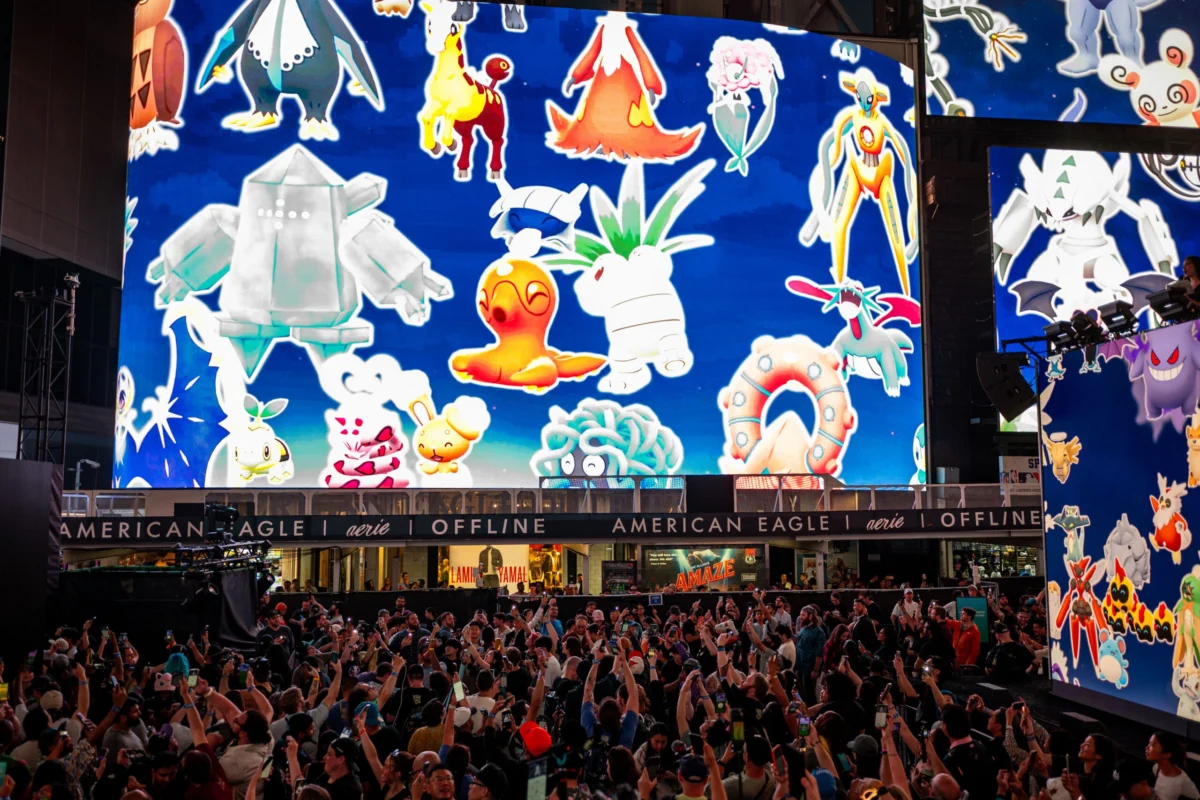
The atmosphere in New York City’s Times Square on a recent Thursday evening was described as electric, a sentiment fueled not only by a sudden rainstorm but by the virtual discharge of Thunderbolt and Hyper Beam attacks as thousands of players engaged the legendary Mega Mewtwo Y. This gathering, which saw more than 1,500 real-world trainers participate in one of the largest in-person mobile gaming battles in history, served as the centerpiece for the 10th-anniversary celebration of Pokémon Go. Since its debut in 2016, the augmented reality (AR) title developed by Niantic has transitioned from a viral sensation into a foundational pillar of the "forever game" genre, maintaining a massive global footprint and generating staggering financial returns.
The event was a carefully orchestrated milestone designed to fulfill a decade-old promise. When Pokémon Go was first teased in a 2015 trailer, it depicted a cinematic vision of hundreds of players swarming Times Square to defeat Mewtwo, with the battle broadcast across the iconic digital billboards of Midtown Manhattan. For years, technical limitations and the sheer scale of such an undertaking kept that specific vision out of reach. However, as part of the 10th-anniversary festivities, Scopely—the mobile gaming giant that acquired Niantic’s games business last year—finally brought that trailer to life. The screens of Times Square were synchronized to display the raid boss, creating a seamless integration of digital gameplay and physical environment that marked a new high point for location-based entertainment.
A Decade of Unprecedented Growth and Market Dominance
The trajectory of Pokémon Go remains an anomaly in the volatile mobile gaming industry. Launched in July 2016, the game utilized a mixed-reality hunting mechanic that encouraged players to explore their physical surroundings to capture virtual creatures. The impact was immediate and global, resulting in more than 130 million downloads within its first 30 days. At its peak that same year, the game boasted 232 million active players and generated nearly $1 billion in revenue within its first six months.
Over the subsequent decade, Niantic and its partners focused on long-term retention rather than short-lived hype. According to data from AppMagic, this strategy has been immensely successful, with the title surpassing $9 billion in lifetime player spending. The game’s enduring profitability and unique community-driven model made it a prime target for acquisition. In a landmark $3.5 billion deal last year, Scopely—the publisher behind hits such as Monopoly Go!—acquired Niantic’s games business, including the Pokémon Go franchise.
Despite the transition in ownership, the core leadership remains focused on the game’s original mission of exploration and social connection. Michael Steranka, Vice President of Product at Scopely, who has been with the project since 2017, noted that the Times Square event was a symbolic achievement. He remarked that the company has finally delivered on the immersive capabilities promised in the game’s initial marketing, bridging the gap between a promotional concept and a functional, large-scale reality.
Chronology of an AR Revolution: From Technical Hurdles to Global Fests
The path to the 10th-anniversary celebration was not without significant challenges. In its early years, Pokémon Go struggled with the technical infrastructure required to support its massive user base. The first Pokémon Go Fest, held in Chicago in 2017, is frequently cited by the community as a low point due to overloaded cellular networks and unstable servers that rendered the game unplayable for thousands of attendees.
However, these early failures provided critical data that allowed the development team to refine their server architecture and local-event logistics. Over the years, the game introduced several key features that expanded the gameplay loop:
- 2017: Introduction of Raid Battles, allowing cooperative play against powerful bosses.
- 2018: The launch of Friends and Trading systems, fulfilling a core social request from the fan base.
- 2019: The debut of Team GO Rocket encounters, adding a narrative-driven player-versus-environment (PvE) element.
- 2020: The implementation of the GO Battle League, creating a competitive player-versus-player (PvP) ecosystem, and the introduction of remote raiding in response to global pandemic restrictions.
- 2022-2024: Expansion of "Mega Evolution" mechanics and the refinement of live, ticketed events in major cities including London, Osaka, and New York.
By 2024, the game’s technical capacity had matured to the point where it could handle 2,000 players in a high-density area like Times Square without the connectivity issues that plagued its infancy. The invitation-only event in New York was managed via community ambassadors to prevent overcrowding, ensuring that the 1,500 attendees could participate in a synchronized raid against Mega Mewtwo Y while a live EDM concert by Loud Luxury provided the soundtrack.
The Human Element: Community Ambassadors and Social Impact
Beyond the financial metrics and technical milestones, the success of Pokémon Go is deeply rooted in its ability to foster real-world communities. Kim Adams, Vice President of Game Development, highlighted the growth of the Community Ambassador program as a primary driver of recent engagement. The program, which utilizes vetted volunteers to organize local gaming groups, has grown from 50 participants to more than 3,000 globally in just two years.
The social impact of the game is reflected in the stories of its players. Howie Ragunton, a federal aviation worker who has played since 2016, credits the game with helping him build a social life after moving to a new city. Ragunton eventually met his wife through the game, proposing to her at a Pokémon Go event earlier this year. His experience is emblematic of a broader trend: the game has become a tool for socialization and mental health maintenance for a diverse demographic.
Furthermore, the game relies on a unique form of crowdsourced data through the Niantic Wayfarer program. Players like Ragunton volunteer to nominate local landmarks as "PokéStops" or "Gyms." This fan-collected data has resulted in a massive database of global points of interest, which not only enhances the Pokémon Go experience but also provides valuable geospatial data for other Scopely Explore applications. To date, players have walked more than 62 billion miles while hunting for Pokémon, a distance equivalent to traveling to Pluto and back several times.
Financial Performance and Future Projections
As of 2024, the Pokémon Go ecosystem remains robust. Scopely reports that more than 800 million people have played the game over the past decade, with a staggering 1 trillion Pokémon caught to date. In 2024, the game maintained over 100 million active players, and despite the maturity of the title, it generated $1 billion in revenue in 2025 (projected based on current fiscal trends).
Engagement metrics indicate that the game is seeing a resurgence in popularity. Daily engagement from active players averages around 45 minutes, and since last year, the company has observed a 10 percent increase in daily playtime and a 29 percent rise in real-world exploration activities. The sale of nearly 1 million tickets for live events in 2024 alone demonstrates the high demand for physical, location-based gaming experiences.
Implications for the Future of Mobile Gaming and AR
The 10th-anniversary celebration serves as a case study for the "forever game" model. By consistently updating the platform and investing in physical community spaces, the developers have ensured that the intellectual property remains relevant across generations. Michael Steranka emphasized that the goal is to maintain Pokémon Go as a multigenerational experience, noting that it is common to see families spanning three generations playing together in local parks.
Looking toward the next decade, the developers remain cautious but optimistic about emerging technologies. While there is speculation regarding new hardware—such as advanced AR glasses or updated peripherals like the Pokémon Go Plus—the company’s leadership maintains that technology will only be adopted if it genuinely enhances the player experience. The focus remains on "immersion" and "joy," with the aim of providing a digital layer to the physical world that offers a reprieve from the stresses of daily life.
As the industry moves toward 2036, the 20th anniversary of the game, the strategy is clear: double down on the community. By empowering local leaders and creating massive, shared moments like the Times Square raid, Pokémon Go has established a blueprint for how mobile games can transcend the screen and become a permanent fixture of global culture. The successful defeat of Mega Mewtwo Y in the heart of New York City was more than just a gameplay victory; it was a demonstration of the enduring power of a community united by a shared digital journey.