
The cinematic retelling of the pivotal post-Watergate interviews between former U.S. President Richard Nixon and British television host David Frost, masterfully directed by Ron Howard and penned by Peter Morgan, offers a compelling examination of power, accountability, and the enduring impact of televised confession. "Frost/Nixon," a film that transcends its theatrical origins, plunges viewers into the charged atmosphere of a nation grappling with the fallout of a presidential scandal, and into the minds of two men locked in a high-stakes intellectual and psychological battle. The 122-minute runtime is packed with a nuanced exploration of historical events, elevated by an ensemble cast that breathes life into the complex personalities at the heart of this gripping narrative.
The Shadow of Watergate and the Quest for Redemption
The film opens with a stark montage, a somber prelude that vividly conjures the specter of Richard Nixon’s 1974 resignation. The echoes of his recorded transgressions – the abuse of power, the criminal conspiracies, and the vindictive targeting of dissenting voices in the press – serve as a potent reminder of a democracy tested to its limits. The subsequent presidential pardon, a controversial act that circumvented a formal judicial reckoning, cast a long shadow, leaving a void where accountability should have been. This historical backdrop, tragically relevant to contemporary discussions of presidential power and public trust, imbues the unfolding drama of "Frost/Nixon" with an immediate and palpable urgency. The film meticulously reconstructs the events leading up to the groundbreaking 1977 interviews, a series of television broadcasts that would ultimately become a defining moment in political history and media relations.
The genesis of these interviews can be traced to the aftermath of Nixon’s departure from the Oval Office. Having resigned in August 1974 to avoid impeachment, Nixon remained a controversial figure. His presidential library and museum, established in Yorba Linda, California, became a focal point for his post-presidency life, a place where he sought to shape his legacy. It was within this context of historical revisionism and a desire for public rehabilitation that the idea of a televised interview began to take shape. The interviews, broadcast over four evenings in September 1977, were not initially conceived as a confessional. Instead, they were presented as a series of discussions on foreign and domestic policy, the Vietnam War, and, crucially, the Watergate scandal.
The Art of the Deal: A Lightweight Interview’s Weighty Consequences
The film’s narrative arc is driven by the unlikely pact between a disgraced former president and a seemingly superficial talk-show host. Richard Nixon, portrayed with a potent blend of gravitas and vulnerability by Frank Langella, sought a controlled platform to re-enter the public consciousness and, perhaps, to mend his fractured legacy. His literary agent, Swifty Lazar, a character brought to life by the astute Toby Jones, presented Nixon with an offer that was as financially lucrative as it was strategically ill-conceived: a series of interviews with David Frost, pitched as a relatively "lightweight" engagement. The promise of millions of dollars for a memoir-writing project, coupled with the interviews, was a tempting proposition for a man seeking to regain influence and financial security.
Nixon and his formidable team, including his former chief of staff Jack Brennan, played with stoic efficiency by Kevin Bacon, anticipated a triumphant return to the political stage. They envisioned a series of interviews where Nixon would deftly sidestep difficult questions, projecting an image of statesmanlike resilience. This strategy, however, critically underestimated David Frost, the man tasked with eliciting these confessions. The film suggests that Nixon, even in his post-presidency, harbored a deep-seated, almost instinctual, belief in his own intellectual superiority and his ability to manipulate any conversation to his advantage. His own admonition to his team, to offer "no holds barred" advice, ironically laid the groundwork for his eventual downfall in the interview setting.
David Frost: The Unassuming Challenger
Michael Sheen embodies David Frost, a figure initially perceived as lacking strong political convictions or a significant voting record. However, the film masterfully reveals Frost’s profound understanding of the medium he commanded: television. The sheer magnitude of Nixon’s farewell address from the White House, witnessed by an estimated 400 million people worldwide, underscored the potential for impact inherent in a direct confrontation with the former president. Frost, watching the televised aftermath of Nixon’s downfall from the set of his program, "Frost Over Australia," recognized a unique opportunity. The camera’s sudden focus on a close-up of Nixon’s face on a monitor, conveying a palpable sense of concealment, was a pivotal moment. This visual cue, a powerful testament to the intimate and revealing nature of the television close-up, sparked a realization in Frost: a story of immense historical significance lay within reach.
This "penny-drop moment" spurred Frost to action. He confided in his producer, John Birt, played by Matthew Macfadyen, and initiated the interview request. While many, including Nixon’s camp, dismissed Frost as a mere showman, the film intricately crafts a compelling character arc for him. Frost’s motivation, the film argues, was not solely about celebrity or financial gain, but a deep-seated desire to achieve something more profound, something that would resonate beyond the ephemeral nature of television. This ambition, fueled by a nascent understanding of the psychological terrain he was about to navigate, set the stage for an unprecedented journalistic endeavor.
A Writer’s Insight: Peter Morgan’s Historical Acumen
Peter Morgan, a writer renowned for his astute portrayals of public figures in historical dramas such as "The Crown" and films like "The Queen" and "The Last King of Scotland," demonstrates his signature skill in "Frost/Nixon." His screenplay delves into the complexities of these two prominent individuals, moving beyond simplistic caricatures to explore the intricate interplay of their personal motivations and their impact on power dynamics. The film is not merely a chronicle of events but an in-depth exploration of the human psyche under pressure, revealing how ambition, ego, and the desire for vindication can shape historical outcomes.
The dialogue-driven rhythm of the film, a natural consequence of its theatrical origins, is particularly striking. Morgan’s ability to imbue conversations with heightened tension and theatricality is evident throughout. A prime example is the dramatic, late-night phone call Nixon makes to Frost on the eve of their final interview. This scene, charged with a palpable sense of desperation and psychological warfare, effectively ratchets up the dramatic stakes. It serves as a catalyst, igniting in Frost a renewed sense of urgency and a commitment to rigorous research, ensuring he would be fully prepared for the final confrontation.
The Mirror Image: Two Men Seeking Validation
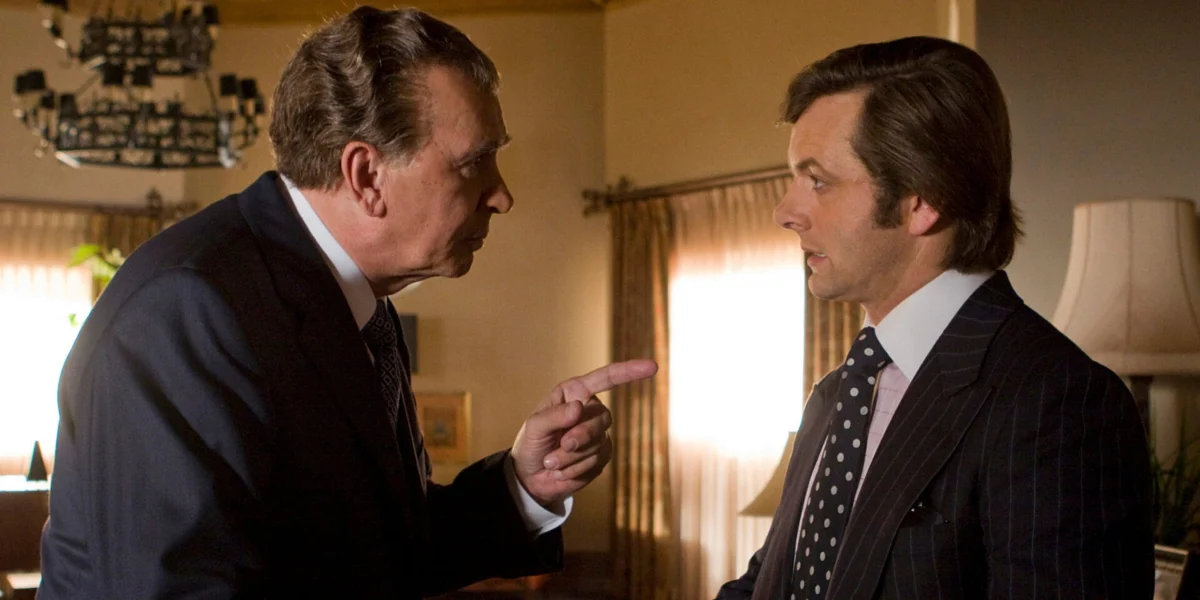
At its core, "Frost/Nixon" presents a fascinating thematic dialogue between its two protagonists, portraying them as two sides of the same coin. Both men, in their own ways, craved public adoration and sought to stand on the victor’s podium. Nixon, the former president grappling with the ultimate loss of power and reputation, and Frost, the ambitious broadcaster striving for a defining moment in his career, were both driven by a profound need for validation. As Langella so powerfully articulates through Nixon’s words, the stakes were existential: for one, success meant continued relevance; for the other, failure promised isolation, with "nothing and no one for company but the voices ringing in [their] head." This delicate dance, a high-stakes psychological chess match disguised as a television interview, is expertly choreographed by Morgan’s sharp writing and Howard’s dynamic direction.
Ron Howard’s Vision: Capturing the Competition
Ron Howard’s direction in "Frost/Nixon" masterfully captures the inherent competitive spirit of the interviews. He employs vivid camera movements and framing techniques that highlight the personal motivations and power struggles between the characters. The film conveys a sense of whirlwind energy in Frost’s portrayal; he is often depicted as restless, perpetually in motion, and at times, elusive, mirroring the chaotic yet brilliant trajectory of his research and interview strategy. This contrasts sharply with the more focused, laser-like research efforts of his team.
For Nixon, Howard observes a carefully constructed facade of confidence that masks a palpable fragility. The film’s astute observations about Nixon’s relationship with television are particularly noteworthy. The power of the close-up, its capacity to convey unspoken truths and to amplify emotional resonance, is a recurring motif. Howard frequently utilizes dual shots, juxtaposing characters in the physical space with their images on television monitors, thereby emphasizing the mediated nature of their interactions and the impact of public perception. Facial reactions to challenging questions are captured with an intimacy that underscores the profound weight of words and their ability to reveal character.
Stellar Performances: Langella and Sheen at the Forefront
The central performances by Frank Langella as Richard Nixon and Michael Sheen as David Frost are the bedrock of the film’s narrative tension. Neither actor relies on overt prosthetics to embody their characters; instead, their transformations are rooted in the spirit and emotionality of these historical figures. This approach, favored by both Howard and Morgan, allows for a more profound exploration of their inner lives.
Langella delivers a tour de force performance, imbuing Nixon with an almost tangible presence. Every calculated move, from the strategic deployment of lengthy answers to absorb airtime to the unexpected "curveballs" thrown just before the cameras roll, is delivered with chilling precision. Langella masterfully conveys Nixon’s intent to control the narrative and shape audience perception, all while maintaining an enigmatic aura of what the character chooses to conceal.
Sheen is an equally formidable presence, expertly portraying Frost’s superficially charming persona and his unwavering underdog spirit. His most impressive achievement is charting Frost’s evolution from a charismatic showman who initially struggles to control the interview’s direction to a formidable interviewer capable of extracting a historic confession. The chemistry between Sheen and Rebecca Hall, who plays Frost’s girlfriend Caroline Cushing, though her role has minimal narrative impact, is genuinely endearing, adding a humanizing touch to Frost’s ambitious pursuit.
Supporting Cast: Insights and Divergences
The supporting cast provides crucial context and depth to the central narrative. Sam Rockwell shines as James Reston Jr., a key researcher for Frost, embodying the film’s moral compass. Rockwell’s portrayal emphasizes the journalistic imperative to hold Nixon accountable, arguing that the interviews must be an uncompromising expression of conviction rather than an exercise in exoneration. Oliver Platt as TV journalist Bob Zelnick and Matthew Macfadyen as producer John Birt also contribute meaningfully, rounding out the team tasked with preparing Frost for his monumental task.
However, the film’s inclusion of supporting characters as documentary-style talking heads, offering retrospective commentary on the interviews, proves to be a structural weakness. These segments, while perhaps intended to offer additional insight, disrupt the precise and compelling narrative flow of the central story, feeling both distracting and superfluous.
The Lingering Question of Accountability
"Frost/Nixon" ultimately resonates through its brilliant performances and the insightful collaboration between director Ron Howard and writer Peter Morgan, whose deep fascination with the subject matter is palpable. The film grapples with the complexities of truth, memory, and the enduring quest for justice. Despite the powerful portrayal of Nixon’s eventual psychological defeat as his tyrannical grip on power fades from the public eye, there remains an inherent irony in the film’s conclusion. As James Reston Jr. eloquently articulates the imperative of not letting Nixon off the hook, the film’s ending, by blurring the lines of culpability and lacking a definitive, sharp indictment, leaves a lingering sense of unfinished business. Yet, this nuanced conclusion, while perhaps lacking the biting finality some might desire, effectively captures the complex psychological fallout of a presidency brought to its knees, a testament to the enduring power of the media to hold even the most powerful figures accountable, or at least, to expose their vulnerabilities. The film’s enduring legacy lies in its ability to remind audiences that the pursuit of truth, particularly in the public sphere, is an ongoing and often arduous endeavor.