Studio Blackbird’s Invisible Hand Shapes the Suspenseful Thriller All Her Fault
The critically acclaimed Peacock miniseries thriller, All Her Fault, a production that has garnered both a Critics Choice Award and a Golden Globe nomination, owes much of its gripping realism and escalating tension to the subtle yet masterful work of Studio Blackbird. This collaboration highlights the increasing reliance on sophisticated visual effects (VFX) to enhance narrative integrity and immerse audiences in complex storytelling, even when the effects themselves are designed to remain unseen. The series, starring Sarah Snook as Marissa Irvine, centers on a harrowing ordeal where a mother’s attempt to collect her son from a playdate unravels into a disorienting mystery when the supposed caregiver has no knowledge of the child.

Studio Blackbird, under the leadership of VFX Supervisor Nick Ponzi and VFX Executive Producer Nerissa Kavanagh, integrated the VFX process into the very fabric of the production from its nascent stages. This proactive approach, deeply rooted in Ponzi’s own background in compositing, underscores a core philosophy: the most effective visual effects are those that seamlessly support the tone, enhance character performances, and propel the narrative forward without drawing attention to themselves. This dedication to invisibility is particularly crucial for All Her Fault, a series where psychological suspense and grounded reality are paramount to its impact.
Recreating Suburban America: The Environmental Transformation
Despite being filmed entirely within the familiar landscapes of Melbourne, Australia, All Her Fault was tasked with authentically portraying the nuanced environment of suburban Chicago. This ambitious undertaking required an extraordinary level of detail in the digital reconstruction of the American Midwest. Studio Blackbird’s artists meticulously adjusted a myriad of environmental elements, including the specific species of trees characteristic of the region, the texture and color of road surfaces, the typical flow of traffic, the architectural styles of rooftops, and the subtle nuances of seasonal lighting. These efforts were not merely cosmetic; they were essential to establishing a believable sense of place that would resonate with viewers and anchor the unfolding drama.
The initial scope of VFX work for the series was projected at approximately 200 shots. However, as the creative vision for the production expanded and the narrative demands became clearer, this number nearly quadrupled, culminating in close to 800 final VFX shots. This significant increase reflects the depth of the environmental and narrative enhancements undertaken by Studio Blackbird, demonstrating their capacity to scale their operations while maintaining a consistent level of quality and artistic integrity.

The Irvine Residence: A Digital Facelift for a Suburban Dream
A pivotal setting within the series is the "Irvine house." Although the physical location was situated in a more rural area, its cinematic portrayal needed to evoke the impression of an affluent Chicago neighborhood. This transformation was achieved through extensive computer-generated (CG) work. Studio Blackbird digitally replaced rudimentary dirt roads with the rich, black asphalt characteristic of upscale American suburbs. Furthermore, entire 3D environments were meticulously recreated to replace the existing surroundings, creating a convincing illusion of location.
Several key sequences, including sweeping drone shots that navigate over a serene lake and the imposing presence of the Irvine residence, were almost entirely constructed using CG. These digitally built environments were crucial for establishing the aspirational yet potentially deceptive veneer of the characters’ lives, serving as a visual foundation for the underlying tensions and secrets within the narrative. The successful execution of these digital landscapes speaks to Studio Blackbird’s proficiency in creating immersive and believable world-building, even when working from a fundamentally different physical reality.
The Climax of Deception: Crafting a Visceral Car Crash
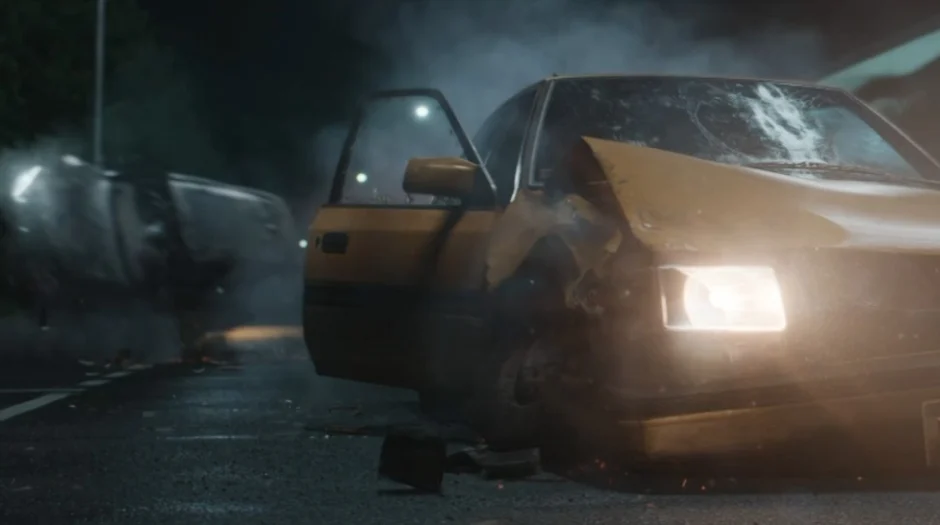
Arguably the most dramatic and narratively significant event in All Her Fault is a catastrophic car crash sequence, executed entirely in CG by Studio Blackbird. The objective was to create an impact that felt viscerally real and emotionally resonant, rather than overtly stylized or gratuitous. While the total on-screen duration of the crash is relatively brief, its narrative weight is immense, serving as the critical juncture where the intricate web of mystery begins to unravel for the audience.

"This is the moment where the mystery finally unravels for the viewer," explains VFX Supervisor Nick Ponzi. "Motives seeded across earlier episodes rise to the surface, and questions or suspicions are finally answered. As with a lot of the work we do at Blackbird, the purpose was to support the narrative without the viewer questioning the reality of the moment on screen."
The technical challenge of this sequence lay in working backward from the desired outcome. "From a technical standpoint, working backwards was key," Ponzi elaborates. "We began with the vehicles’ final resting positions – where they end up needed to serve the framing and the story beats of this key reveal. From there, we reverse-engineered the crash itself, ensuring the physics, trajectories, and energy of the impact plausibly delivered the cars to those positions. Balancing real-world physics with narrative intent was one of the biggest challenges of the sequence, but it was critical to getting the moment to feel authentic rather than engineered." This meticulous, analytical approach ensured that the visual spectacle served the story, rather than overpowering it.
The Symphony of Sound and Spectacle: Intertwining Auditory and Visual Cues
The impact of the car crash sequence is amplified by its intricate connection to sound design and its role in reflecting character psychology, particularly that of Carrie (played by Sofia Lillis). Ponzi highlights how auditory cues, subtly woven into earlier episodes, gain profound significance during the crash. "In earlier episodes, fragments of non-diegetic crash audio are threaded through moments of heightened tension, at first reading almost as manifestations of her internal turmoil," he notes. "When the crash finally unfolds on screen, those auditory cues snap into focus. What once felt abstract becomes literal, and everything clicks into place."

This deliberate integration of sound and visual storytelling underscores Studio Blackbird’s holistic approach. "We considered the connection between character and event seriously when animating the sequence, particularly with Carrie’s car," Ponzi continues. "This wasn’t just about simulating an accident; it was about making sure the mechanics of the crash reinforced the emotional and narrative logic of the story. The staging, timing, and final composition all needed to communicate very specific story points." The animation of Carrie’s vehicle, therefore, became an extension of her emotional state and the narrative’s unfolding revelations.
Grounding the Violence: The Science of Simulated Destruction
The creative team’s directive was clear: the crash had to feel brutal, reflecting the collision of "tragedy and deception." To achieve this, Studio Blackbird drew heavily on real-world data and observations. "To ground the sequence, we leaned heavily on real-world references," says Ponzi. "Our team built a substantial library of real accident footage, particularly focusing on road and intersection collisions similar to the scripted scene."
These extensive references informed every aspect of the simulation, from the broad, sweeping movements of the vehicles to the minutiae of debris scatter, the behavior of smoke and steam post-impact, and the way vehicles settle in the aftermath. Crash test footage proved to be an invaluable resource. "Watching how SUVs behave when struck laterally, how they lift, twist, and tumble, reveals nuances you simply wouldn’t invent," Ponzi explains. "Incorporating those unexpected behaviors into the animation is often what pushes a shot from ‘convincing’ to ‘believable.’" This commitment to authentic physical responses, even in fictional scenarios, is a hallmark of high-quality visual effects work.

Meticulous Planning: From Matchbox Cars to Virtual Stages
The success of such a complex sequence hinges on meticulous preparation. Ponzi describes the initial blocking of the crash scene as a wonderfully "old-school" collaboration between the episode director, Kate Dennis, and the Director of Photography, Earle Dresner. Using a printed map of the location and a few Matchbox cars, they were able to physically manipulate the elements to discuss intent and staging before any digital work began. This tactile approach facilitated clear communication and conceptual alignment early in the process.
Simultaneously, NantStudios was developing a full CG version of the location for use on the volume stage. This allowed Studio Blackbird to begin spatially testing how the crash might unfold. "We took those early block-outs and layered in a combination of simulation and hand animation in our pre-vis to refine the physics and get closer to what we wanted on screen," Ponzi shares. This iterative pre-visualization process was crucial for ironing out the complexities of the crash dynamics.
Seamless Integration: Connecting the Digital and the Practical
Once the final trajectories and resting positions of the vehicles were approved, Studio Blackbird collaborated closely with the Production Designer, Rob Harris, and the on-set team. This ensured that any practical elements, such as damaged vehicles used in post-crash shots, were altered in precisely the right locations and aligned perfectly with the animated sequences. This meticulous coordination was particularly vital for shots requiring actors to remain within the vehicles, including scenes where Peter (Jake Lacy) navigates the environment after the crash. These moments had to be filmed in situ and seamlessly integrated back into the animated crash sequence, requiring a high degree of technical precision.

The Art of the Unseen: Nuance as the Ultimate Credibility
When asked about his favorite aspect of the work on All Her Fault, Ponzi emphasizes the collective effort and the subtle details that contribute to the overall believability. "It’s hard to pick just one as so much detail went into this from our incredible VFX team," he states. "I love the subtle asymmetry in the way Carrie’s car absorbs and releases energy during the impact. It’s not a single hero moment, but a collection of small, almost imperceptible behaviors – a hesitation in the roll, a slight twist in the chassis, the uneven collapse of panels – that collectively sell the weight and violence of the crash."
These are the nuanced details that, while not consciously registered by the audience, are deeply felt, contributing to the emotional credibility of the scene. "Those are the kinds of details audiences don’t consciously notice, but they feel them, and the team worked hard to get these in there," Ponzi concludes. "When you’re dealing with a moment this important to the story, that emotional credibility is everything." Studio Blackbird’s work on All Her Fault stands as a testament to the power of invisible VFX to elevate storytelling and create truly immersive cinematic experiences, proving that sometimes, the most impactful elements are those that viewers never even realize are there.