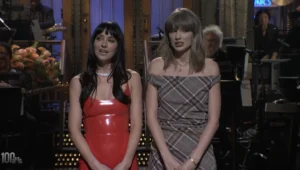

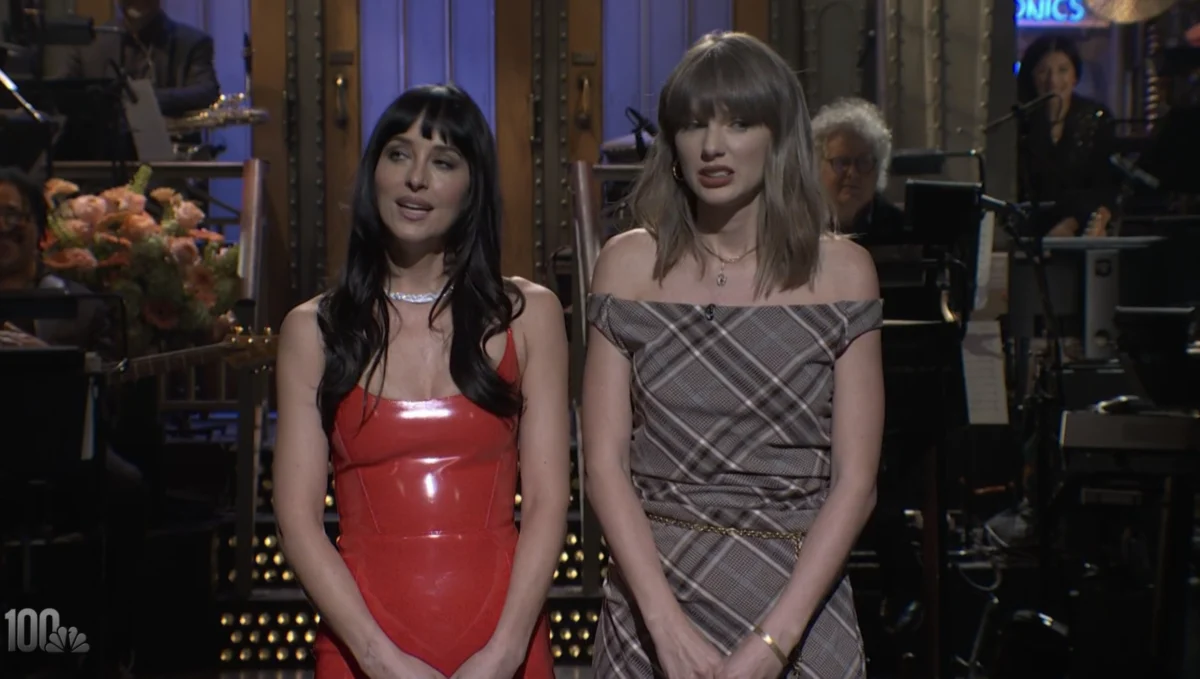
The comedic landscape of Saturday Night Live was significantly altered this past Saturday as actress Dakota Johnson returned to host the iconic sketch comedy program for her third time. While the hosting duties were expected to focus on her upcoming projects and career trajectory, the evening took a meta-narrative turn during the opening monologue. In a segment that blended celebrity self-deprecation with high-profile guest appearances, Johnson was joined by global music superstar Taylor Swift, creating a viral moment that bridged the gap between Hollywood’s film industry and the music world.
The appearance marked a continuation of the increasingly collaborative relationship between the two stars, who have frequently been linked in pop culture discourse. Beyond the humor of the sketch, the episode served as a strategic platform for both the entertainment industry’s ongoing recovery from box office struggles and the promotional rollout of Swift’s latest musical endeavor, The Life of a Showgirl: Encore Edition.
The Monologue Dynamics and Pop Culture Commentary
Dakota Johnson’s monologue was characterized by a sharp, self-referential wit. Addressing the audience at Studio 8H, Johnson leaned into the public perception of her romantic history, joking about her high-profile relationships with musicians. She framed her dating life as a form of "public service," humorously claiming that her experiences with these artists effectively save other women from the psychological and financial burdens of seeking mental health intervention.
The comedic tension reached its peak when Johnson introduced Taylor Swift as her "literal therapist." The subsequent back-and-forth between the two provided a satirical look at the nature of celebrity friendships. Swift’s characterization of their relationship—one defined by late-night wine sessions, unburdening of personal grievances, and the stoic dismissal of "crazy" situations—offered a grounded, albeit scripted, contrast to the typical glitz associated with their public personas.
This segment functioned as a masterclass in modern celebrity PR. By acknowledging the public’s fascination with their private lives, both women were able to control the narrative, turning potential tabloid fodder into a polished, rehearsed comedic bit that delighted the studio audience and generated significant engagement across social media platforms.
Strategic Promotion: Patient Zero and Musical Synergy
The synergy between Johnson and Swift extended well beyond the SNL stage. Following the live broadcast, the professional alignment became clearer with the release of the music video for Swift’s latest single, "Patient Zero." The video, which features both Johnson and actor Colin Farrell, represents a sophisticated cross-promotion strategy. By debuting the visual component of the track at the MTV VMAs—a massive event in its own right—and utilizing the reach of Saturday Night Live, Swift ensured maximum visibility for her new album, The Life of a Showgirl: Encore Edition.
The Encore Edition, released just last Friday, includes four new tracks, signaling a period of prolific creative output for the artist. This approach highlights the changing nature of the music industry, where albums are no longer static products but living entities that receive staggered releases and multimedia support. The song "Cleveland," also featured on the album, provides further insight into this strategy, as it explicitly addresses Swift’s marriage to NFL star Travis Kelce. By weaving these personal milestones into her music and performing them in high-visibility contexts, Swift maintains an intimate connection with her fanbase while simultaneously dominating the media cycle.
The Madame Web Narrative and Box Office Realities
Johnson’s monologue also addressed the elephant in the room: the commercial performance of her recent film, Madame Web. In a candid moment, she referenced her previous SNL appearance, which occurred while she was actively promoting the Sony-produced Marvel film. Her admission that she was "still promoting" the film because it had yet to turn a profit served as a pointed critique of the current state of superhero cinema.
The box office performance of Madame Web has been widely documented as a significant "bomb," failing to resonate with both critics and audiences. By addressing this failure directly, Johnson demonstrated a level of professional vulnerability that is often absent in high-stakes promotional circuits. From an industry perspective, this acknowledgment highlights the volatility of modern film financing. As studios struggle to replicate the success of the Marvel Cinematic Universe, the failure of standalone franchise entries like Madame Web has led to increased scrutiny regarding franchise sustainability and creative direction.
Political Satire and the Cold Open
Transitioning from the monologue to the show’s cold open, the writers maintained a sharp focus on the current political climate. The sketch, which featured a mock-up of "Republican heavy hitters" filming midterm campaign advertisements, utilized a cast of recurring characters to satirize political discourse. The inclusion of Marcello Hernández as Marco Rubio, Mikey Day as Mitch McConnell, and Jeremy Culhane as J.D. Vance provided a satirical mirror to the internal tensions within the Republican party.
The appearance of Pete Hegseth, played by Colin Jost, added a layer of absurdity to the segment. By incorporating a fictionalized, non-alcoholic version of a drink marketed as "Spider-Man’s new non-alcoholic bitch beer," the writers engaged in a biting commentary on the performative nature of modern political branding. Jost’s line, "I need all you patriots at home to do the gayest thing ever and vote," captured the paradoxical tone of contemporary political messaging, where aggressive hyper-masculinity often sits uncomfortably alongside attempts to engage a broader, more diverse electorate.
Historical Context and SNL’s Evolution
Saturday Night Live has historically served as a cultural barometer for American society. Dakota Johnson’s history with the show—dating back to her debut in 2015—reflects the program’s ability to maintain continuity while evolving with its hosts. Her previous hosting stints and cameos, including the 40th anniversary special, have solidified her position as a recurring member of the SNL family.
The current season, Season 52, has already demonstrated an ambitious approach to booking, as evidenced by the premiere with New York Knicks star Jalen Brunson. The inclusion of non-traditional hosts, such as professional athletes and cultural icons from the music and film worlds, suggests that NBC is committed to diversifying its guest list to capture a younger, more digitally engaged audience. With upcoming episodes featuring Shane Gillis and Inde Navarrette, the show is clearly positioning itself to remain relevant amidst the rise of alternative media and streaming-based entertainment.
Industry Implications and Future Outlook
The implications of this episode are twofold. First, it highlights the increasing importance of "crossover" events. In an era of fragmented media consumption, the ability to mobilize a massive audience through the intersection of television, music, and digital social media is invaluable. The collaborative effort between Johnson and Swift is a blueprint for future celebrity marketing, demonstrating that transparency and humor can be as effective as traditional advertising.
Second, the episode underscores the ongoing challenges facing the film industry. The humor surrounding Madame Web is not just a joke; it is a reflection of a broader anxiety regarding the future of the blockbuster model. As audiences become more selective and critical of franchise-based content, major studios will need to pivot their strategies. Whether this leads to a reduction in high-budget, low-reward projects remains to be seen, but the public discourse generated by Johnson’s comments suggests that the industry is at a crossroads.
Ultimately, this installment of Saturday Night Live was more than just a collection of sketches; it was a complex orchestration of brand management, political commentary, and industry self-reflection. By navigating these varied themes, the production team managed to capture the cultural zeitgeist, providing viewers with a snapshot of the current intersection of Hollywood, music, and politics. As the season progresses, the success of these collaborative segments will likely dictate the direction of the program, ensuring that SNL continues to function as a vital, if sometimes chaotic, centerpiece of American popular culture.