

The intersection of classic science fiction iconography and avant-garde international animation achieved a milestone with the debut of Star Wars: Visions Volume 3. Released globally on Disney+ on October 29, 2025, the nine-part anime anthology marked a deliberate return by Lucasfilm to traditional Japanese animation studios following the globally diversified production lineup of Volume 2. Among the standout installments is Black, a dialogue-free, deeply psychological short produced by David Production. Written, directed, and character-designed by veteran animator Shinya Ohira—whose illustrious credits include contributions to cinematic landmarks such as Akira, Spirited Away, and The Boy and the Heron—the episode captivated audiences and critics alike, subsequently earning a prestigious 2026 Primetime Emmy Award nomination for Outstanding Animated Program.
The Genesis and Conceptual Framework of Black

Departing from the conventional swashbuckling heroics typically associated with the Star Wars universe, Black investigates the horrific psychological toll of armed conflict. The narrative plunges viewers into the final, agonizing moments of a nameless Imperial stormtrooper who suffers a fatal gunshot wound during the tumultuous events of the Battle of Endor. Stricken on the forest moon, the soldier experiences a vivid, terrifying fever dream characterized by a profound internal identity crisis fueled by battlefield trauma, profound self-doubt, and the psychological weight of blind obedience.
Director Shinya Ohira drew heavy inspiration from psychological horror and surrealist cinema, citing Damian Nenow’s celebrated short film Paths of Hate as a key visual reference. Much like the disorienting, hallucinatory decline depicted in Adrian Lyne’s 1990 psychological thriller Jacob’s Ladder, Black externalizes a dying soldier’s internal deterioration. The choice to eschew dialogue and traditional narration was deliberate. From the earliest conception phase, Ohira intended to construct a narrative driven entirely by raw character acting, physical movement, and profound emotional expression, stripping away audible explanations to force the audience to interpret the psychological landscape purely through visual metaphors.
Global Collaboration and Logistical Hurdles

Bringing this ambitious psychological nightmare to life required a monumental, cross-continental production effort that tested the limits of traditional hand-drawn animation techniques. Rather than relying solely on an in-house team at David Production, Ohira and producer Jacob Ayres cast a wide net across the globe, recruiting freelance animators and students from disparate corners of the world, including China, the United Kingdom, France, Germany, Austria, Australia, Poland, and the Philippines.
The logistical hurdles faced by the production staff were immense. Ohira structured the short into nine distinct scenes, assigning each sequence to a different animator to cultivate a wildly varied and inventive visual style. However, this decentralized approach introduced unique challenges.
"In addition to the many long and challenging action shots, there are many shots of different vehicles moving through 3D environments," producer Jacob Ayres noted during production reflections.

Because the directive from day one mandated that every single frame be meticulously hand-drawn, finding artists capable of rendering convincing mechanical vehicles—such as TIE fighters—and integrating them seamlessly into complex three-dimensional environments proved exceptionally difficult. Furthermore, the sheer duration of individual shots created physical bottlenecks. While a standard animation sequence typically consists of multiple fast cuts lasting only a few seconds each, many shots in Black run continuously for approximately 60 uninterrupted seconds. When printed out for physical processing, cleaning, and checks, these extended sequences generated stacks of materials running into hundreds of pages per shot.
Despite operating across immense geographical and linguistic divides, the global collective of artists delivered work that exceeded expectations. Ayres highlighted the dedication of individual contributors, pointing to a student from overseas who not only completed an entire scene single-handedly but subsequently stepped in to assist peers facing rigorous deadlines.
Technological Evolution and 1980s Cel Aesthetics

The execution of 60-second continuous shots represents a monumental technical achievement within hand-drawn animation. In the traditional analog era of cel animation, executing corrections on continuous sequences of that length would have necessitated photographing every single frame completely from scratch—a task rendering such audacious pacing virtually impossible. Modern digital photography tools empowered David Production to preserve the fluid, unbroken momentum of the battlefield hallucinations without relying on disruptive cuts.
Aesthetically, Ohira consciously rejected the hyper-polished digital rendering styles common in modern mainstream anime, opting instead for a deliberate homage to 1980s cel animation. By heavily utilizing pencil-textured animation frames, the production team imbued the project with a rough, raw, tactile quality that mirrors the fraying mental state of the protagonist.
The central thematic motif of duality—a cornerstone of the broader Star Wars mythos—manifests explicitly through the introduction of two contrasting figures: Red and Green, soldiers clad in distinct crimson and verdant armor. According to Ohira, these characters serve as physical embodiments of fundamental conceptual binaries, representing good and evil, as well as life and death. By narrowing the narrative focus onto an anonymous background soldier rather than a mythic Jedi or Sith lord, the short interrogates the psychological mechanisms that drive ordinary individuals to participate in catastrophic wars.

Production Methodology and Scene Construction
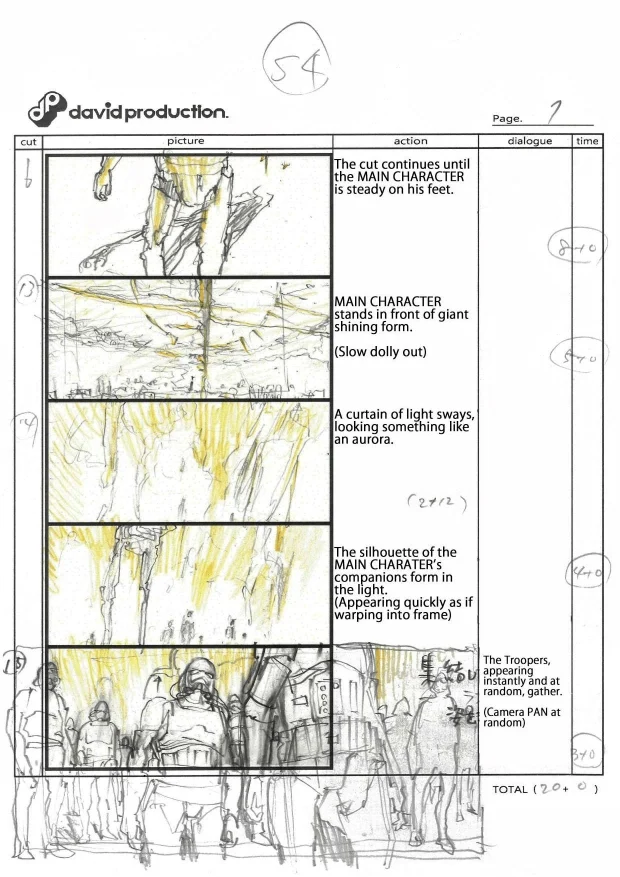
The creation of Black proceeded without traditional, exhaustive motion tests or extensive pilot animatics. Instead, rough key animations for each shot were compiled into digital test movies, allowing Ohira to review, direct, and apply corrections iteratively.
The division of labor among nine different international animators meant that the final visual identity of the short was heavily shaped by the individual styles of its contributors. Ohira provided foundational storyboards to establish the broad emotional strokes and structural flow, but empowered the artists to inject their personal flair into their respective segments. This trust yielded remarkable efficiency; every single frame produced by the animators was utilized in the final cut, leaving zero waste on the editing floor.

Among the most demanding sequences was the seventh scene, which features a surreal horseback battle sequence. Because this sequence was animated traditionally on physical paper rather than through digital tablets, every stage of the pipeline—from key animation and cleanup to rigorous in-betweening—demanded significantly more time and manual labor from the staff.
Concurrently, the meticulous color-balancing across scenes was intentionally engineered to highlight piercing tones of green and red, amplifying the pervasive sense of unease. Footlight shadows and dynamic, ground-level camera work were carefully calibrated to make viewers feel as though they were experiencing the frantic, hallucinatory theater of war with their own eyes.
Industry Reception and Broader Implications

Upon its release on Disney+ as part of the Star Wars: Visions Volume 3 lineup, Black received immediate critical acclaim for its daring departure from conventional franchise storytelling. The willingness of Lucasfilm to grant external auteurs radical creative freedom yielded an artistic triumph that resonated deeply with both viewers and industry peers.
The culmination of this creative risk-taking materialized when the Television Academy announced the nominees for the 78th Primetime Emmy Awards, officially recognizing Black in the fiercely competitive category of Outstanding Animated Program. For David Production, the nomination validates the immense logistical hurdles overcome during production—juggling cross-border schedules, coordinating disparate artistic styles, and ensuring fair compensation for a vast network of international freelancers.
Beyond accolades, the success of Black signals a shifting paradigm for corporate-owned intellectual properties. By demonstrating that premier global franchises can successfully merge with high-art, independent animation sensibilities without alienating core audiences, the project sets a new benchmark for anthology storytelling. As studios increasingly look toward international talent pools to revitalize established properties, the triumph of Shinya Ohira’s bleak, beautiful psychological journey stands as a testament to the enduring power of uncompromising artistic vision.