

Amidst decades of conflict and displacement, Palestinian cultural heritage has faced persistent threats of looting, destruction, and seizure. Since the escalation of hostilities in October 2023, the pace of this cultural erosion has accelerated, particularly within the Gaza Strip, where historical landmarks and academic institutions have suffered unprecedented damage. In response to this existential threat to national memory, a dedicated team at the Palestinian Museum in the occupied West Bank has pioneered a digital initiative designed to transcend physical borders and survive kinetic warfare. By constructing what they term an "unlootable archive," these curators and technologists are leveraging distributed digital infrastructure to ensure that even if physical artifacts are lost, the historical narrative of the Palestinian people remains accessible to the world.
Amer Shomali, a prominent visual artist and the general director of the Palestinian Museum in Birzeit, highlights the urgency of the mission. According to Shomali, within a single week of the current conflict, Israeli military actions resulted in the bombing of two art galleries, seven museums, and two primary archives in Gaza, alongside damage to hundreds of archaeological sites. He characterizes this not merely as collateral damage of war, but as a systematic "battle of trying to erase the Palestinian culture and Palestinian memory." With estimates suggesting that roughly 80 percent of the nation’s historical collections have been looted, destroyed, or remain under external control, the museum’s shift toward digital preservation represents a strategic pivot in the preservation of national identity.
A Fortress of Memory: The Palestinian Museum in Birzeit
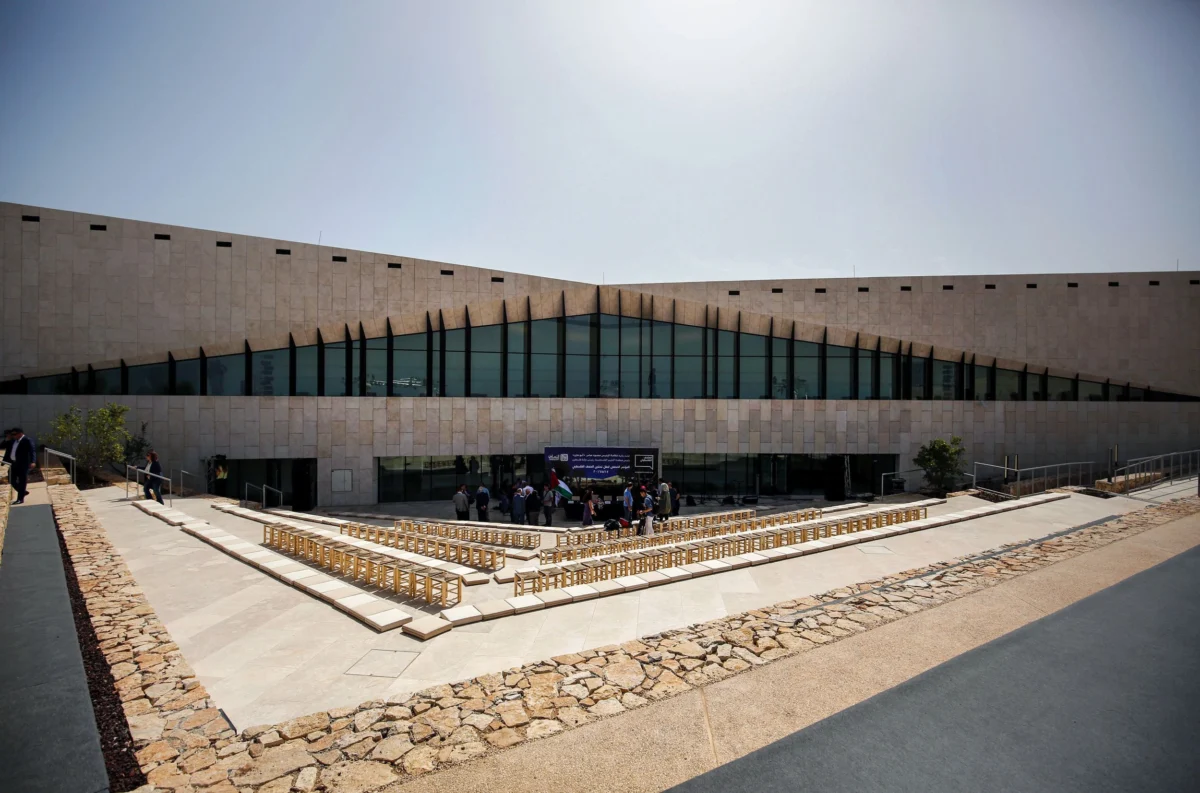
The Palestinian Museum itself is a masterpiece of modern architecture, designed by the New York-based firm Heneghan Peng—the same architects responsible for the Grand Egyptian Museum. Located in Birzeit, the building sits among terraced gardens of native flora, serving as a physical repository for critical collections, including the photography of Khalil Raad and the murals of Vera Tamari. However, the physical reality of the museum is often defined by the constraints of the occupation. Shomali notes that the site is frequently isolated by various military checkpoints, which complicates access for many Palestinians living in the West Bank and East Jerusalem.
The museum’s mission has evolved from being a traditional exhibition space into a hub for digital resistance. This transition was born out of a historical necessity. Since 1948, Palestinian artifacts have been scattered globally or subsumed into foreign archives. Shomali observes that historical efforts to archive Palestinian life have often been a race against time and aggression: "We document, they loot; but every time we document, we document with less vivid memory." To break this cycle, the museum turned to technology in 2018 to build a repository that could not be physically seized or destroyed by conventional means.
The Evolution of the Digital Archive
The Palestine Museum Digital Archive began as a grassroots effort involving "door-knocking" campaigns. Researchers visited families across the West Bank, seeking permission to scan personal heirlooms, including old photographs, private letters, land deeds, and family diaries. This bottom-up approach was intentional; by focusing on the personal records of citizens rather than just state-level documents, the museum began to construct a "mesh" of information that allows for a social history of Palestine.
As of early 2026, the open-source archive has grown to encompass more than 500,000 digitized items. This collection includes:

- Identification Papers and Maps: Documents that trace the genealogy and land ownership of families over generations.
- Audio-Visual Materials: Films and music recordings that capture the cultural life of the region prior to and during various periods of displacement.
- Historical Manuscripts: Brittle newspapers from the early 20th century and delicate religious texts, such as a 19th-century Bible printed in Jerusalem.
- Personal Diaries: Narratives that provide a first-hand account of historical events, offering a counter-perspective to official state histories.
The technical operation is managed by a core team of three full-time staff members specializing in digitization, metadata, and linguistic research. Their work is supported by an international network of volunteers and funded through a combination of diaspora donations and institutional partnerships, including the University of California and the Gerda Henkel Foundation. To manage the vast array of historical records, the museum is even exploring the use of specialized bots capable of reading and translating Ottoman Arabic, a crucial skill for processing records from the late 19th and early 20th centuries.
Cultural Destruction and Legislative Challenges
The necessity of a digital backup is underscored by data from international observers and research institutes. As of March 2024, UNESCO had verified damage to 164 cultural sites in Gaza, including 43 historical buildings, nine religious sites, and several museums. The Applied Research Institute-Jerusalem (ARIJ) reported in 2025 that at least 2,400 archaeological sites in the West Bank have been taken over or are under the direct control of Israeli authorities.
Further complicating the situation is a legislative push within the Israeli Knesset. Reports from June 2026 indicate that Israeli lawmakers are advancing bills that would place ancient sites within occupied territories under the jurisdiction of the Israeli Ministry of Heritage. Palestinian officials and various human rights organizations have decried this move as a form of "de facto annexation," arguing that it provides a legal framework for the permanent seizure of Palestinian cultural property and the expansion of settlement activity around archaeological zones.
This legislative environment creates a precarious future for physical heritage. In towns like Sebastiya, near Nablus, raids on archaeological sites are frequently reported, often occurring under military protection. These incidents reinforce the museum’s philosophy that physical preservation alone is insufficient in a conflict zone where the legal and physical landscape is constantly shifting.
Distributed Resilience and Cybersecurity
To protect the archive from both physical and virtual threats, the Palestinian Museum has implemented a distributed storage system. Multiple copies of the data are housed on servers in different geographical locations worldwide. This redundancy ensures that even if the server in Birzeit or any other single node is destroyed or seized, the archive remains intact and accessible.
However, the digital realm brings its own set of challenges. Shomali reveals that the museum’s digital platform faces persistent cyberattacks, often occurring on a monthly basis. These attacks frequently result in temporary outages, requiring the technical team to reinitiate the website using secure backups. "We can’t protect it from being hacked," Shomali admits, "but we can protect it from disappearing." This resilience is the cornerstone of the "unlootable" concept—a recognition that while access can be hindered, the data itself is now part of a global, indestructible network.
Global Outreach: The "Exhibition in a Box"
The Palestinian Museum’s digital strategy extends beyond mere storage; it is designed for active dissemination. One of the project’s most innovative features is the "exhibition in a box" initiative. This "Ikea-style" model allows users anywhere in the world to download high-resolution exhibition materials, print them, and host their own curated shows about Palestinian history and culture.

This model has democratized the museum’s reach, enabling more than 260 exhibitions to take place in diverse locations ranging from San Francisco to Japan. The materials have been translated into five languages, allowing local curators to engage their own communities with Palestinian narratives.
- Madrid, Spain: Curator Pablo Llorca spent months sifting through the digital archive to create the exhibition To Tell My Story, which debuted in October 2025. The show has since traveled to 15 different locations across Spain and has garnered interest from the Spanish Ministry of Culture.
- San Francisco, USA: Artist Leyya Mona Tawil utilized the archive’s music collections to produce My Name is Palestine, an immersive exhibition that explores the history of Palestinian sound and performance. Tawil describes the archive as a "living" entity that represents a society under active threat.
Implications for the Future of Cultural Preservation
The Palestinian Museum’s digital initiative serves as a case study for "bottom-up" historiography. By bypassing the traditional structures of a state archive—which are often the first targets in times of regime change or conflict—the project empowers individual citizens and the diaspora to act as stakeholders in their own history.
Mohammad Rabae, who oversees the digitization process, emphasizes that the work is as much about ethics as it is about technology. "We always try to respect the privacy, dignity, and rights of the people represented in the records," he states. For Rabae, the act of carefully unfolding a brittle 1930s newspaper or scanning a faded letter is a form of "historical evidence" preservation that guards against the revisionism that often follows the physical destruction of communities.
The broader implications of this work suggest a new paradigm for cultural heritage in conflict zones globally. As technology becomes more accessible, the ability of a centralized power to "erase" the history of a displaced or occupied population is diminished. The Palestinian Museum has demonstrated that digital resilience can provide a sense of continuity and agency for a people whose physical reality is defined by fragmentation.
In the words of the late Palestinian poet Mahmoud Darwish, often cited by Shomali, "We who are able to remember are able to liberate ourselves." Through the Palestine Museum Digital Archive, that memory is no longer confined to the vulnerable pages of a diary or the fragile walls of a building in Birzeit; it is now a distributed, global reality that resists erasure through the sheer power of data. By ensuring that the past remains "unlootable," the museum is providing the foundation upon which a future narrative can be built, regardless of the physical challenges that remain on the ground.