


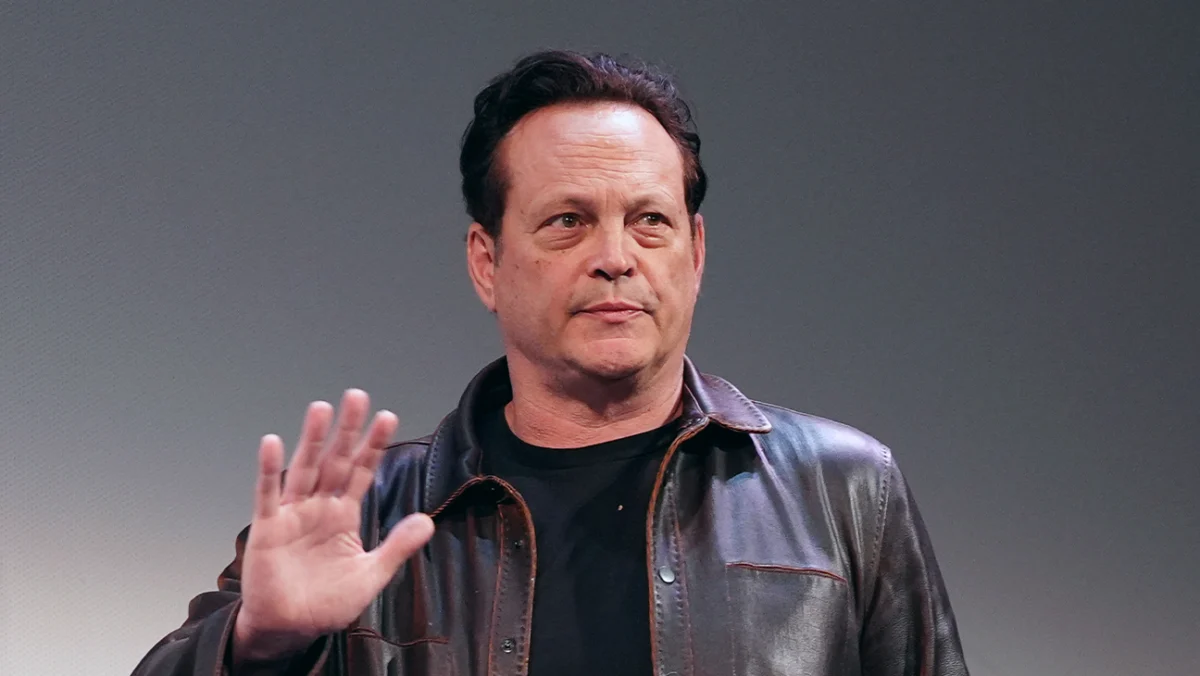
Actor and producer Vince Vaughn has vocalized significant dissatisfaction with the current trajectory of late-night talk shows, specifically lamenting their pronounced and often singular focus on politics. Appearing on Theo Von’s This Past Weekend podcast, Vaughn described the programs as having converged into "the same show," characterized by an "agenda-based" approach that he believes alienates audiences and compromises comedic integrity. His critique underscores a growing sentiment within and outside Hollywood regarding the evolving nature of broadcast comedy and its engagement with contemporary political discourse.
Vaughn’s observations, while not targeting specific hosts by name, implicitly address a prevalent style adopted by figures such as Jimmy Kimmel, Stephen Colbert, Seth Meyers, and Jimmy Fallon, who have increasingly incorporated pointed political commentary and criticism, particularly directed at former President Donald Trump, into their nightly routines. This shift represents a notable departure from traditional late-night formats that, while always touching on current events, often balanced political humor with broader entertainment, celebrity interviews, and more universally appealing comedic sketches.
The Evolution of Late-Night Political Humor and Vaughn’s Critique
The history of late-night television in the United States is replete with examples of hosts engaging with politics, from the early, more innocuous jabs of Johnny Carson to the more biting satire of David Letterman and Jay Leno. However, the intensity and partisan nature of political commentary have demonstrably escalated in recent decades, reaching a fever pitch during and after the 2016 presidential election cycle. For Vaughn, this evolution has led to a problematic homogenization of content.
"A lot of the late shows have struggled," podcaster Theo Von initially posited, suggesting that their humor had become narrowly focused, often at the expense of broader appeal. Vaughn concurred, elaborating on his view that the pursuit of a specific political narrative has superseded genuine humor and connection with the audience. He argued that these shows have become "really agenda-based," attempting to "evangelize people to what they thought." This approach, he contends, has stripped the shows of their authenticity, making them feel less like entertainment and more like an unwelcome lecture. "It stopped being funny, and it started feeling like I was in a f***ing class I didn’t want to take," Vaughn stated, encapsulating the sentiment of many viewers who seek escape and laughter from late-night programming rather than partisan reaffirmation or political instruction.
This perceived lack of authenticity is, in Vaughn’s view, a critical factor contributing to the significant decline in late-night viewership. He posits that when "they all [become] the same show," focusing exclusively on "their politics and who’s good and who’s bad," the distinctiveness and appeal that once characterized individual programs evaporate. The consequence, he suggested with a relatable analogy, is akin to being trapped in an uncomfortable conversation: "Imagine sitting next to someone like that on a fing plane. You’d be like, how do I get out of this fing seat?"
The Rise of Podcasts and the Search for Authenticity
Vaughn drew a sharp contrast between the struggles of traditional late-night and the surging popularity of podcasts. He noted that podcasts, despite having "less production, less writers [and] less staff," have flourished because "people want authenticity." This observation highlights a broader trend in media consumption where audiences are increasingly gravitating towards platforms that offer unvarnished, direct, and often less curated conversations. The intimate and conversational nature of podcasts, free from network censors, corporate advertisers’ overt influence, or the pressure to appeal to a mass broadcast audience, allows for a different kind of engagement—one that many viewers now seek over the polished, often politically charged monologues of network television.
The podcasting boom, accelerated by technological advancements and shifts in media habits, represents a significant challenge to established media formats. Listeners can choose from an almost infinite array of voices, perspectives, and niche topics, fostering a sense of community and direct connection with creators that traditional television often struggles to replicate. For personalities like Vaughn, this environment offers a more fertile ground for genuine discussion, untainted by what he perceives as the prescriptive political narratives dominating late-night television.
Declining Viewership and Broader Industry Trends
Vaughn’s criticism about declining ratings is supported by ample industry data. While late-night television has always been susceptible to fluctuations in viewership based on host changes, competitive landscapes, and broader cultural shifts, the past decade has witnessed a more sustained and significant downward trend across the board for traditional broadcast late-night programs.
For instance, major late-night shows like CBS’s The Late Show with Stephen Colbert, NBC’s The Tonight Show Starring Jimmy Fallon, and ABC’s Jimmy Kimmel Live!, while still commanding millions of viewers, have seen their overall audiences shrink considerably compared to their peak years. Data from Nielsen Media Research consistently indicates that total viewership for these programs has decreased by double-digit percentages over the last several years. For example, while Stephen Colbert occasionally leads in total viewers, the overall late-night audience has fragmented dramatically. The Late Show might average around 2-3 million viewers, a significant number, but a far cry from the 10-15 million that Johnny Carson regularly commanded in the 1980s or even the 5-7 million figures seen in the early 2000s for Letterman and Leno.
While Vaughn attributes this decline primarily to the political nature of the content, industry analysts point to a confluence of factors:
- Changing Viewing Habits: The proliferation of streaming services, on-demand content, and social media platforms means viewers no longer adhere to linear television schedules. Many prefer to watch clips online the next day or skip traditional TV entirely.
- Media Fragmentation: Audiences are increasingly fragmented across myriad digital platforms, each offering specialized content. Late-night shows, designed for a broad appeal, struggle to retain viewers when niche content is so readily available.
- Increased Competition: Beyond other TV shows, late-night now competes with YouTube creators, TikTok influencers, and, as Vaughn pointed out, podcasts, all vying for audience attention in the post-primetime hours.
- Generational Shifts: Younger demographics, in particular, are less likely to consume traditional broadcast television, preferring digital-first content.
- Political Saturation: In an era of 24/7 news cycles and constant political commentary across all media, some viewers may actively seek out entertainment that offers a respite from, rather than a continuation of, political discussions.
Vaughn’s argument that "they all became the same show" suggests that in their collective embrace of a particular political stance, late-night programs have inadvertently sacrificed the unique comedic voices and diverse perspectives that once differentiated them, thus losing their competitive edge in a saturated market.
Conan O’Brien’s Echoing Sentiments: The Peril of Anger Over Comedy
Vince Vaughn is not an isolated voice in this critique. Earlier in the year, late-night veteran Conan O’Brien offered a strikingly similar perspective, cautioning comedians against allowing political anger to overshadow their primary comedic mission. Speaking at an Oxford Union event, O’Brien articulated his concern that some comedians have resorted to simplistic "F Trump" rhetoric, sacrificing nuanced humor for overt political expression.
"I think some comics go the route of, ‘I’m going to just say, ‘F Trump’ all the time,’ or that’s their comedy," O’Brien explained. "Well, now a little bit you’re being co-opted because you’re so angry. You’ve been lulled into just saying ‘F Trump. F Trump. F Trump. Screw this guy.’ And I think you’ve now put down your best weapon, which is being funny, and you’ve exchanged it for anger."
O’Brien’s seasoned perspective as a former late-night host with decades of experience in the industry lends significant weight to this argument. He emphasized that while political times may feel serious, a comedian’s fundamental role remains to be funny. "If you’re a comedian, you always need to be funny," he asserted. The challenge, according to O’Brien, is to "find a way to channel that anger," transforming it into effective satire and humor rather than mere vitriol. He concluded by stressing that "good art will always be a perfect weapon against power, but if you’re just screaming and you’re just angry, you’ve lost your best tool in the toolbox."
Both Vaughn and O’Brien highlight a critical tension: the balance between a comedian’s desire to comment on societal issues and their imperative to entertain. When the former eclipses the latter, they argue, the efficacy of the comedy diminishes, and the audience connection erodes.
Broader Implications and the Future of Late-Night
The critiques from figures like Vaughn and O’Brien raise important questions about the future trajectory of late-night television and the role of comedy in an increasingly polarized society.
- Impact on Audience Trust and Engagement: When entertainment becomes perceived as "agenda-based," it risks alienating segments of the audience who may feel preached to, or whose political views differ from those espoused on air. This can erode trust and lead to a further balkanization of media consumption, where individuals only seek out content that reaffirms their existing beliefs.
- The Business Model: Declining viewership directly impacts advertising revenue, a critical component of broadcast television’s business model. Networks may face increasing pressure to adapt formats, seek new talent, or rethink their approach to political humor to attract and retain a broader audience.
- The Role of Satire: Traditionally, satire has thrived on challenging power structures and societal norms through wit and clever observation. If late-night comedy becomes too overtly partisan, it risks preaching to the choir rather than genuinely challenging or provoking thought across the political spectrum. The nuance often inherent in effective satire can be lost in the pursuit of immediate political points.
- Talent Development: The current landscape might also influence the types of comedians who rise to prominence in late-night. A focus on political commentary could inadvertently deter talent whose strengths lie in observational humor, character work, or non-political satire.
The sentiments expressed by Vince Vaughn and Conan O’Brien reflect a broader cultural discussion about the intersection of entertainment, politics, and authenticity in the digital age. As audiences continue to migrate to diverse platforms in search of content that resonates with them, traditional late-night television faces the ongoing challenge of adapting its approach to remain relevant, entertaining, and genuinely comedic in a rapidly evolving media ecosystem. The call for authenticity and a return to humor over agenda suggests a potential path forward, but one that requires a careful re-evaluation of current strategies and a willingness to diversify comedic voices and perspectives.