


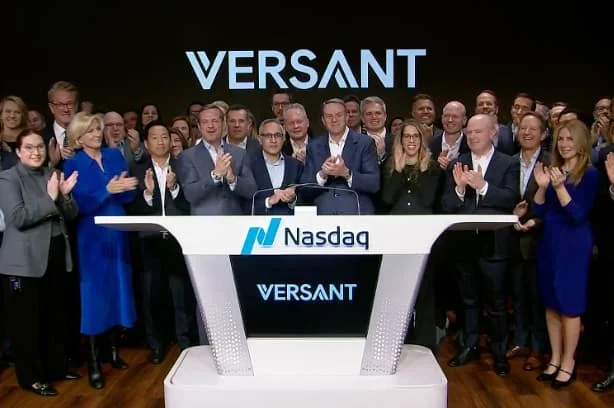
Versant Media Group is scheduled to release its first quarterly earnings report as a publicly traded entity on Tuesday, marking a critical milestone for the company and offering Wall Street its most comprehensive look yet at the financial health of a specialized portfolio of cable networks and digital platforms. The report arrives nearly four months after the company’s high-profile debut on the Nasdaq on January 5, 2026, a move that effectively decoupled several of NBCUniversal’s legacy cable assets from its parent company, Comcast Corporation. As investors digest the results, the focus will remain on whether Versant can navigate the secular decline of traditional pay television while leveraging its robust slate of live sports, news, and digital transactional businesses to ensure long-term sustainability.
The formation of Versant Media Group represented one of the most significant structural shifts in the media industry in recent years. By spinning off a collection of networks—including CNBC, MS Now, USA Network, Golf Channel, Syfy, E!, and Oxygen—alongside digital powerhouses like Fandango and Rotten Tomatoes, Comcast sought to streamline its core operations around broadband, wireless, and its Peacock streaming service. For Versant, the transition meant stepping into the public eye as a "pure-play" media stock at a time when the broader industry is grappling with the rapid erosion of the traditional cable bundle.
A Strategic Decoupling: The Road to Independence
The journey to Tuesday’s earnings report began in late 2024, when Comcast first signaled its intent to explore a spinoff of its cable networks. The decision was driven by a desire to insulate Comcast’s stock price from the "cord-cutting" narrative that has weighed heavily on legacy media conglomerates. By January 2026, the plan came to fruition with Versant’s IPO. The new entity was designed to be a lean, cash-flow-positive company with a specific focus on high-value live content and digital platforms that operate outside the traditional television ecosystem.
However, the transition has not been without its challenges. Since its January debut, Versant’s stock has experienced a decline of approximately 25%, bringing its market capitalization to roughly $4.8 billion. Financial analysts attribute much of this volatility to technical selling pressure, a common phenomenon following large-scale spinoffs where institutional investors who held the parent company’s stock may sell off shares of the new entity if it does not fit their specific investment criteria. Beyond the technicals, the market remains wary of the "linear cliff"—the fear that the decline in cable subscriptions will accelerate faster than new revenue streams can be established.
Analyzing the Financial Foundation
The upcoming earnings report will provide the first official update to the financial figures released prior to the IPO. Securities and Exchange Commission filings previously revealed a downward trend in top-line revenue for the assets now under the Versant umbrella. The portfolio generated $7.8 billion in 2022, which fell to $7.4 billion in 2023, and further decreased to $7.1 billion in 2024. This contraction reflects the broader industry trend of shrinking affiliate fees and a softening linear advertising market.
Despite the revenue decline, Versant leadership has emphasized the company’s profitability and its "light" debt load compared to peers like Warner Bros. Discovery or the newly merged Paramount-Skydance entity. By maintaining a clean balance sheet, Versant aims to provide itself with the financial flexibility necessary to invest in growth areas or pursue strategic acquisitions. The company has already begun this process, recently completing the acquisition of Free TV Networks, a provider of over-the-air digital broadcast channels, and Indy Cinema Group, which has been integrated into Fandango to bolster its cinema-operating capabilities.
The Power of Live: Sports and News as a Defensive Moat
A central pillar of Versant’s pitch to the investment community is its concentration on live programming. Unlike general entertainment networks that struggle to compete with on-demand streaming services like Netflix and Disney+, Versant’s core assets—CNBC and MS Now—provide essential, real-time information that viewers still prefer to consume live. CEO Mark Lazarus highlighted this advantage during the company’s investor day in December, noting that 62% of Versant’s audience is driven by live sports and news.
In the realm of sports, Versant possesses a strategic, if not "tier-one," portfolio. While it lacks the massive, multi-billion-dollar contracts associated with the NFL or NBA, it maintains significant rights for golf, NASCAR, and the WWE. Analysts at Raymond James have noted that this specific focus is a net positive, as it avoids the exorbitant costs of top-tier rights while maintaining high value for cable distributors who need "appointment viewing" to keep subscribers attached to the bundle.
The stability of these assets is further bolstered by long-term carriage agreements. Before the spinoff, NBCUniversal secured multi-year deals with major distributors, including Charter Communications and Google’s YouTube TV. According to Anand Kini, Versant’s COO and CFO, more than half of the company’s pay TV subscribers are covered by agreements that extend through 2028, with some sports rights secured past 2030. These contracts provide a vital cushion, protecting the company from the immediate impact of subscriber losses and providing "visibility" into future cash flows.
The 2026 Transition: Pivoting to a Digital Future
While the pay TV business currently accounts for more than 80% of Versant’s revenue, management has been transparent about the need for a radical business model transition. The year 2026 has been characterized by Kini as the "first year" of this evolution. The long-term goal is to achieve a 50/50 revenue split between traditional pay TV and a diversified mix of digital, platform-based, subscription, and transactional businesses.
The digital segment is anchored by Fandango and Rotten Tomatoes, two brands that enjoy high consumer recognition and operate as essential tools in the theatrical movie-going ecosystem. By expanding these platforms into broader "transactional" services, Versant hopes to capture a larger share of the entertainment dollar that is moving away from the television screen. Additionally, the company is looking to expand its presence in the ad-supported streaming (FAST) space, capitalizing on the growing consumer appetite for free, linear-style digital viewing experiences.
Industry Comparisons and Market Sentiment
The market’s reception of Versant is being closely watched as a bellwether for other media companies considering similar moves. The recent history of pure-play media stocks has been mixed. Newsmax, which began trading on the NYSE last year, saw an initial surge followed by a sharp decline, illustrating the volatility inherent in networks tied closely to the cable bundle.
In contrast, larger conglomerates have struggled with the complexity of managing both declining legacy assets and expensive streaming ventures. Warner Bros. Discovery initially contemplated a split similar to Comcast’s but ultimately opted for a different path. Versant’s focused approach is intended to offer investors a "cleaner" way to play the media sector, though many institutional analysts remain cautious. Goldman Sachs, for instance, initiated coverage with a "Neutral" rating, acknowledging the company’s strong free cash flow but citing the "secular challenges" of the linear network business as a primary headwind.
Upcoming Hurdles: Distribution Renewals and Macro Trends
Despite the protection offered by existing carriage deals, 2026 will present the first real test of Versant’s independent leverage at the negotiating table. Two significant distribution agreements are reportedly up for renewal this year. Without the broader NBCUniversal portfolio—which includes the NBC broadcast network and the powerhouse Olympics rights—Versant must prove to distributors that its specific mix of news and niche sports is indispensable.
Recent trends in the distribution landscape offer a glimmer of hope. Charter Communications recently reported its first quarterly gain in cable subscribers since 2020, suggesting that the rate of cord-cutting may be stabilizing for some providers. If the "bundle" can find a floor, Versant stands to benefit as one of the most efficient operators within that ecosystem.
Conclusion: A Definitive Moment for Media Investors
As Versant Media Group prepares to report its earnings on Tuesday, the stakes extend beyond simple revenue and profit figures. The results will serve as a report card on the viability of the "spinoff" strategy as a solution to the media industry’s structural woes. Investors will be looking for signs that the company’s digital pivot is gaining traction and that its live-content moat is sufficiently deep to withstand the ongoing shifts in consumer behavior.
For the broader media landscape, Versant’s performance may dictate whether other giants—such as Disney or Paramount—pursue further divestitures of their own cable assets. If Versant can demonstrate a path to growth through digital diversification and disciplined management of its legacy networks, it may provide a blueprint for the survival of "traditional" media in a digital-first world. Conversely, if the earnings reveal a faster-than-expected deterioration of the core business, it could signal further consolidation and a more aggressive retreat from the cable model that defined the industry for decades.